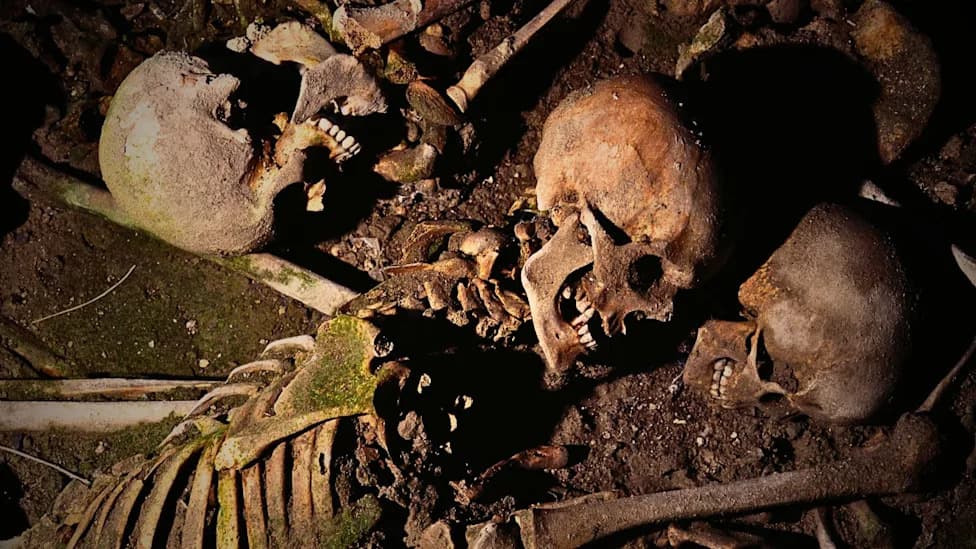
The Jerash excavation in Jordan uncovered a sixth-century mass grave beneath a Roman hippodrome that tested positive for Yersinia pestis, making it the oldest genetically confirmed plague burial in the Eastern Mediterranean. DNA from more than 230 individuals indicates a single, uniform strain likely responsible for one outbreak dated to 640–659 CE, and the site was sealed by a later earthquake. The discovery illuminates how pandemics shaped mobility, social vulnerability, and burial practices in late antiquity.
World's Oldest Genetically Confirmed Plague Grave Discovered Under Roman Racetrack in Jerash
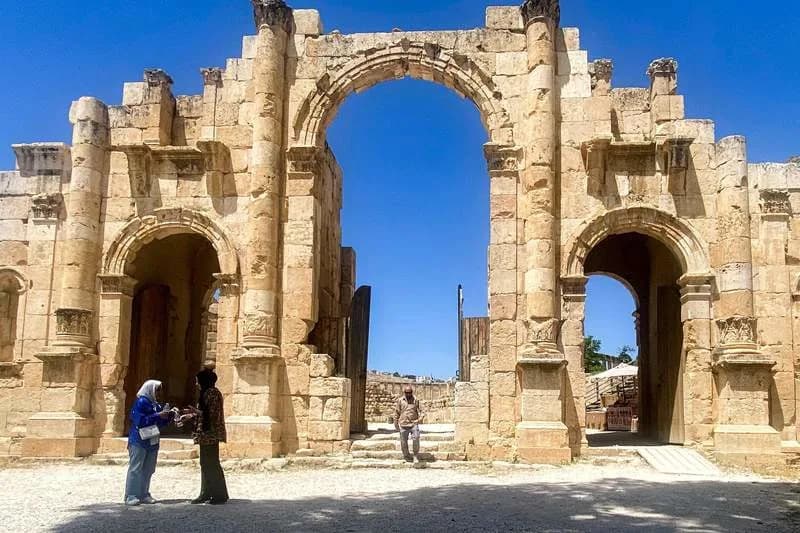
People stand before the Roman-era South Gate, was built in honour of the Roman Emperor Hadrian on the occasion of his visit circa 130 CE, is pictured at the Roman ruins of Jerash in northern Jordan on April 29, 2026. (photo credit: Mussa HATTAR / AFP via Getty Images)
Archaeologists and geneticists have confirmed that a sixth-century mass burial beneath the Roman hippodrome in Jerash, Jordan, contains Yersinia pestis DNA, making it the oldest genetically authenticated plague-related cemetery found so far in the Eastern Mediterranean.
Genetic and Chronological Findings
Researchers extracted DNA from more than 230 individuals interred beneath the second-century racetrack and identified Y. pestis, the bacterium responsible for bubonic plague and the First Pandemic (the Plague of Justinian, which circulated across the Byzantine Empire between 541 and 750 CE). Genomic analysis showed that all recovered Y. pestis genomes belonged to a single, homogeneous strain, indicating the deaths resulted from a single, concentrated outbreak rather than multiple separate episodes.
Dating and Site Formation
Archaeological dating places the burials between 640 and 659 CE. The burial chambers appear to have been sealed shortly afterward when an earthquake caused the hippodrome's stone seating to collapse and bury the underlying structures.

A man walks along the 800-metre-long Cardo colonnade at the ancient Roman ruins of Jerash in northern Jordan on April 29, 2026. (credit: Mussa HATTAR / AFP via Getty Images)
Archaeological Context
The remains were found compacted among pottery fragments and collapsed masonry inside two subterranean chambers labeled W2 and W3, areas that likely served as a ceramic workshop before being repurposed or sealed. Field evidence indicates the bodies were placed quickly with minimal funerary rite, consistent with historical descriptions of mass-casualty events that overwhelm a city's normal burial capacity.
"The Jerash site turns that genetic signal into a human story about who died and how a city experienced crisis," said lead researcher Rays H. Y. Jiang, an associate professor at USF's College of Public Health.
Significance
Because the grave predates the mass burial pits associated with the Black Death in medieval Europe by roughly 800 years, it provides a rare, well-preserved example of how pandemic disease affected communities in late antiquity. The combined archaeological and biological evidence also sheds light on mobility and social connections: while migration in peaceful times may be slow and generational, crises can concentrate people from diverse, more mobile backgrounds in one place, making those hidden connections visible.
Implications: By linking genetic data to burial context, researchers can better understand pandemics as social as well as biological events—revealing which groups were most vulnerable and why, lessons that still resonate for modern public-health planning.
Help us improve.