Manipur has endured three years of escalating ethnic violence that began in May 2023 and has since fragmented into a multi‑actor conflict involving Meitei, Kuki‑Zo and Naga communities. More than 250 people have died and over 58,000 remain internally displaced, with thousands of firearms looted early in the crisis fueling further attacks. A striking number of FIRs record perpetrators as 'unknown', producing no convictions and deepening mistrust. Observers warn that political paralysis, porous borders and the normalisation of armed civilian groups risk long‑term destabilisation and radicalisation of children.
Manipur’s 'Unknown' Killers: Three Years Of Fragmented Ethnic Violence And A Crisis Of Accountability
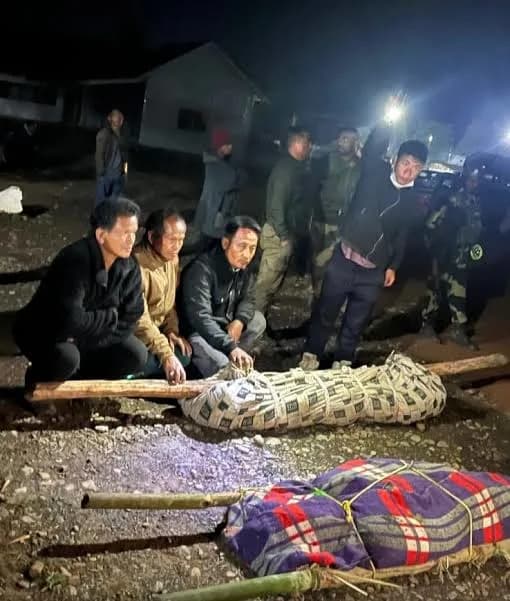
Men sit beside the bodies of two labourers killed in Ukhrul in March 2026 [Tanushree Pandey/Al Jazeera]
The raw wail of a 37-year-old nurse crouched beside two small coffins became a new, tragic chapter in Manipur’s spiralling violence: an improvised rocket‑propelled grenade hit her family home on April 7, killing her infant daughter and five‑year‑old son and leaving the mother wounded. Their father, a paramilitary soldier serving far away, learned only later that the calls he treasured would be the last he ever received.
Violence That Has Escalated And Fragmented
What began in May 2023 as an ethnic confrontation between the predominantly Hindu Meitei community and the mainly Christian Kuki‑Zo minority has, over three years, grown into a far more complex and fragmented conflict that now involves multiple armed groups, armed civilian volunteers and overlapping territorial claims with Naga factions. Official tallies and local reports place the death toll at more than 250 and estimate that over 58,000 people remain internally displaced, many living in sprawling relief camps that have in effect become semi‑permanent settlements.
Investigations Stymied By 'Unknown' Assailants
A recurring and corrosive feature of the crisis is the frequency with which first information reports (FIRs) and official documents record perpetrators as “unknown” or “unidentified.” Al Jazeera reviewed FIRs and found this pattern repeated across thousands of cases—more than 12,000 FIRs filed from May 2023 through the end of 2025 for killings, sexual assaults, abductions and arson. In many high‑profile incidents the accused remain unnamed, and not a single one of those cases has yet resulted in a conviction where the attacker was listed as “unknown.”
“Just the previous evening I had called my wife. She put our daughter on the phone. She could not speak yet but recognised my voice. I was trying to teach her to say papa. I never thought that would be the last time I heard her,” the father told Al Jazeera.
Why Attribution Is So Difficult
Several factors help explain why attribution has become so elusive: the looting and spread of thousands of firearms from police and paramilitary armouries early in the conflict; the emergence of armed village volunteer groups on all sides; fluid, localized command structures within some insurgent formations; and a porous 1,600km border with Myanmar that appears to have facilitated illicit arms flows. Security officials and local sources describe a battlefield in which the lines between civilians, volunteers and insurgents are blurred and where multiple actors operate in the same space.
Political Paralysis And Institutional Limits
Political and institutional constraints have compounded the problem. Critics say there has been insufficient political direction and coordination between state and federal authorities, and some observers argue that electoral and political considerations have limited decisive action. Investigations have been handed to federal agencies such as the National Investigation Agency (NIA) in high‑profile cases, yet many FIRs still list no identifiable suspects—fueling local anger and distrust.
Human Cost: Displacement, Trauma And A Lost Generation
Relief camps now shelter tens of thousands of people who face long‑term insecurity, limited access to services, disrupted schooling and growing economic hardship. Aid workers warn of mounting psychological trauma and the risk that children, exposed for prolonged periods to violence and the perceived prestige of armed actors, may be drawn into armed groups. Testimony from aid workers and displaced people underscores a dire lack of rehabilitation and psychosocial support.
What Comes Next
Unless investigators can break the cycle of unidentified perpetrators and courts can deliver accountability, the conflict risks becoming entrenched. Experts warn that continued weak attribution, the circulation of weapons and fragmented command structures will prolong instability and may pose a wider internal security challenge for India. Families continue to grieve without answers; communities continue to arm themselves; and, in many areas, law and order has given way to a de facto multi‑actor conflict where 'unknown' killers are both a symptom and a driver of further violence.
Key Facts: More than 250 dead; over 58,000 internally displaced; thousands of firearms looted and still in circulation; more than 12,000 FIRs frequently listing perpetrators as “unknown.”
Help us improve.