
JWST MIRI observations show LHS 3844 b is likely an airless, dark rocky world whose dayside (~1,000 K) emits a nearly featureless infrared spectrum. Spectral comparisons rule out granite‑rich, silica‑dominated crust and instead favor mafic/ultramafic rock or an old, space‑weathered regolith. No volcanic SO2 or thick CO2 atmosphere was detected, though caveats and observational limits leave some scenarios open. The study demonstrates that thermal emission can reveal exoplanet surface geology and offers a new way to classify rocky worlds.
JWST Reveals a Dark, Airless Rocky World: LHS 3844 b Looks More Like Mercury Than Earth
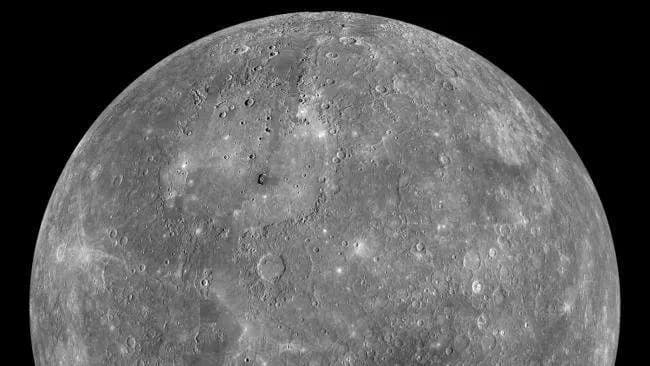
This high-resolution photo of the planet Mercury probably resembles the rocky exoplanet LHS 3844 b. Results from JWST observations favour an airless rocky planet with a dark, basalt-like surface, likely space-weathered by irradiation and meteorite impacts. (CREDIT: Center for Astrophysics | Harvard & Smithsonian)
Observations from the James Webb Space Telescope (JWST) show that LHS 3844 b — a rocky exoplanet about 48.5 light‑years away — lacks oceans, clouds, or a substantial atmosphere. Instead, its thermal emission points to a dark, heavily processed surface more akin to Mercury or the Moon than to anything on Earth.
Using JWST’s Mid‑Infrared Instrument (MIRI), a team led by Sebastian Zieba and Laura Kreidberg (Max Planck Institute for Astronomy; Center for Astrophysics | Harvard & Smithsonian) analyzed the planet’s dayside infrared glow. Their results, published in Nature Astronomy, indicate that LHS 3844 b is likely airless and covered either by relatively fresh volcanic rock or by older material darkened and ground down by space weathering.
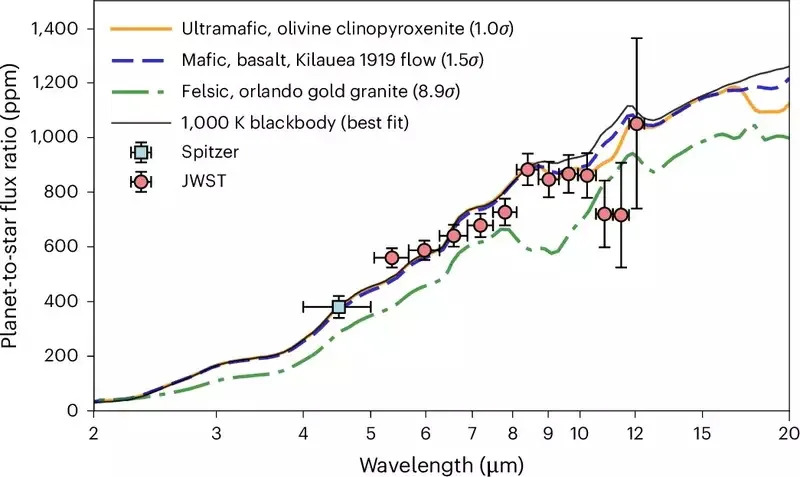
The measured planet-to-star flux ratio as a function of wavelength compared with a range of solid slab surfaces. (CREDIT: Nature Astronomy)
LHS 3844 b is roughly 30% larger than Earth and orbits a cool red dwarf star in about 11 hours, so closely that one hemisphere is permanently sunlit (tidally locked). The permanent dayside reaches temperatures near 1,000 K, hot enough to emit strongly in the infrared but apparently not hot enough to form a global magma ocean.
How the measurement was made. The team did not image the planet directly. Instead, they measured small changes in the combined light from the star-plus-planet system as the planet moved through its orbit and passed behind the star (secondary eclipse). MIRI separated the planet’s thermal emission between 5 and 12 micrometers into narrow spectral bins; the authors also included an earlier Spitzer measurement covering 4–5 micrometers. The combined JWST+Spitzer spectrum is largely featureless and closely matches a ~1,000 K blackbody.
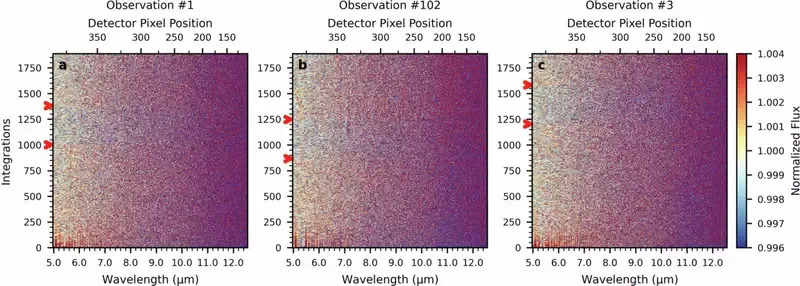
2D light curves of the JWST observations. (CREDIT: Nature Astronomy)
What the spectrum implies about the surface. The absence of strong spectral features allowed comparison with laboratory libraries of rocks and minerals measured on Earth, the Moon and Mars, including different textures (solid slabs, coarse fragments, and fine powders). Granite‑rich, silica‑dominated crusts — typical of Earth’s continents — were decisively ruled out (the paper reports a granite sample rejected at ~8.9σ). Instead, the data favor darker, magnesium‑ and iron‑rich materials such as basaltic or ultramafic compositions (pyroxene and olivine). Solid slab‑like surfaces provided the best fits; coarsely crushed surfaces also match reasonably well, while fresh fine powders (bright, high‑albedo dust) were inconsistent with the measured emission.
Space weathering and alternative explanations. On airless worlds, micrometeorite impacts and high radiation fluxes grind rock into fine regolith and darken the surface by creating tiny iron particles and incorporating carbonaceous material. That process can make an older surface appear darker and more consistent with the JWST observations. The authors outline two main scenarios that both fit current data: (1) a relatively fresh, dark mafic surface perhaps renewed by recent volcanism; or (2) an ancient, geologically quiet surface blanketed by darkened regolith, similar to Mercury or the Moon. At present both remain viable.
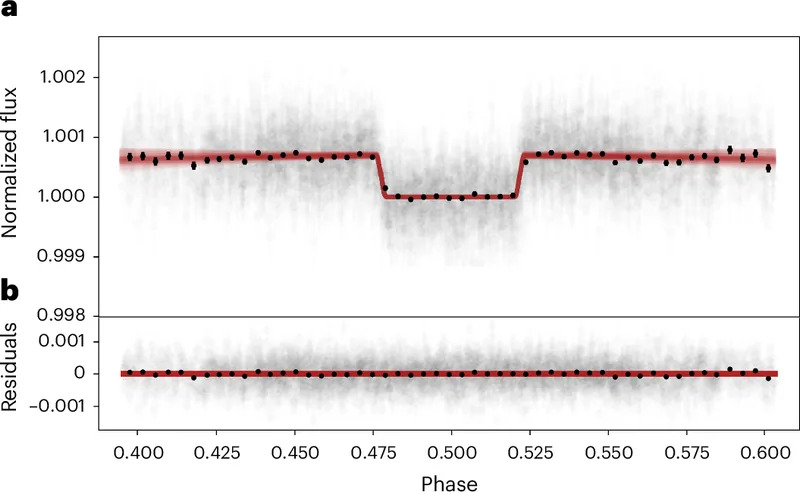
Phase-folded JWST MIRI/LRS white light curve of LHS 3844 b. (CREDIT: Nature Astronomy)
Search for volcanic gases and atmospheric limits. The team searched for spectral signatures of volcanic outgassing, particularly sulfur dioxide (SO2), which shows strong mid‑infrared features. No SO2 was detected. Using atmospheric models, they exclude CO2‑dominated atmospheres with surface pressures ≥100 mbar at ~5σ, and they place an upper limit excluding SO2 partial pressures ≥10 microbar at ~3σ. Venus‑like SO2 levels are ruled out at >12σ. These non‑detections weaken the case for recent large‑scale volcanism that would produce detectable atmospheric gases, though outgassed volatiles might freeze out on the cold nightside and evade detection.
Caveats. The atmospheric modeling assumes radiative‑convective equilibrium and no clouds, and the JWST observations sampled only part of the planet’s thermal emission (the analysis adopted the earlier Spitzer phase‑curve result suggesting minimal nightside heat redistribution). Uncertainties increase beyond ~10 micrometers, where some tentative mineral features could lie. The authors note that future observations are needed to resolve remaining ambiguities.
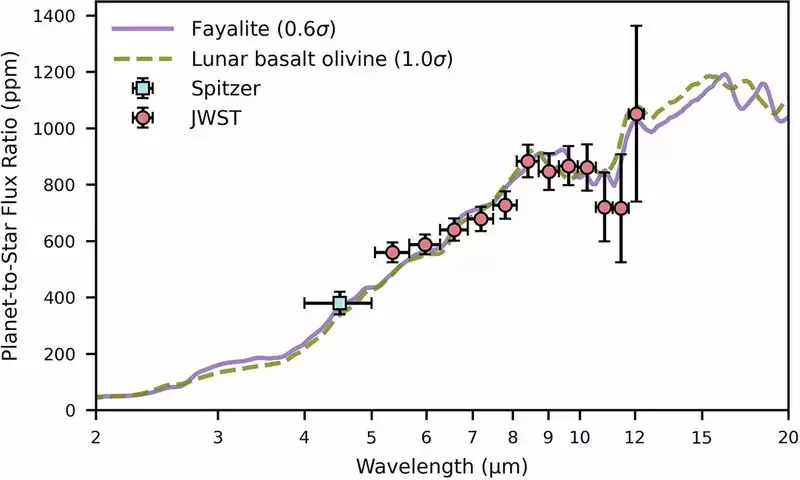
The measured planet-to-star flux ratio as a function of wavelength compared to a range of surfaces from the RELAB database. (CREDIT: Nature Astronomy)
Why this matters. This study demonstrates that thermal emission alone can probe the geology of rocky exoplanets — not just their atmospheres. By reading surface spectra, astronomers can begin classifying rocky worlds by crust type, surface history, and geologic activity. For LHS 3844 b, the evidence argues against an Earth‑like, water‑linked, silica‑rich crust and instead points to a harsher world shaped by either past volcanism or relentless space weathering.
The team has already scheduled additional JWST observations to test whether the surface behaves like solid rock or angle‑dependent regolith by measuring how emitted light varies with viewing angle. The full results appear in Nature Astronomy.
Help us improve.





















