
The University of Malta team used age, chemical and kinematic data for over 100,000 giant stars from APOGEE-DR17, Gaia, and LAMOST-DR3 to locate the Milky Way’s outermost active star-forming zone at about 40,000 light-years. Stellar ages form a U-shaped profile — younger toward a break radius, older beyond it — consistent with radial migration and observations of diffuse, cold gas that cannot form new stars. Possible causes include bar-driven dynamics, a gas-phase transition, and a disk warp.
Astronomers Pinpoint the Milky Way’s Edge at Its Final Star-Forming Region
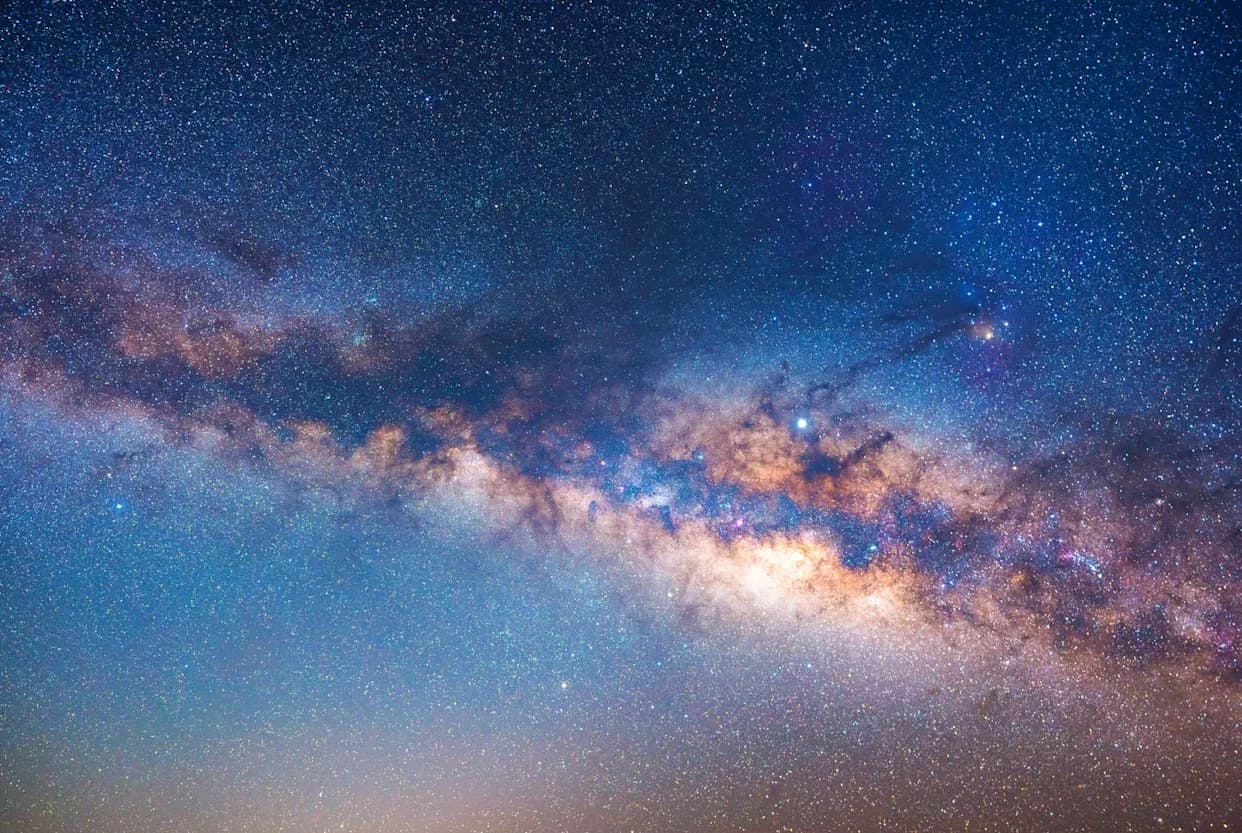
Scientists Finally Found the Edge of Our GalaxyWitthaya Prasongsin - Getty Images
Researchers from the University of Malta report that the Milky Way’s outermost active star-forming region — and thus a practical definition of the galaxy’s edge — lies at roughly 40,000 light-years from the galactic center. The team mapped stellar ages and compositions using more than 100,000 giant stars from APOGEE-DR17, Gaia, and LAMOST-DR3 to reach this conclusion.
How the Edge Was Found
From Earth our galaxy appears as a seemingly endless band of stars, but the Milky Way has a measurable outer disk where active star formation fades into interstellar space. By combining age, chemical, and kinematic data, the researchers identified a clear radius where the trend of younger stars with increasing radius reverses: beyond this "break radius" the stellar population grows older.
Data and Methods
The study analyzed >100,000 giant stars sampled across multiple surveys (APOGEE-DR17, Gaia, LAMOST-DR3). These datasets provide stellar ages, metallicities and motions that let astronomers trace how populations change with distance from the galactic center despite challenges from dust extinction that obscure direct views of stellar density.
A U-Shaped Age Profile
The Milky Way exhibits a U-shaped stellar age profile: ages generally decline with radius until a break, then increase again past that point. This pattern is common in Type II disc galaxies and is consistent with simulations that include radial migration, where stars formed nearer the center move outward over time.
Why Star Formation Stops
Combining the stellar-age and chemical evidence, the team places the outer disk — the last active star-forming zone — at about 40,000 light-years from the center. Observations beyond that radius show cold, slow-moving, and very diffuse gas that appears too tenuous and low in energy to collapse into new stars. The galaxy’s central bar, a slight warp in the disk, or a thermally regulated gas-phase transition (or a combination of these effects) could be responsible for halting star formation beyond the break.
“While breaks among disc galaxies are common, whether the Milky Way has such a broken profile remains an open question,” the authors note in Astronomy & Astrophysics, adding that our vantage point inside the disk makes mapping stellar density challenging.
Broader Implications
The results help define the Milky Way’s structure more precisely and illustrate how internal dynamics and gas physics shape where stars can form. The chemical trends — younger, metal-rich stars concentrated inward and older, metal-poor stars outward — support the idea that many outer-disk stars formed earlier near the center and migrated outward. The study even reinforces suggestions that the Sun likely formed closer to the center and moved outward over time.
Bottom line: The Milky Way’s practical outer edge is marked by its last active star-forming region at roughly 40,000 light-years; beyond that, the galaxy is dominated by older stars and gas too diffuse to sustain new star formation.
Help us improve.





















