
Using JWST’s mid‑infrared observations, astronomers produced the first climate maps of Earth‑sized exoplanets by tracking TRAPPIST‑1b and TRAPPIST‑1c over full orbits. The data show extreme day–night temperature swings—exceeding ~500°C—implying little or no dense atmosphere on the inner planets. Modeling rules out substantial atmospheres for TRAPPIST‑1b and disfavors dense envelopes for TRAPPIST‑1c, though thin atmospheres for c remain possible. The approach highlights thermal phase curves as a powerful tool for assessing habitability around red dwarfs.
JWST Produces First Climate Maps of Earth‑Sized TRAPPIST‑1 Worlds — Inner Planets Likely Airless
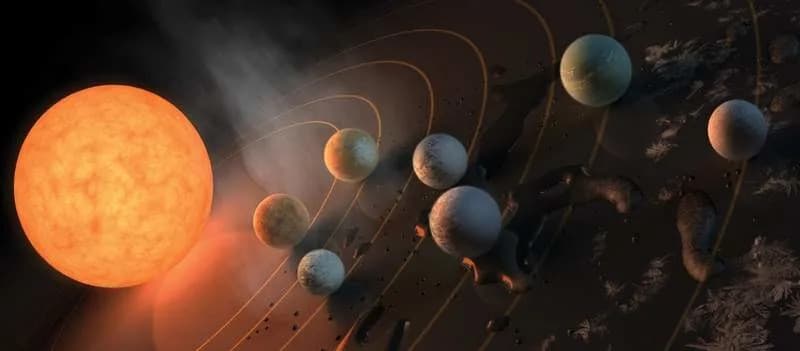
This artist’s impression displays TRAPPIST-1 and its planets reflected in a surface. The potential for water on each of the worlds is also represented by the frost, water pools, and steam surrounding the scene. (CREDIT: NASA/R. Hurt/T. Pyle)
An international team using the James Webb Space Telescope (JWST) has, for the first time, created climate maps of small, rocky exoplanets with masses similar to Earth's by observing the two innermost worlds in the TRAPPIST‑1 system: TRAPPIST‑1b and TRAPPIST‑1c. Rather than targeting a large gas giant, researchers focused on these tightly orbiting, tidally locked planets to test whether they retain atmospheres under intense stellar radiation.
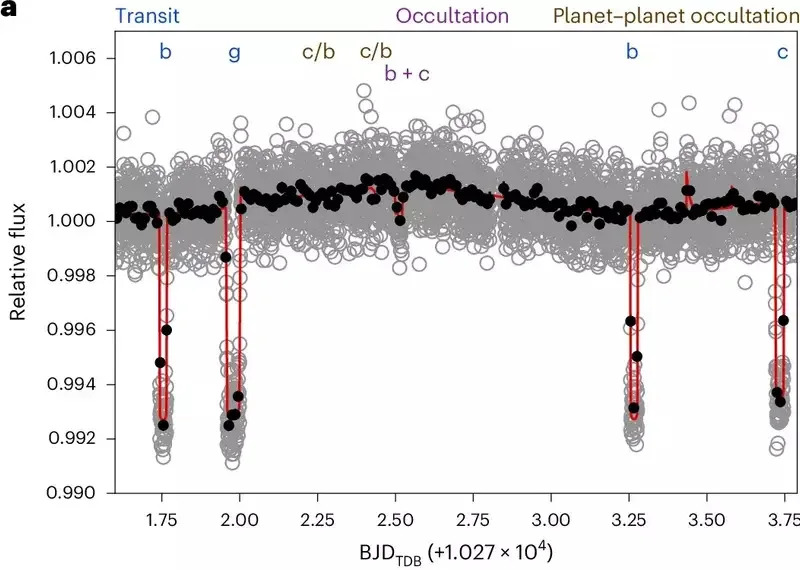
Detrended programme 3077 light curve obtained in analysis 1, with the best-fit planet model deduced from the same analysis superimposed. (CREDIT: Nature Astronomy)
Continuous Infrared Monitoring Reveals Extreme Day–Night Contrasts
Between November 22 and 25, 2023, JWST’s Mid‑Infrared Instrument (MIRI) recorded roughly 59–60 hours of continuous observations, collecting 5,336 integrations at a 39‑second cadence. By tracking infrared flux across full orbits, the team constructed thermal phase curves that estimate temperatures on both the dayside and nightside of each planet.
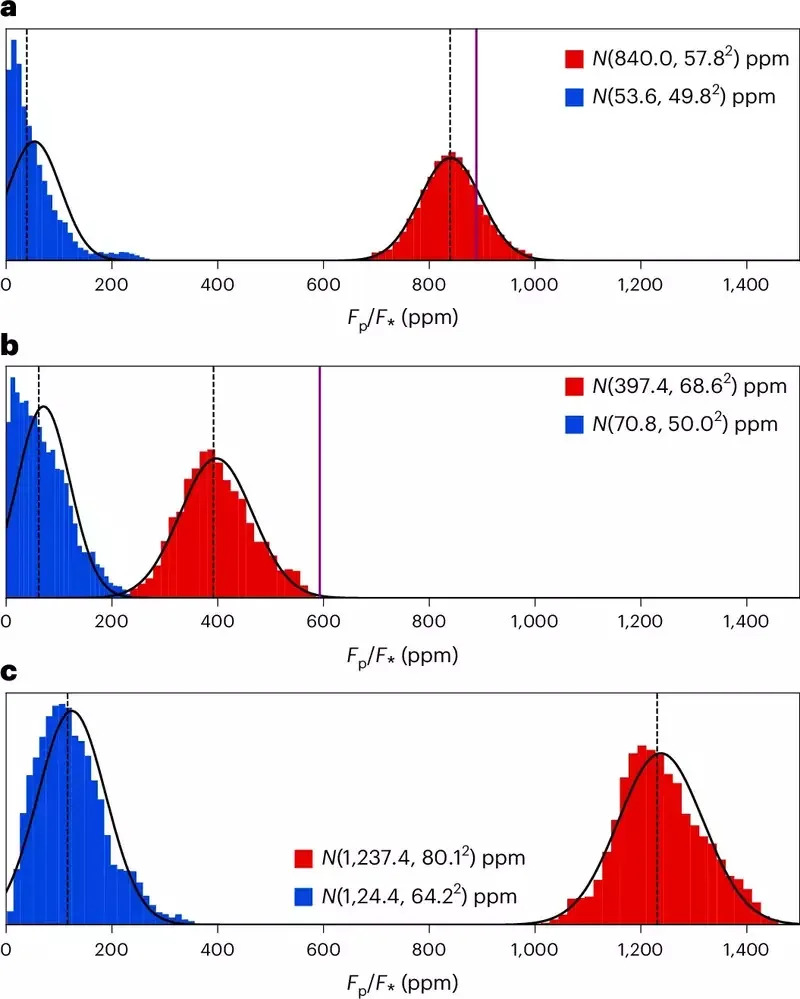
Analysis 1 posterior PDFs for the relative fluxes of the dayside (red) and nightside (blue) of TRAPPIST-1 b (a), TRAPPIST-1 c (b) and the sum of the two planets (c). (CREDIT: Nature Astronomy)
The results were stark: TRAPPIST‑1b’s dayside exceeded 200°C while TRAPPIST‑1c’s dayside approached ~100°C, and both planets’ nightsides plunged below −200°C. Those extreme contrasts—exceeding 500°C in some measures—indicate minimal heat redistribution and point to little or no dense atmosphere on these inner worlds.
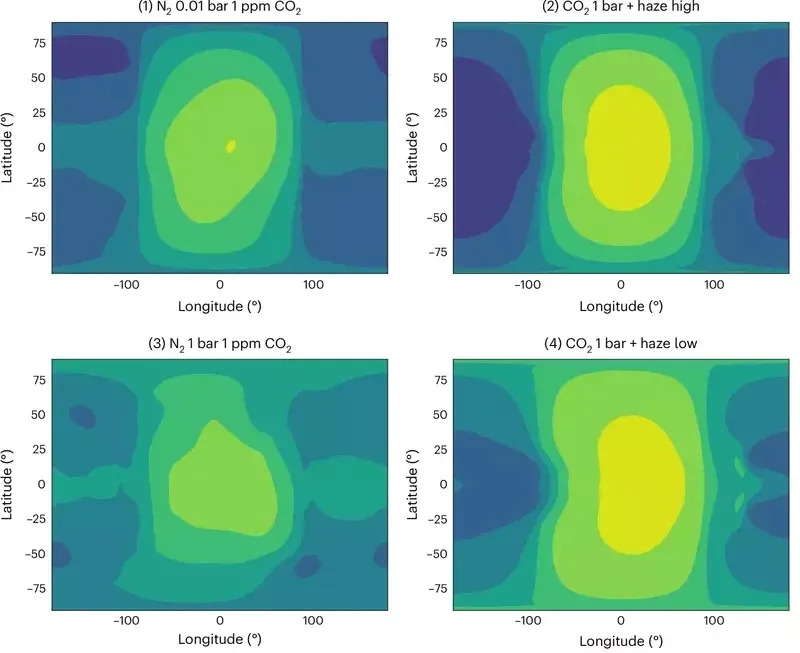
Temperature maps computed for four distinct GCM simulations along with a low-albedo, airless-planet case. (CREDIT: Nature Astronomy)
Modeling Confirms Atmosphere Is Unlikely on TRAPPIST‑1b; TRAPPIST‑1c Remains Ambiguous
The team compared the phase‑curve data to both a simplified day–night climate‑photochemical model and a full three‑dimensional global climate model. For TRAPPIST‑1b, models that included substantial atmospheric heat transport were inconsistent with the observed nightside flux and phase‑curve offset; the simplest interpretation is that TRAPPIST‑1b is essentially airless.
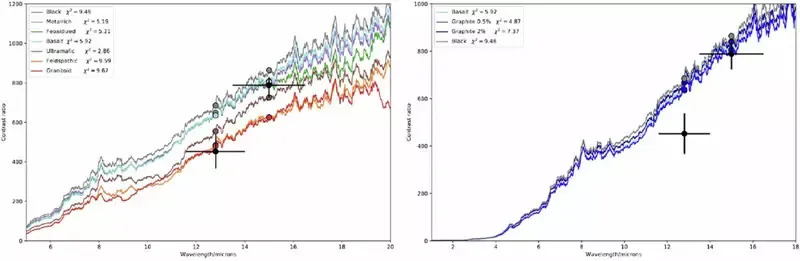
TRAPPIST-1 b’s dayside spectrum for different geologically fresh surface materials (left) and a space weathered basalt surface (right). (CREDIT: Nature Astronomy)
TRAPPIST‑1c is a more nuanced case. The data rule out full heat redistribution and disfavor many dense‑atmosphere scenarios (including steam‑dominated envelopes of 1–10 bars), but some thin, low‑opacity atmospheres—such as oxygen‑rich layers near 0.1–1 bar or tenuous mixes with small amounts of water or CO2—cannot yet be completely excluded.
Surface Composition and Space Weathering
Assuming a bare‑rock TRAPPIST‑1b, the team modeled surface materials using a database of seven geologically fresh compositions. Combined phase‑curve and eclipse fits favor relatively bright materials, with ultramafic (ultrabasic) rock emerging as the leading candidate, though not at >3σ significance. When moderate space weathering is included—analogous to processes on the Moon and Mercury—feldspathic and granitoid surfaces also become plausible.
Implications for Habitability and Future Observations
These two planets are the most heavily irradiated members of their system and serve as stress tests for atmospheric survival. The study strengthens the case that stellar activity and proximity to red dwarfs can strip or prevent dense atmospheres on inner planets, but it does not rule out atmospheres on the outer TRAPPIST‑1 worlds, including TRAPPIST‑1e in the habitable zone. JWST observations of TRAPPIST‑1e and upcoming measurements of TRAPPIST‑1c at 12.8 μm, along with transmission spectroscopy for gases such as CO2, will further clarify which planets in the system retain atmospheres.
“The TRAPPIST‑1 system is incredible! Seven planets, some with masses similar to Earth’s, orbit the same star,” said Emeline Bolmont (University of Geneva). “It is the perfect playground for comparative planetology.”
Research findings are published in Nature Astronomy. These thermal phase‑curve methods provide a stronger way to assess atmospheres on tidally locked, Earth‑sized planets around red dwarf stars—stars that make up more than 75% of the Milky Way’s stellar population.
Help us improve.





















