
The ELN said it will meet with Colombia's next president but refuses to negotiate with outgoing President Gustavo Petro, accusing him of "treachery" and alleged coordination with U.S. counterpart Donald Trump. Talks with Petro collapsed in January 2025 after an ELN offensive that killed more than 100 people. Front-runner Iván Cepeda has pledged to continue peace talks, while right-wing rivals favor a security-first approach.
ELN Open To Peace Talks With Colombia's Next President — Refuses To Negotiate With Petro
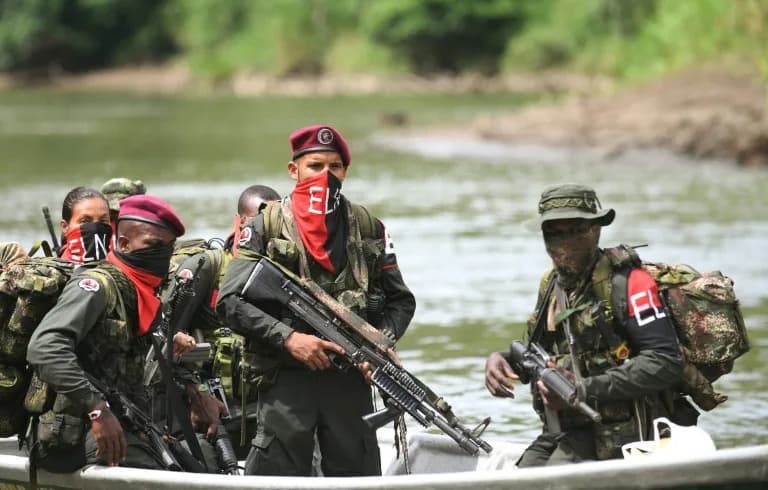
The National Liberation Army (ELN) is the largest active guerrilla group in Colombia (Daniel Munoz)
Colombia's largest active guerrilla group, the National Liberation Army (ELN), said Monday it is willing to resume peace negotiations with whoever succeeds leftist President Gustavo Petro after elections that begin on May 31. However, the group reiterated that it will not return to talks with Petro personally.
Breakdown Of Previous Talks
Petro, who is due to leave office in August, championed a policy of "total peace" aimed at negotiating the disarmament of armed groups after more than six decades of conflict. Talks between his government and the ELN collapsed in January 2025 after the ELN launched an offensive against rival guerrillas in northeastern Colombia that left more than 100 people dead.
Positions And Accusations
On Friday, Petro used X to say he was willing to reopen negotiations:
"If the ELN decides to work with us to dismantle illicit economies, new paths to peace will open up again."
In response, the ELN said it would not negotiate with Petro, accusing him of "treachery to gain military advantages" and alleging he coordinated with his U.S. counterpart, Donald Trump, to target Colombian drug-trafficking networks. Those claims are the ELN's accusations and have not been independently verified.
Offer To Talk To The Next Government
Despite rejecting Petro personally, the ELN said it would be open to discussions with the incoming government about its "proposal to build a National Agreement" as a pathway to peace. The group framed this as a pragmatic step toward ending violence and illicit economies.
Election Implications
Left-leaning Senator Iván Cepeda — a key architect of Petro's peace strategy — is currently leading opinion polls to become the next president and has pledged to continue negotiations with drug-trafficking factions that rejected the landmark 2016 peace accord with the FARC. Trailing him are right-wing candidates Abelardo de la Espriella and Paloma Valencia, who both oppose dialogue with armed groups and have promised tougher security measures instead.
About The ELN
The ELN is the Americas' longest-surviving guerrilla group and sustains itself through drug trafficking and other illicit enterprises. Its willingness to negotiate with an incoming administration — while rejecting Petro personally — adds a new element to a fraught political landscape as Colombia heads into national elections.
Why it matters: The ELN's stance means Colombia's next president could face immediate choices about whether to reopen talks, pursue hardline security policies, or seek a hybrid approach to undercut the illicit economies that finance armed groups.
Help us improve.





















