
JWST has directly detected infrared emission from the dayside surface of exoplanet LHS 3844 b, a super-Earth about 30% larger than Earth and ~50 light-years away. Observations with the MIRI instrument during three secondary eclipses show a dark, airless world with dayside temperatures near 1,340°F (725°C). Spectral comparisons rule out an Earth-like silica crust and instead favor a basalt-dominated surface; no volcanic gases were detected. Follow-up JWST measurements will test whether the surface is fresh lava or long-term space-weathered material.
JWST Directly Probes an Exoplanet Surface: “A Dark, Hot, Barren Rock”
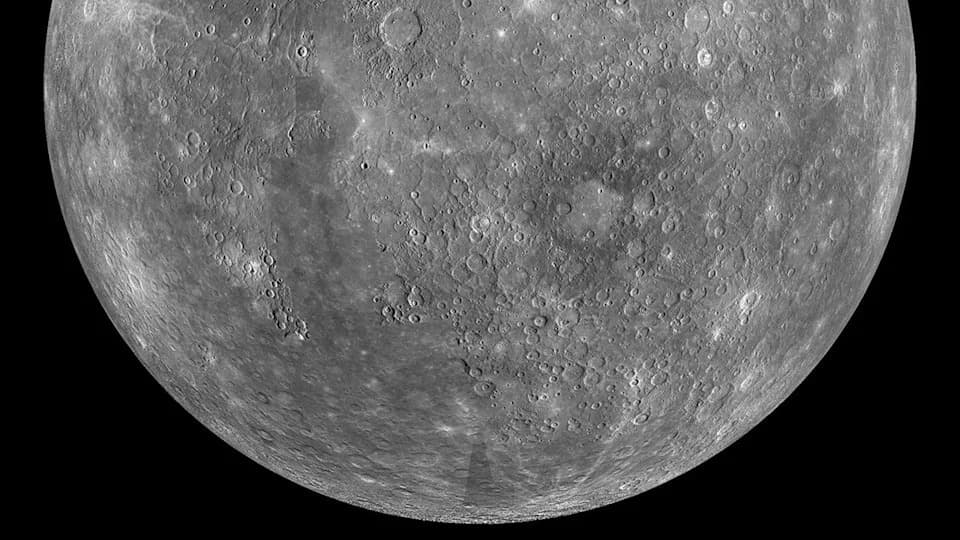
Scientists say this high-resolution photo of the planet Mercury probably resembles the rocky exoplanet LHS 3844 b, which the JWST just observed. | Credit: NASA/Johns Hopkins University Applied Physics Laboratory/Carnegie Institution of Washington
A team of astronomers has used the James Webb Space Telescope (JWST) to directly measure infrared light from the surface of an exoplanet for the first time. The target, LHS 3844 b, is a rocky "super-Earth" roughly 30% larger than Earth and located about 50 light-years away. Unlike most exoplanet studies that probe atmospheres, these observations capture heat radiated from the planet's dayside, allowing scientists to infer surface composition.
What the Observations Reveal
Using JWST's Mid-Infrared Instrument (MIRI), the team observed three secondary eclipses in 2023–2024 — moments when the planet passed behind its host red dwarf star — and measured the infrared emission from the intensely hot dayside. The dayside temperature reaches near 1,340°F (725°C), and the measured spectrum is inconsistent with an Earth-like, silica- and granite-rich crust.
Instead, the spectral signature best matches basalt: a dark, iron- and magnesium-rich volcanic rock commonly found on the Moon and Mercury. The data also indicate the planet is effectively airless; the observations show no evidence for a substantial atmosphere.
"Thanks to the amazing sensitivity of JWST, we can detect light coming directly from the surface of this distant rocky planet," said Laura Kreidberg of the Max Planck Institute for Astronomy, principal investigator for the observations. "We see a dark, hot, barren rock, devoid of any atmosphere."
Interpreting the Surface
The researchers propose two leading explanations for the dark, basalt-like surface. One possibility is a relatively young surface resurfaced by recent volcanic flows, leaving fresh basaltic lava that has not yet been space-weathered. However, active volcanism typically releases gases such as carbon dioxide (CO2) or sulfur dioxide (SO2), and MIRI did not detect these gases at levels it should have seen if volcanism were releasing them in reasonable amounts.
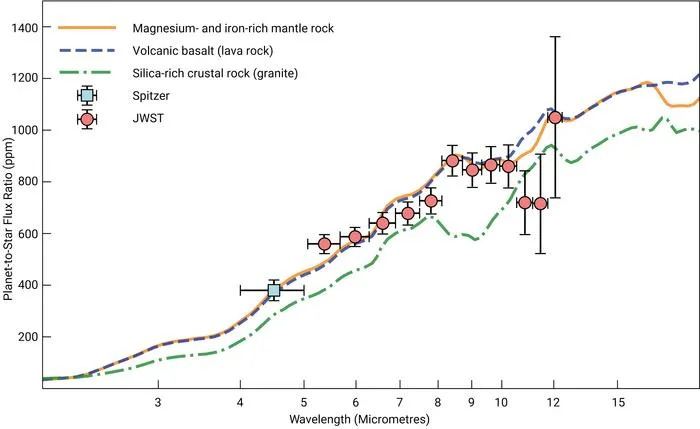
Infrared spectrum of LHS 3844 b’s hot dayside derived from the brightness contrast to its host star in ppm (parts per million = 0.0001%) at different wavelengths. The observational data obtained from the James Webb and Spitzer Space Telescopes (circles and squares) are consistent with mantle (solid orange line) or lava rock (dashed blue line), whereas they rule out an Earth-like crust (dash-dotted green line). | Credit: Sebastian Zieba et al./MPIA
Alternatively, the surface could be an old, inactive crust covered by a thick layer of fine, dark material produced by long-term space weathering (radiation and micrometeorite bombardment). Without an atmosphere to protect or alter the surface, this process can progressively darken and break down rocks, producing a regolith similar to that of the Moon or Mercury.
"This planet likely contains very little water," said study lead author Sebastian Zieba of the Center for Astrophysics | Harvard & Smithsonian. The lack of an Earth-like silica crust supports that conclusion: silica-rich surfaces typically form through water-driven processes and plate tectonics, which appear absent here.
Next Steps
Follow-up JWST observations are planned to refine the planet's surface properties and to distinguish whether the dayside is dominated by fresh basalt flows or a loose, weathered regolith. The team is confident the same technique can be applied to other rocky exoplanets to clarify their crust types and geological histories.
The study describing these results was published on Monday, May 4, in the journal Nature Astronomy.
Help us improve.





















