Social posts claiming man-made warming is "saving" humanity from an Ice Age misrepresent the science, experts say. Milankovitch orbital cycles operate over tens of thousands of years, while current CO2-driven warming is far faster and destabilising ecosystems. Scientists acknowledge emissions may delay a distant Ice Age, but warn the scale of greenhouse warming already threatens agriculture, water supplies and the resources needed for an estimated 9.6 billion people by 2050. The rapid pace and magnitude of change — not hypothetical millennia-distant outcomes — are the urgent concern.
No — Global Warming Is Not ‘Saving’ Humanity From Extinction, Scientists Say
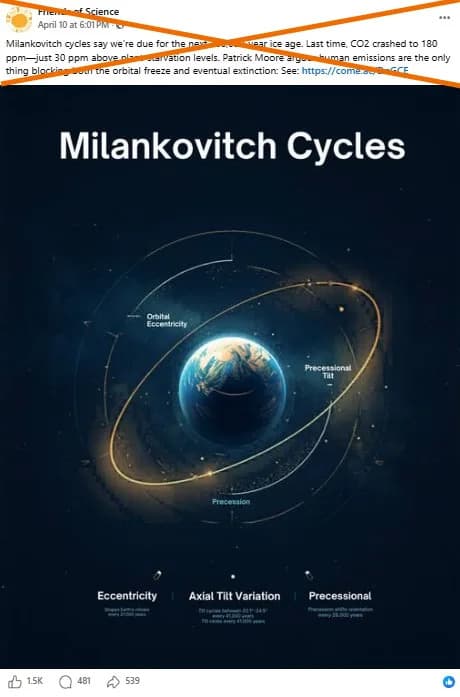
A screenshot of a Facebook post taken on May 1, 2026
Social media posts claiming that human-caused warming is "saving" humanity from an imminent Ice Age misrepresent the science and ignore the very real, near-term harms of rapid warming. While natural orbital changes (Milankovitch cycles) do drive Ice Ages on timescales of tens of thousands of years, the pace and magnitude of recent CO2 increases are destabilising modern ecosystems and the systems that support human civilisation.
What the Viral Claim Says
In April 2026 a climate-sceptic Facebook group shared a graphic asserting that "human emissions are the only thing blocking both the orbital freeze and eventual extinction." The post, which also circulated on LinkedIn and other platforms, was often supported by a 2015 report from Patrick Moore — a controversial commentator who has been criticised for overstating his links to Greenpeace.
Why That Argument Is Misleading
Milankovitch cycles are slow, regular changes in Earth’s orbit and tilt that alter how much sunlight reaches the planet. These cycles operate over tens of thousands to hundreds of thousands of years and can set the stage for Ice Ages. NASA and climate scientists stress these processes are long-term drivers, not explanations for the rapid warming we observe today.
Speed and scale matter. Researchers such as Bethan Davies (Newcastle University) note that temperature trends expected from orbital influences are already off their predicted course. Instead of the cooler Northern Hemisphere summers Milankovitch timing would favour now, human-driven warming is rapidly raising temperatures across the globe.
What Scientists Emphasise
"We are rapidly forcing the climate in the direction opposite to an Ice Age. In climate terms, we are entering unknown territory." — Steven Soter, American Museum of Natural History
Carbon dioxide (CO2) is the chief long-term regulator of Earth’s climate. Since pre-industrial times CO2 concentrations have risen by more than 50 percent — a large and fast change relative to the stable climate of the Holocene (roughly the last 11,700 years). Scientists say that injecting carbon that took millions of years to sequester back into the atmosphere represents a major shock to a delicately balanced system.
Experts acknowledge that, in theory, sustained higher greenhouse gas levels could delay the onset of a future Ice Age by thousands of years. But that is not a reason to celebrate: the scale of warming required — and already reached in many regions — far exceeds what would be needed merely to postpone glaciation, and it carries severe consequences.
Real Risks: Agriculture, Water And Ecosystems
The most immediate dangers are the destabilisation of agriculture, drinking-water supplies, coastal communities and other systems that underpin modern life. Scientists warn that these systems are already under stress from heat, drought, floods, and shifting seasonal patterns — trends that threaten food security and the resources needed to support an estimated 9.6 billion people by 2050.
About The Claim’s Source
Patrick Moore, frequently cited in these posts, has presented himself as a former Greenpeace advocate. Greenpeace has publicly stated that Moore’s formal ties to the organisation ended many years ago, and his broader views on climate and CO2 benefits are widely disputed by mainstream scientists.
Bottom Line
Framing rapid, human-driven warming as a welcome delay of an Ice Age is inaccurate and dangerous. The relevant question for society is not whether warming might shift glacial timing over many millennia, but how to manage and reduce the immediate risks that rising greenhouse gases pose to agriculture, water supplies, public health and biodiversity.
Help us improve.