
Researchers using the ColdSIM simulation suite find that the early universe shifted from a cold, dense state to a warmer, lower-density phase when the first stars and galaxies switched on, changing how galaxies grew. The team reports low stellar return fractions and very short gas depletion times, meaning early galaxies relied on fresh inflows from the cosmic web and converted gas into stars far faster than modern galaxies. JWST has already revealed unexpectedly bright high-redshift galaxies, and upcoming facilities like the SKA will test these predictions.
Why Early Galaxies Were So Intense — ColdSIM Points to Rapid Gas Inflows and Low Recycling
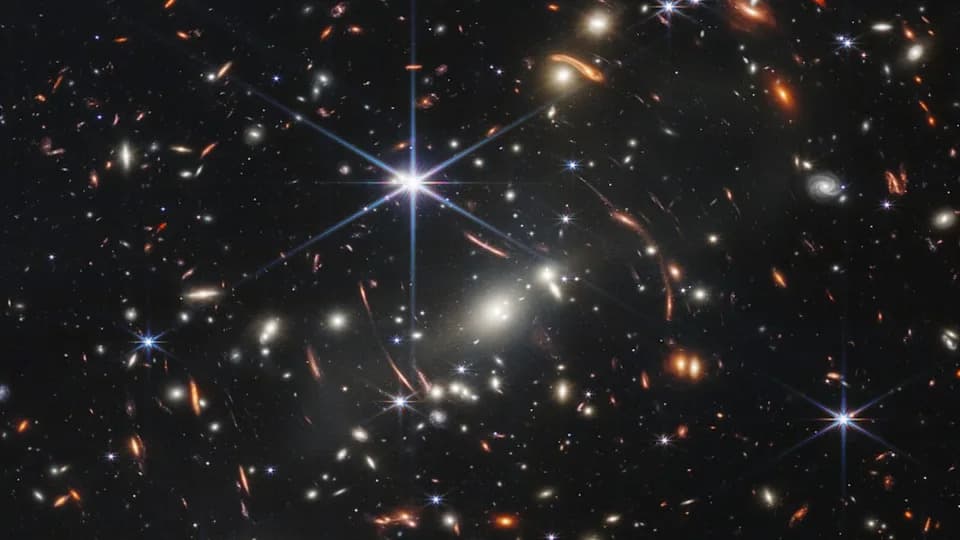
This deep-field image by NASA's James Webb Space Telescope shows some of the earliest and most distant galaxies ever seen. | Credit: NASA, ESA, CSA, and STScI
New high-resolution simulations are offering a clearer picture of why the first galaxies in the universe were such prodigious star factories. Researchers led by Umberto Maio (INAF) and Céline Péroux (ESO) used a simulation suite called ColdSIM to follow the distribution and thermodynamic state of ordinary matter (baryons) during the first billion years after the Big Bang. Their results help explain how the cosmos shifted from a cold, dense environment into a warmer, more irradiated one as the first luminous sources switched on.
Cold Beginnings and a Rapid Transition
Before the epoch of reionization—the interval when ultraviolet light from the first stars and galaxies ionized and illuminated the intergalactic medium—the gas between galaxies was largely cold and dense, creating favorable conditions for star formation. ColdSIM shows that as massive stars ignited and ultraviolet photons spread, that gas rapidly warmed and became lower in density. In short, the universe moved from a relatively quiescent, cool state to a far more energetic and irradiated environment over a short cosmic time.
Key Physical Findings
Two of the most important physical outcomes from the simulations are:
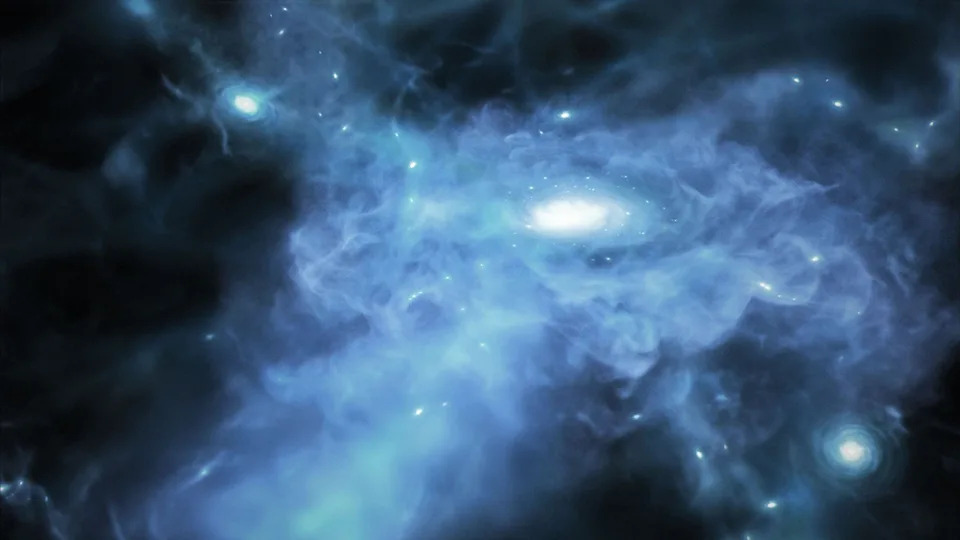
Artist's concept showing a galaxy forming only a few hundred million years after the Big Bang, when gas was a mix of transparent and opaque during the Era of Reionization. | Credit: NASA, ESA, CSA, Joseph Olmsted (STScI)
- Low Stellar Return Fractions: Early stellar populations returned less processed material to the interstellar medium than expected. That means young galaxies depended heavily on fresh, pristine gas flowing in along the cosmic web rather than recycling previously processed material.
- Extremely Short Gas Depletion Times: The simulations find that galaxies in the first few hundred million years could convert their gas into stars much faster than typical galaxies today. These short depletion times imply very high star-formation efficiencies and sustained bursts of stellar production.
Why It Matters
These findings matter because they change how we extrapolate from local, well-studied galaxies to the universe’s infancy. The physical processes that regulate gas accretion, cooling and feedback operate differently when cosmic structures are smaller, denser and evolving rapidly. ColdSIM intentionally minimizes simplifying approximations and resolves multiple gas phases and flows, producing a more complete picture of early galaxy assembly.
Uncertainties and Ongoing Challenges
Despite the advances, important uncertainties remain. Simulating the first billion years requires modeling complex multi-phase gas physics and energetic feedback from massive stars and black holes. Unknowns such as the initial mass function (IMF) of the first stars, the metallicity thresholds that enable efficient cooling, and the strength of stellar and black-hole driven winds can all alter the predicted pace and character of early star formation.
Observations Will Test the Models
Observationally, the James Webb Space Telescope (JWST) has already found surprisingly bright and massive galaxies at very high redshift, consistent with a more active early universe. Future facilities—most notably the Square Kilometre Array (SKA)—will probe the cold gas reservoirs in these systems and provide critical tests of the ColdSIM predictions. Together, improved simulations and new observations are converging on a more dynamic view of how the first galaxies grew.
Bottom line: The early universe transitioned quickly from cold and fertile to warm and irradiated as the first stars lit up, and that transition—combined with rapid inflows of pristine gas and limited recycling—helped drive the extraordinary star-formation rates seen in infant galaxies.
Help us improve.





















