
Researchers detected a fleeting, ultra-thin atmosphere around the 500‑km Kuiper belt object (612533) 2002 XV93 using a 2024 stellar occultation observed from three Japanese sites. The light curve showed a gradual dimming about 1.5 seconds before and after totality, a signature of refraction through gas. Models indicate a surface pressure of roughly 100–200 nanobars (5–10 million times weaker than Earth's) and imply the atmosphere is likely transient unless replenished by a recent impact or cryovolcanism. The findings, published in Nature Astronomy, revise ideas about which small bodies can host atmospheres.
Scientists Detect an 'Impossible' Atmosphere on Tiny Kuiper Belt World (612533) 2002 XV93
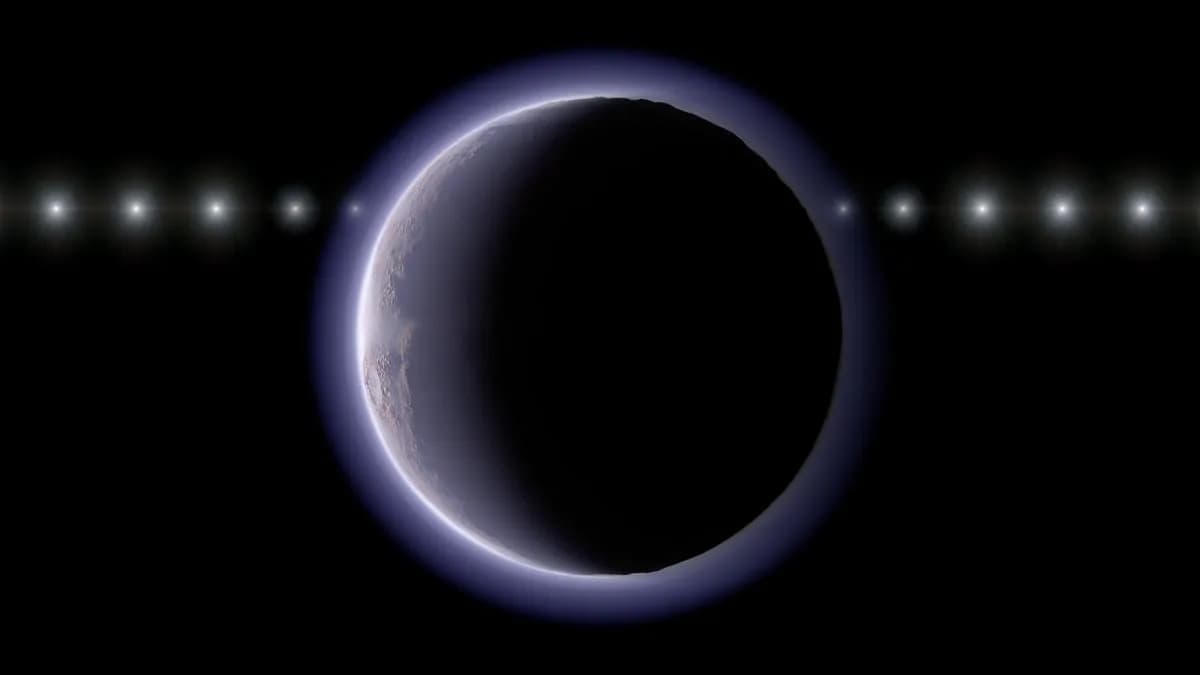
An artist's impression of the occultation of 2002 XV93. (NAOJ/Ko Arimatsu)
Far beyond Neptune, astronomers have discovered a startling, ultra-thin atmosphere around a small Kuiper belt object that challenges assumptions about which bodies can hold gas. The object, catalogued as (612533) 2002 XV93, is roughly 500 kilometers (310 miles) across — a size once thought too small for sustained atmospheric retention — yet observations indicate a tenuous gaseous envelope.
YouTube Thumbnail
2002 XV93 is a plutino, locked in a 2:3 resonance with Neptune and orbiting at about 40 astronomical units from the Sun. Plutinos and other Kuiper belt objects preserve clues to the early Solar System's composition and dynamics, but their great distance makes them faint and difficult to study directly.
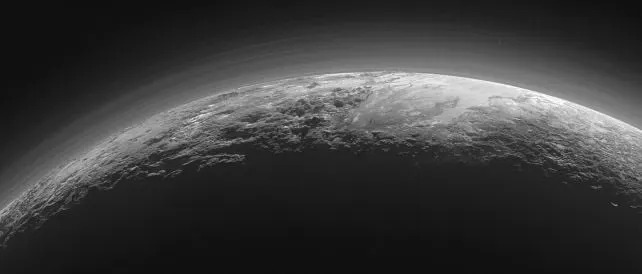
An image captured of Pluto by the New Horizons spacecraft in 2015, showing layers of atmospheric haze. (NASA/JHUAPL/SwRI)
In 2024, a team led by Ko Arimatsu of the National Astronomical Observatory of Japan captured a rare stellar occultation — the plutino passing in front of a distant star — from three observing sites across Japan. The occultation lasted about 15–20 seconds, but the pattern of starlight dimming was unexpected: instead of an abrupt drop and recovery, the light curve showed a gradual fading starting roughly 1.5 seconds before totality and a symmetric brightening about 1.5 seconds after.
YouTube Thumbnail
Refraction Reveals a Thin Atmosphere
That gradual dimming and recovery is a clear signature of refraction — starlight bending as it crosses an atmosphere. The team built refraction models using temperature structures and compositions inspired by Pluto, testing methane-, nitrogen-, and carbon monoxide–dominated atmospheres and a range of density profiles.
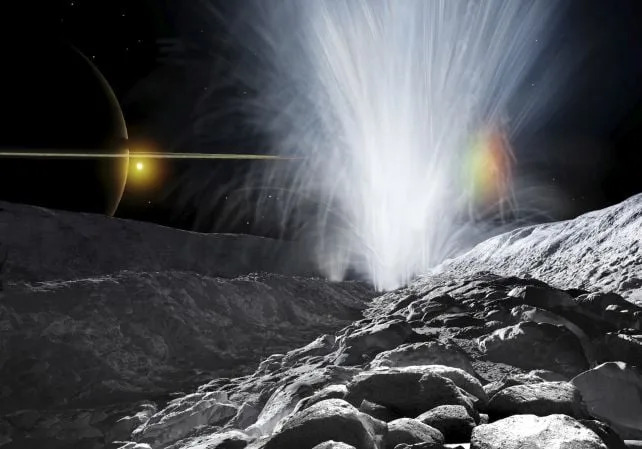
An artist's impression of an active cryovolcano onSaturn's moon Enceladus. (Ron Miller/Stocktrek Images/Getty)
The best-fit models point to a surface pressure on the order of 100–200 nanobars — roughly 5–10 million times thinner than Earth's atmosphere at sea level. Detecting atmospheric refraction at such low pressures from the outer Solar System demonstrates both the sensitivity of modern occultation techniques and the power of coordinated observations.

Subscribe to ScienceAlert's free fact-checked newsletter
Transient Or Replenished?
Modeling indicates an atmosphere this thin would be lost to space on timescales of a few hundred to about a thousand years, implying the current envelope is likely transient or actively replenished. The researchers propose two plausible sources: a relatively recent impact that released volatiles, or ongoing cryovolcanism — eruptions of volatile-rich material from the interior — similar in principle to processes suspected on Pluto.
“Even a few-hundred-kilometer TNO can host, at least transiently, an atmosphere, challenging standard volatile-retention scenarios,” the authors write in their paper.
This result is the first detection of an atmosphere on a small trans-Neptunian object other than Pluto and was published in Nature Astronomy. Beyond revising models of volatile retention, the discovery highlights how precise occultation monitoring and refined refraction modeling can reveal subtle properties of distant worlds.
Help us improve.





















