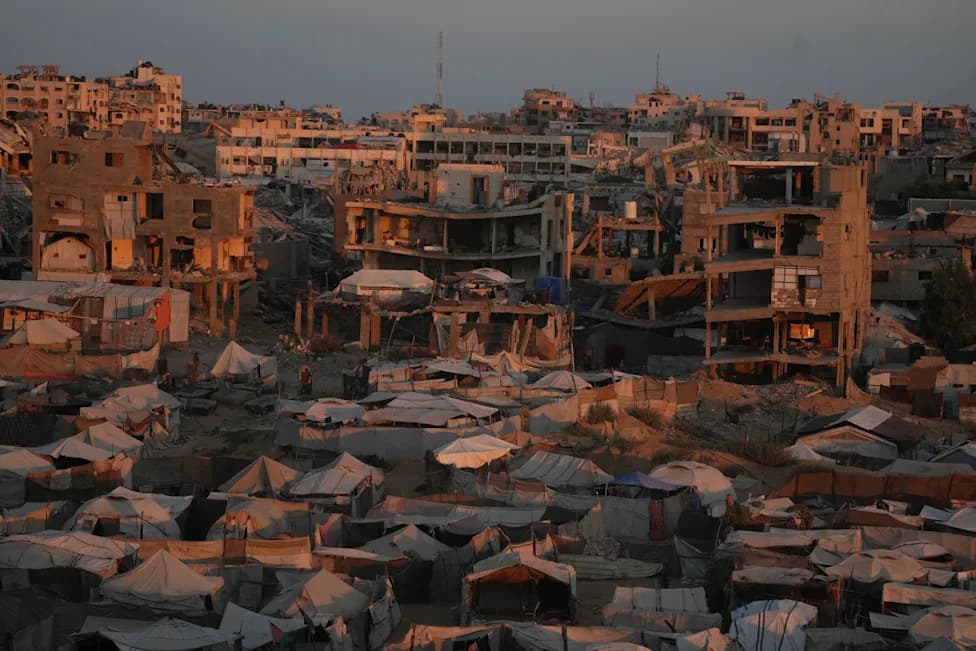
Key developments: Israeli officials have warned they may abandon a fragile ceasefire to compel Hamas to disarm, while local medics report 828 deaths since the truce began and at least 72,608 fatalities overall. Mediators led by Nikolay Mladenov are promoting a phased disarmament roadmap tied to aid and reconstruction, which Palestinian factions have rejected. Analysts say the threats may serve political goals as Israel’s military remains stretched across multiple fronts.
Truce In Gaza Frays as Israel Threatens Renewed Offensive to Force Disarmament
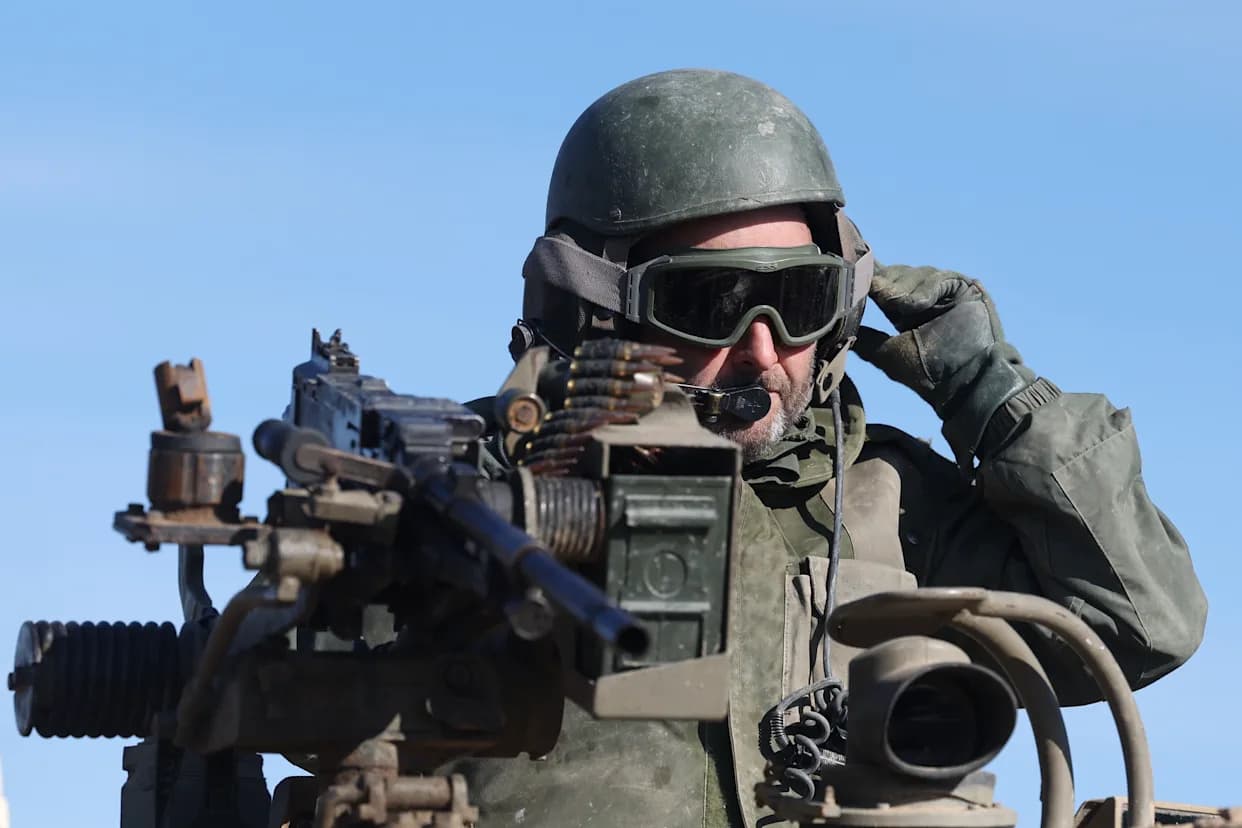
An Israeli soldier sits in a tank in southern Israel near the boundary with the Gaza Strip[File: Abir Sultan/EPA]
In the shattered neighbourhoods of Khan Younis and Deir el-Balah in the Gaza Strip, the persistent drone patrols and the thunder of controlled demolitions make clear that active conflict has not truly stopped.
Although a ceasefire has been nominally in place since October, families continue to pull bodies from the rubble. Local medical sources report that 828 Palestinians have been killed since the truce began, while the overall death toll since the wider conflict started stands at at least 72,608.
Rising Tensions In Jerusalem And On The Ground
In Jerusalem, Prime Minister Benjamin Netanyahu unexpectedly cancelled a planned security cabinet meeting and held smaller consultations instead. At the same time, senior military figures have signalled a possible return to large-scale operations. A senior officer in the Israeli General Staff told Channel 15 that another round of fighting was "almost inevitable," citing Hamas’s refusal to surrender weapons and what the military describes as the "failure" of the International Stabilization Force — the multinational body set up under the truce to oversee security and implementation of the ceasefire.
Army Radio has reported that Israeli forces have steadily widened the area under their control inside Gaza. By incrementally shifting the ceasefire-established "Yellow Line" westward, the military now controls roughly 59% of the Gaza Strip, according to these reports, and has redeployed troops from the Lebanon front into Gaza and the occupied West Bank.
Mediators Push Disarmament Roadmap
In Cairo, mediators have pressed Palestinian factions to accept a new plan backed by Nikolay Mladenov, the high representative linked to the United States-supported Board of Peace. Abdul Jabbar Said, a member of Hamas’s political bureau, told the Palestinian site Ultra Palestine that Mladenov is promoting a roadmap that would require the complete disarmament of Hamas over 281 days in five stages. The proposal conditions the flow of humanitarian aid, reconstruction and the opening of crossings on the phased handover of weapons.
Analysts and Palestinian officials have told Al Jazeera that the framework is intended to produce the political surrender of armed groups. Observers also say the plan risks turning the National Committee for the Administration of Gaza (NGAC) — a technocratic body created to administer civilian affairs and reconstruction — into a de facto security instrument serving the occupation.
Said confirmed to Ultra Palestine that a unified front of Palestinian factions, including Hamas, Palestinian Islamic Jihad and the Popular Front for the Liberation of Palestine (PFLP), has rejected the disarmament prerequisite. Instead, they insist on the full implementation of the first phase of the ceasefire, which they say Israel has violated by restricting the agreed entry of 600 aid trucks per day.
“The resistance insists that disarmament is linked to the goal of establishing a Palestinian state and a complete end to the occupation,” said Wissam Afifa, a Gaza-based political analyst. He argued that the US and Israel are trying to separate the question of weapons from any political horizon — effectively turning humanitarian relief into leverage.
Political Calculations And Military Strain
Some analysts suggest the drumbeat of renewed war could be a tactical move to deflect from Israeli setbacks elsewhere and to shore up political standing. Mamoun Abu Amer, an expert on Israeli affairs, told Al Jazeera the warnings function as a "smoke screen" intended to pressure mediators and strengthen Netanyahu’s position ahead of elections.
Analysts also highlight the strategic risks. Citing former operations chief Israel Ziv, Abu Amer noted that Israel’s military is stretched across multiple fronts and heavily fatigued: reservists are expected to serve an average of roughly 80 days in 2026. Opening a fresh large-scale offensive in Gaza while the crisis in southern Lebanon remains unresolved would create a difficult and risky scenario for Israeli commanders.
Human Cost And Prospects
For civilians trapped in Gaza, high-level manoeuvring offers little protection. Medical statistics released on Saturday put the cumulative death toll since the war began at at least 72,608; three more Palestinians were reported killed by Israeli strikes on Sunday afternoon. With humanitarian access constrained and political talks deadlocked, Gazans fear another devastating offensive as the fragile truce continues to unravel.
Help us improve.