
Naval blockades have long been a powerful tool of war — able to cripple economies and create humanitarian crises without a land invasion. From the reported closure of the Strait of Hormuz to long-running sieges in Gaza, Biafra and WWI-era eastern Mediterranean, these operations have produced mass shortages, hundreds of thousands of civilian deaths in some cases, and important political consequences. Their impact depends on enforcement, alternative supply routes and international response.
Strait of Hormuz and Major Modern Naval Blockades: How Sea Power Shapes War and Humanitarian Risk
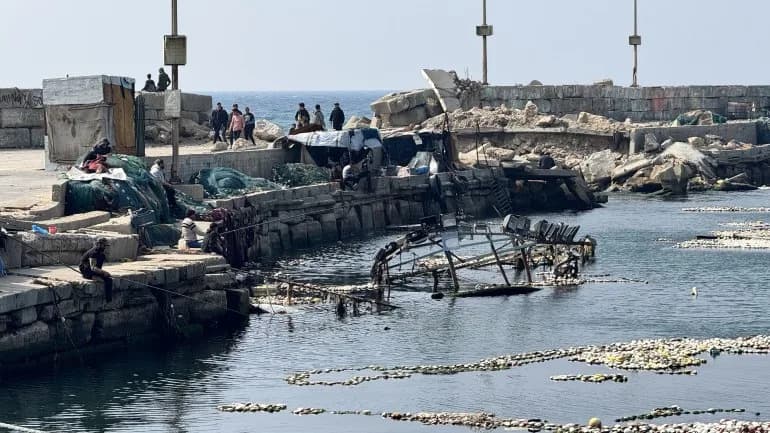
A view of the severely damaged Gaza City port as fishermen work under difficult conditions due to Israeli attacks, March 8, 2025 [Hamza ZH Qraiqea/Anadolu]
The Strait of Hormuz — historically a conduit for roughly one-fifth of global oil and gas shipments — has been reported as effectively out of normal use after competing U.S. and Iranian maritime measures. Naval blockades are an age-old instrument of war: they require no invasion forces, only the ability to deny an adversary access to supplies. Over time such interdictions have reshaped economies, societies and alliances, sometimes producing immediate shocks and sometimes causing long-term humanitarian harm.
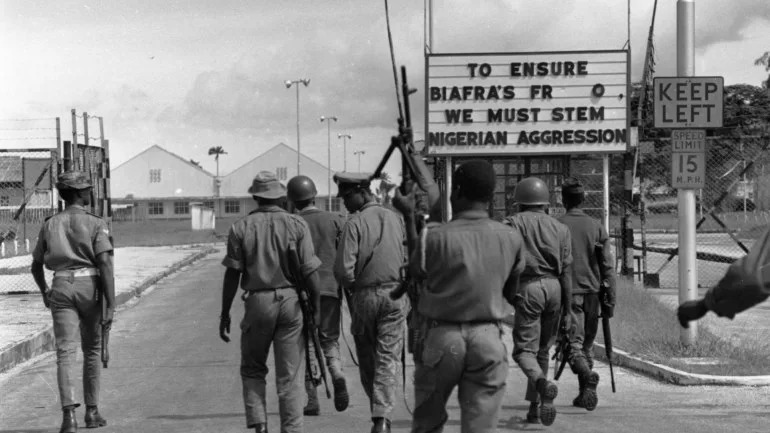
Nigerian troops entering Port Harcourt, after routing Biafran troops during the Nigerian Civil War [File: Evening Standard/Getty Images]
Gaza Strip (2007–present)
Israel has maintained tight land, sea and air restrictions on the Gaza Strip since 2007. These measures have severely limited the flow of goods and essential supplies to around 2.3 million residents and have restricted freedom of movement. Before October 2023, Gaza fishermen were commonly confined to 6–15 nautical miles (11–28 km) from shore, below the 20-nautical-mile (37 km) area referenced in the Oslo Accords.
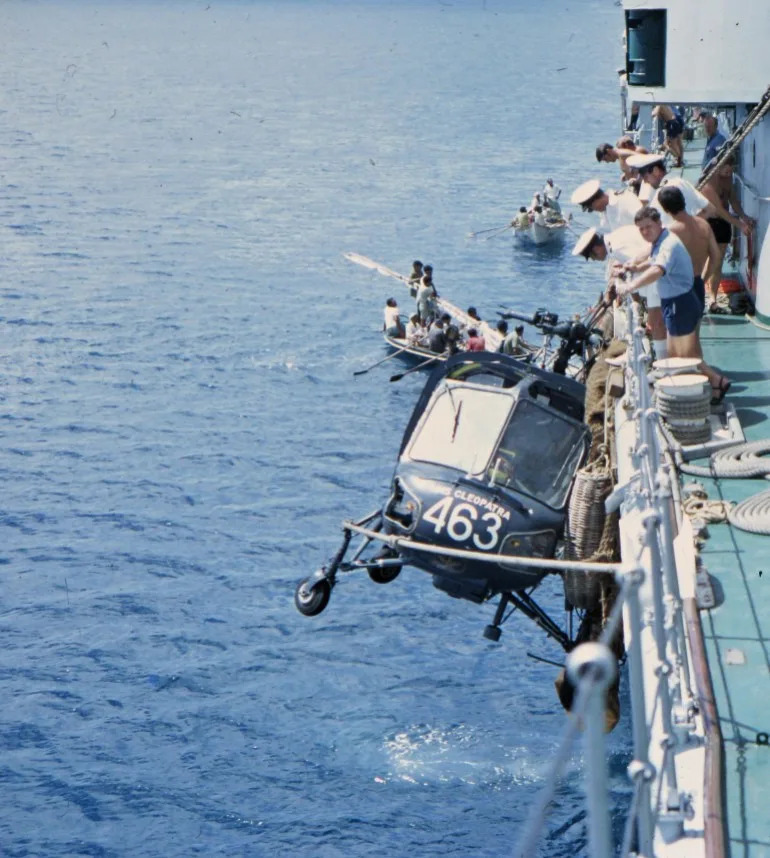
HMS Cleopatra’s Wasp helicopter encounters an engine failure at high altitude during the blockade on the Port du Beira in 1971; the aircraft was recovered after it crash-landed [File: 50tony Wikimedia Commons]
Following the October 2023 conflict, some sources and critics described Israeli policies as producing catastrophic shortages; independent observers have reported incidents in which fishermen and other civilians were killed while operating at sea. Since 2008, several 'Freedom Flotilla' campaigns have attempted to breach the naval restrictions; from 2010 onwards, flotillas have been intercepted or boarded in international waters. On April 30 (most recent Global Sumud Flotilla operation), Israeli forces intercepted or boarded 22 of 58 vessels, some reported to be more than 1,000 km from Gaza.
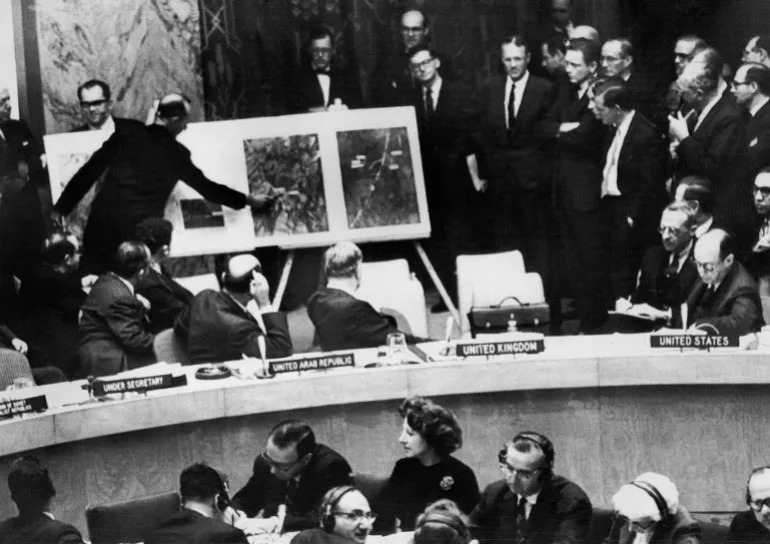
A US official shows aerial views of one of the Cuban medium-range missile bases, taken in October 1962, to the members of the UN Security Council [File: AFP]
Biafra and the Nigerian Civil War (1967–1970)
After the secessionist Republic of Biafra declared independence in July 1967, the Nigerian federal government imposed land, sea and air blockades. The interdiction contributed to a large-scale humanitarian catastrophe: contemporary and later estimates place the death toll between roughly one and two million people, the majority from hunger and disease. The blockade lasted nearly three years and ended with Biafra's surrender in January 1970.
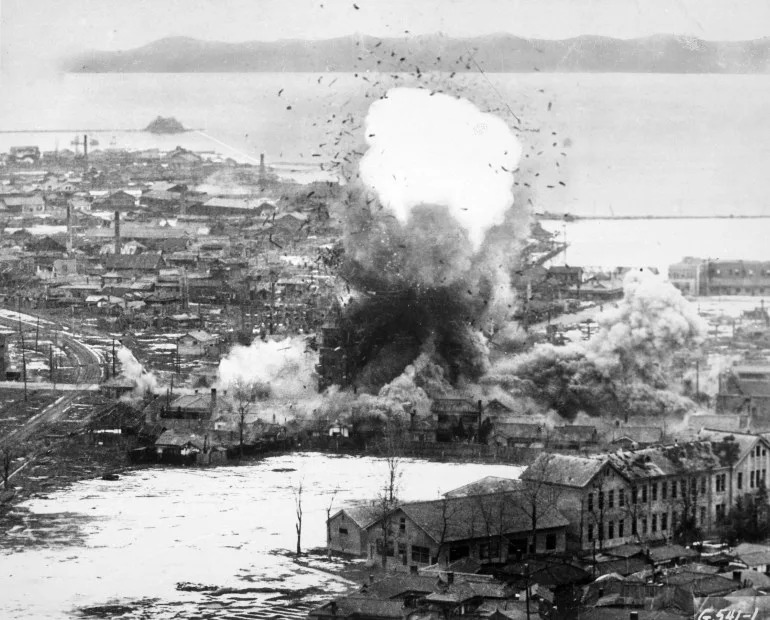
US B-26 Invaders dropped para-demolition bombs at supply warehouses and dock facilities at the Wonsan port in North Korea in 1951 [File: Wikimedia Commons]
Beira Patrol (Rhodesia, 1966–1975)
The Royal Navy operated the Beira Patrol for nine years to prevent oil from reaching Rhodesia via the Mozambican port of Beira, enforcing UN sanctions after Rhodesia's unilateral declaration of independence. The patrol largely failed to stop fuel reaching Rhodesia — supplies continued via South Africa and other Mozambican ports — and the operation tied up substantial UK naval resources (about 76 ships over nine years, with two frigates typically on station). The patrol ended in July 1975 after Mozambique's independence provided a credible local blockade.
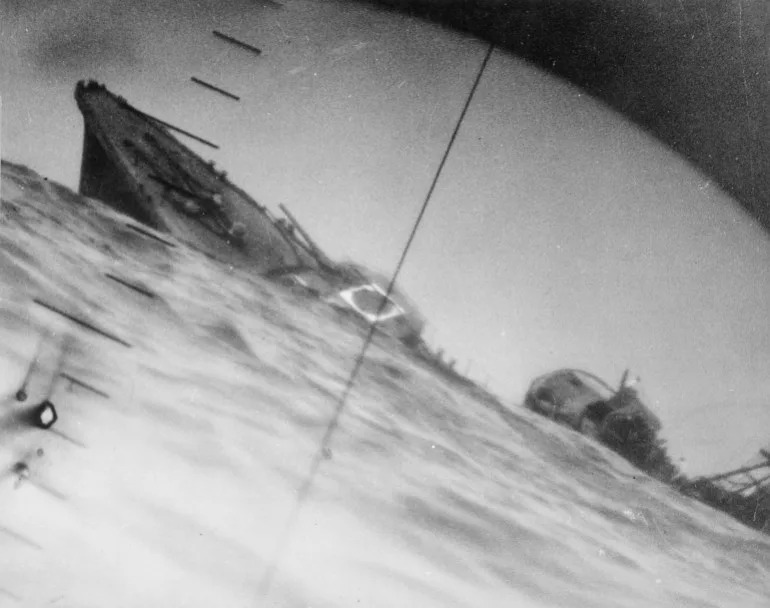
The US sinking of the Japanese destroyer Yamakaze on June 25, 1942 [File: US Navy via Wikimedia Commons]
Cuban Missile Crisis Quarantine (October–November 1962)
In October 1962 the United States established a naval 'quarantine' of Cuba after U-2 reconnaissance revealed Soviet missile sites being installed on the island. The term 'quarantine' was chosen to avoid the legal implications of a blockade. The US drew a line roughly 500 nautical miles (920 km) from Cuba's coast and authorised warships to stop and inspect vessels suspected of carrying offensive weapons. The 13-day standoff ended when the Soviet Union agreed to remove the weapons in exchange for a U.S. public pledge not to invade Cuba and a secret understanding on U.S. missiles in Turkey; the quarantine formally ended on November 20, 1962.
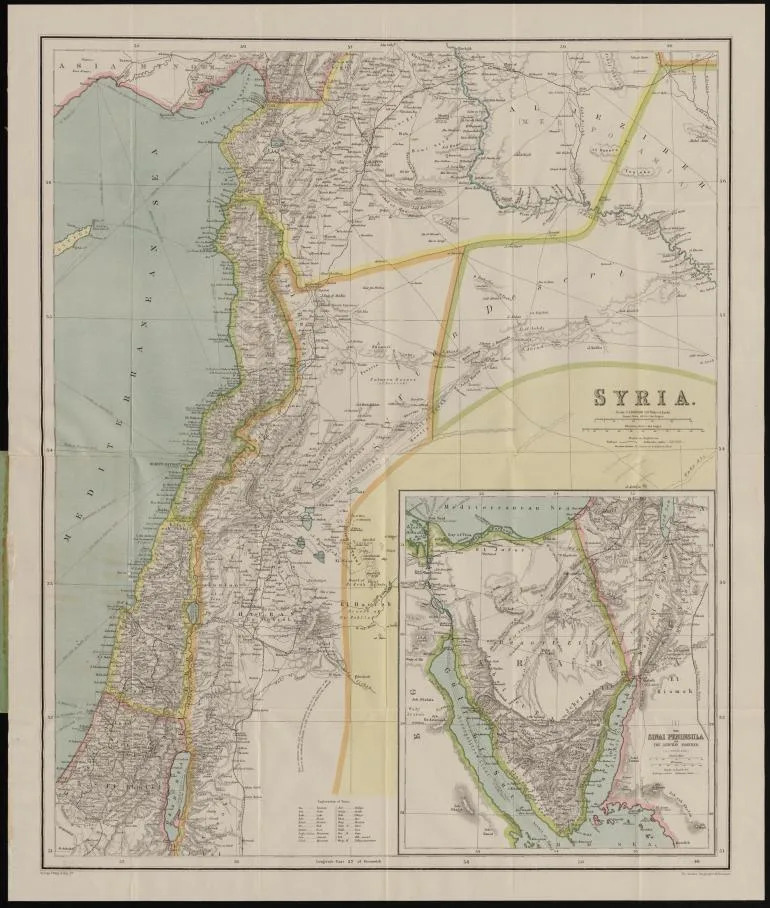
World War I map shows modern Palestine and Syria, published in 1918 [File: Wikimedia Commons]
Wonsan Blockade (Korean War, 1951–1953)
UN naval forces led by the United States imposed a blockade of the North Korean port of Wonsan in February 1951 that lasted about two and a half years (861 days). The operation sought to deny the North Korean navy access to a strategically important harbour, airfield and refinery. The blockade followed dangerous mine-clearance efforts in October 1950, during which the minesweepers USS Pledge and USS Pirate were sunk. The interdiction constrained enemy resupply along the east coast and ended with the Korean Armistice Agreement in July 1953.
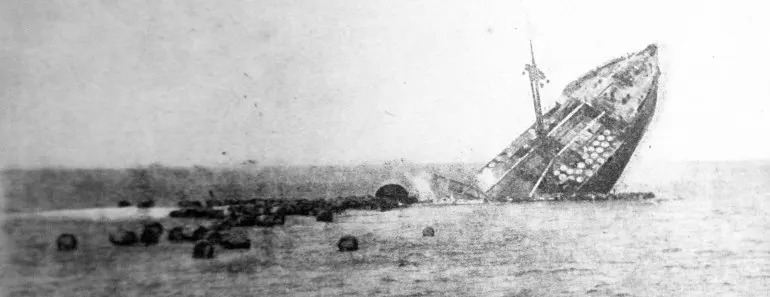
German U-35 submarine sinking the French steamer, Herault, in the Mediterranean, off Cabo San Antonio, Spain, June 23, 1916 [Courtesy of the Library of Congress]
U.S. Submarine Campaign Against Japan (Pacific War, 1942–1945)
From 1942 the United States executed a de facto maritime blockade of Japan by combining submarine attacks on merchant shipping with extensive minelaying. Japan — heavily dependent on imported oil, rubber and raw materials — was particularly vulnerable. U.S. submarines sank roughly 1,300 Japanese merchant vessels and about 200 warships; by 1945 oil imports had largely ceased and food shipments collapsed, contributing to severe shortages. Historians debate the precise scale of civilian starvation, but the blockade is widely acknowledged as a decisive factor in crippling Japan's wartime economy prior to surrender in August 1945.
Eastern Mediterranean Blockade (World War I, 1915–1918)
In August 1915 Allied navies imposed a blockade along the eastern Mediterranean coast to cut supplies to the Ottoman Empire. The interdiction, which extended from the Aegean–Mediterranean intersection down to the Egyptian frontier, targeted munitions, oil, food and medicine. A locust plague and drought compounded shortages, and contemporary reports estimate roughly 500,000 deaths in Lebanon and Greater Syria by 1918, with Mount Lebanon losing about one-third of its population. The blockade ended as Allied forces occupied the region in October 1918.
British Blockade of Germany (World War I, 1914–1919)
The Royal Navy began a broad blockade of Germany in August 1914, extending from the English Channel to Norway. Mine-laying and trade restrictions sought to deprive Germany of imports, including food and fertiliser. The civilian impact grew severe by the winter of 1916–17 (the 'Turnip Winter'); scholars estimate between 424,000 and 763,000 civilian deaths from malnutrition-related disease. Elements of the blockade remained until July 1919, after the Treaty of Versailles.
Conclusion: Naval blockades remain a potent form of coercion: they can alter the course of wars, produce major civilian suffering, and shift geopolitical calculations without traditional ground invasions. Their effectiveness varies with political will, international law, alternative supply routes, and the capacity of intervening navies.
Help us improve.





















