
Researchers combined decades of Hubble, JWST, Keck and Voyager data to study Uranus’s faint outer μ and ν rings. They conclude the μ ring is supplied by micrometeoroid impacts on the icy moon Mab, while the ν ring forms from collisions and impacts on embedded non-icy parent bodies that likely contain organics. The analysis also confirmed a clear color difference: the μ ring appears blue and the ν ring appears red. These results improve understanding of how tenuous planetary rings are generated and maintained.
Study Solves Mystery of Uranus’s Two Outer Rings — Origins Traced to Mab and Hidden Parent Bodies
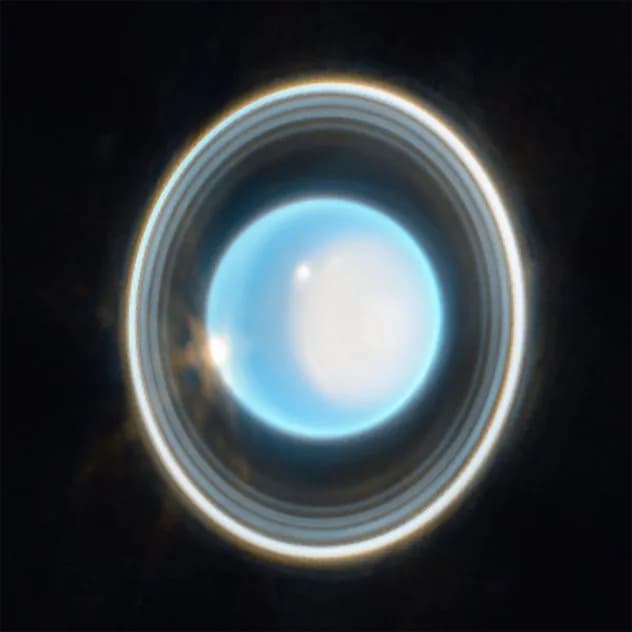
A close-up view of Uranus and its rings. This is just he third time that NASA was able to see the planet's faintest rings. (NASA, ESA, CSA, STScI. Image processing: J. DePasquale (STScI))
Scientists say they have finally solved how two faint outer rings around Uranus formed, resolving a puzzle that had perplexed astronomers for decades nearly 2 billion miles away.
The new study presents the most comprehensive characterization of Uranus’s outer rings to date, combining decades of observations from the Hubble Space Telescope, the James Webb Space Telescope, the W.M. Keck Observatory and measurements from Voyager, the only spacecraft to fly past the planet.
How the Rings Formed
By analyzing the rings’ composition, color and radial extent, researchers identified two different formation paths. The study concludes that the μ (mu) ring is continually replenished by micrometeoroid impacts on the small, icy moon Mab. Those impacts eject fine icy particles into orbit, producing the blue-tinted dust seen in the μ ring.
In contrast, the ν (nu) ring appears to originate from collisions between — and micrometeoroid strikes on — parent bodies embedded within the ring itself. Unlike Mab, these parent objects are inferred to be at least partially non-icy and to contain organic-rich materials, which help explain the ν ring’s redder color.
"Based upon the rings' composition and their radial breadth, we propose the μ ring is produced by micrometeoroid impacts on the icy moon Mab, while the ν ring arises from collisions between — and micrometeoroid hits on — parent non-icy bodies embedded in that ring," the study says.
Why This Matters
Uranus’s rings are much fainter and narrower than Saturn’s, so characterizing their sources helps astronomers understand how different ring systems form and evolve. The contrasting colors — blue for the μ ring and red for the ν ring — provide clues about grain size and composition: fresh icy grains scatter blue light, whereas organic-rich or weathered materials tend to redden the reflected light.
Overall, the findings show that small moons and unseen parent bodies can be important dust sources for tenuous ring systems and underscore the value of combining long-term, multi-observatory datasets to study distant planets.
Help us improve.





















