
The search for extraterrestrial intelligence is accelerating. Next‑generation observatories such as the Square Kilometre Array Observatory (SKAO) and advanced AI systems will vastly increase sensitivity and data throughput, allowing scientists to hunt both intentional beacons and faint technological leakage. Historic efforts — from Project Ozma to SETI@home — have explored only a vanishingly small fraction of the Milky Way. If a candidate signal emerges, international verification protocols exist, but social media makes public communication and coordination more complex than before.
The Search for Aliens Levels Up: Telescopes, AI and a New Era for SETI

Cutting-edge radio observatories have unprecedented sensitivity, as demonstrated in this image of the center of our galaxy taken by MeerKAT in South Africa - a precursor array to the larger Square Kilometer Array. This image, released in 2022, reveals striking, parallel radio filaments whose origins remain mysterious. Credit: SARAO, Heywood et al. (2022)/J. C. Muñoz-Mateos
Just over four decades ago, Carl Sagan imagined in his novel Contact what it might look like to intercept a radio transmission from an intelligent extraterrestrial civilization. In the book, alien beings broadcast instructions for building a spacecraft so humans can meet them. While fictional, Sagan’s background as an astronomer lent the story technical plausibility and a memorable template for how a real detection might unfold.
After roughly a century of listening from Earth, no confirmed alien transmission has been found. That hasn’t dimmed hopes: humanity has scanned only a tiny fraction of the Milky Way, but next‑generation telescopes and AI‑driven analysis are poised to transform the search over the coming decade.
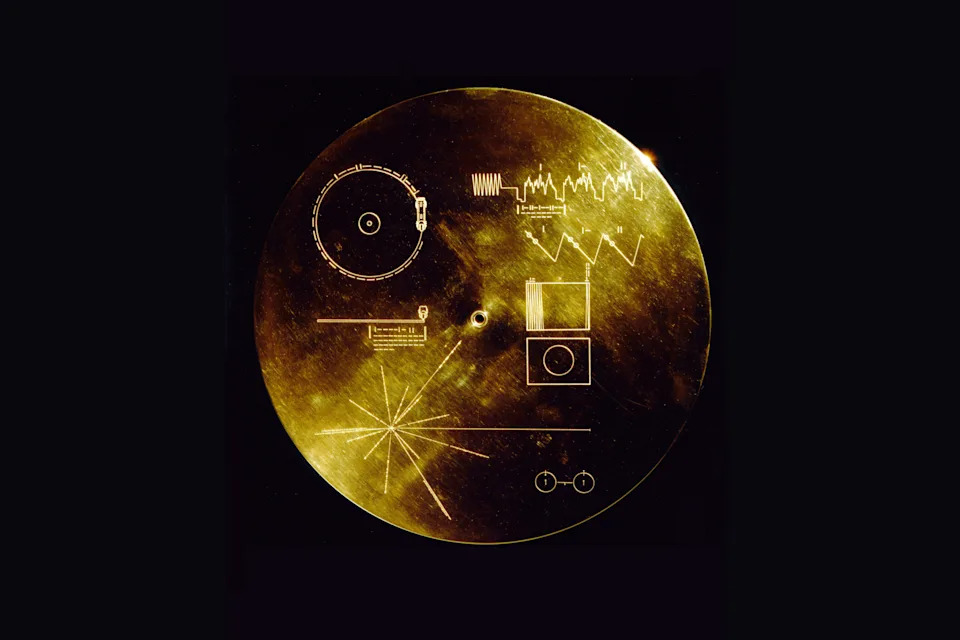
When the twin Voyager probes launched in 1977, each carried a copy of a gold-plated phonograph record featuring audio and video recordings from Earth. Their protective covers, pictured here, featured schematic explanations of how to play and decode the data (top and center); a map of the location of our Sun relative to 14 known pulsars (lower left); and a diagram of the spin-flip transition of the hydrogen atom which produces emission at 1420.4 MHz. The time period between passing wave crests at this frequency provided the reference unit for time periods in the other diagrams, which were expressed in binary. Credit: NASA/JPL
From Project Ozma to Big Data
Early searches for extraterrestrial radio signals go back much farther than most people realize. In 1924, astronomer David Peck Todd coordinated periods of radio silence across some U.S. stations during a close approach of Mars so astronomers could listen for unusual transmissions. That experiment produced no messages but helped establish an early model for coordinated listening.
The modern era of SETI began in 1960 with Frank Drake’s Project Ozma. Using an 85‑foot dish at Green Bank, West Virginia, Drake tuned a narrow receiver to 1420.4 MHz — the hydrogen line — and listened to Tau Ceti and Epsilon Eridani for months. The hydrogen frequency was chosen because neutral hydrogen is ubiquitous and might serve as a natural “hailing” frequency. No clear artificial signals were detected, but the experiment launched a systematic approach to the search.

The name of the Square Kilometre Array refers to the project's ultimate goal of having dishes and antennas with a collecting area totaling 1 square kilometer. However, the project - pictured here in a photo illustration - will begin its science operations at roughly 10 percent that level. Credit: SPDO/TDP/DRAO/Swinburne Astronomy Productions (CC BY 3.0)
Technology and Scale Have Changed Dramatically
Today’s instruments are far more powerful. As Steve Croft of the SETI Institute notes, we can now observe billions of frequency channels simultaneously on much larger dishes and arrays. Projects such as Breakthrough Listen have leveraged that capability to examine hundreds of thousands — and by some counts more than a million — stellar targets with vastly superior computing power and algorithms.
Still, the Milky Way is enormous. Cumulative searches to date have covered roughly 0.00001 percent of the galaxy — a vanishingly small slice — which is one reason the absence of detections is not yet definitive.
Credit: Astronomy: Roen Kelly
Leakage, Beacons, and the New Search Strategy
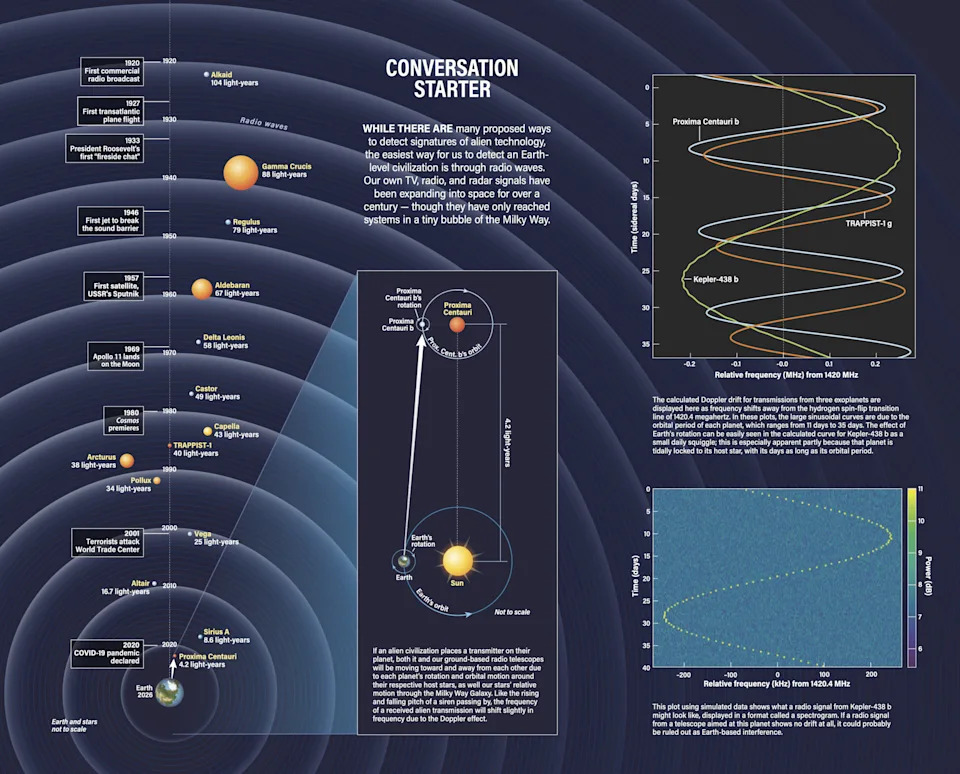
Historically, SETI focused on deliberate beacons. Increasingly, researchers also look for technological “leakage” — unintentional emissions such as broadband radio, radar, and satellite transmissions that might betray an advanced civilization. Earth’s own radio bubble now extends about 100 light‑years, and improved observatories are beginning to reach distances where comparable leakage could be detectable.
The Square Kilometre Array Observatory (SKAO)
The SKAO, under construction in South Africa and Australia, will be a transformational facility. When fully complete it will comprise hundreds of dishes and thousands of antennas. Even phase one — roughly 10 percent of the planned collecting area — will be several times more sensitive than many existing large single dishes and will observe an order of magnitude more stars at once.
Credit: Astronomy: Roen Kelly after Li et al. (2022)https://doi.org/10.3847/1538-4357/ac90bd
A 2025 study led by Sofia Sheikh (SETI Institute) estimated that SKAO could detect Deep Space Network‑style transmissions out to about 65 light‑years and deliberate beacons comparable to Arecibo’s transmissions out to roughly 12,000 light‑years. SKAO’s broad frequency coverage (roughly 350 MHz to 15.4 GHz, including the hydrogen line) means SETI researchers can mine ordinary astronomical data for technosignatures as part of many science programs.
The Drake Equation, Fermi’s Paradox, And What We Don’t Know
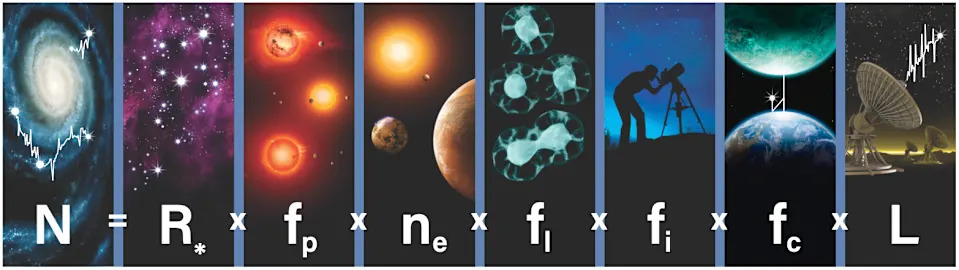
Frank Drake’s famous equation frames the problem by multiplying factors such as star formation rate, fraction of stars with planets, number of habitable worlds, probability life and intelligence arise, and how long technological civilizations persist. Modern exoplanet surveys have narrowed some inputs (we now know most stars host planets), but major uncertainties remain: how often life begins, how commonly intelligence arises, whether civilizations produce detectable signals, and how long they endure.
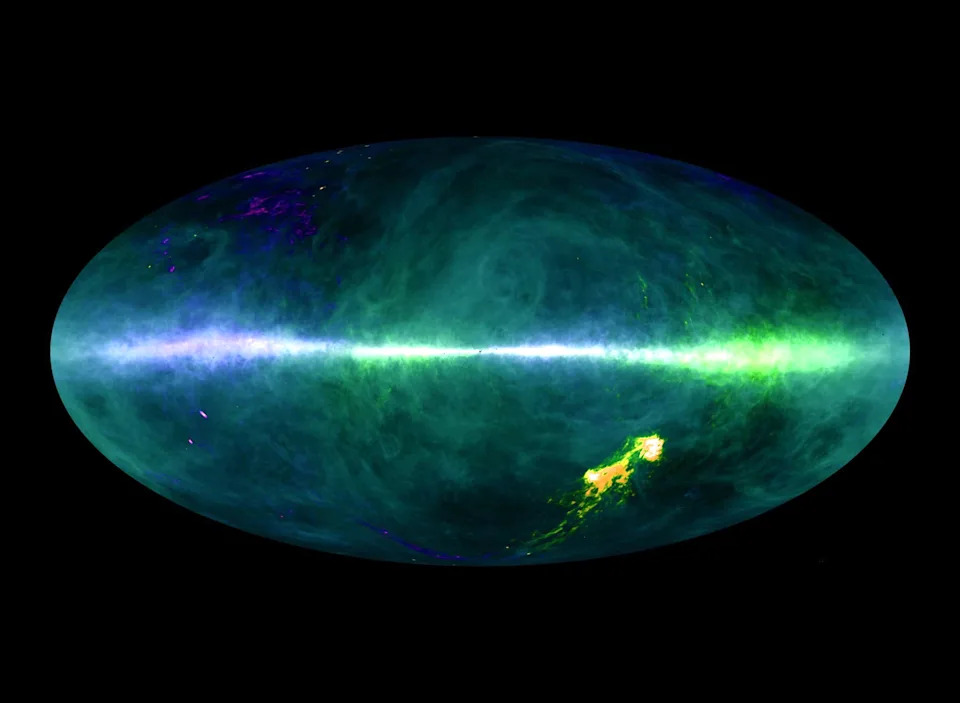
One of the most important frequencies in radio astronomy is 1420.4 MHz. Cold hydrogen atoms emit radio waves at this frequency when their electrons reverse the orientation of their spin. This so-called spin-flip transition occurs while the atom is in its ground state - it does not require the gas to be heated by a nearby star to a higher energy level. Though this emission is faint, it allows astronomers to map the structure of hydrogen clouds across the entire sky, seeing more than just the clouds that are lit by stars. The ubiquity of this emission has led SETI researchers to hypothesize that extraterrestrial civilizations might use the frequency as a hailing channel. Credit: Benjamin Winkel and the HI4PI collaboration
Fermi’s Paradox — "Where is everybody?" — persists because reasonable estimates can imply many technological civilizations, yet we have no confirmed contact. Possible explanations include extreme rarity, short lifetimes for civilizations, or simply that we have not yet looked in the right way, at the right time, or with enough sensitivity.
Big Data, AI, And The Hunt For Hidden Signals
We now live in an era of Big Data astronomy. Modern arrays produce torrents of data that preclude manual inspection. Researchers increasingly rely on machine learning to remove terrestrial interference, flag unusual patterns, and prioritize follow‑up. Students and early career scientists are often reminded that an algorithmic breakthrough could reveal a signal already sitting on disk.
A major challenge is distinguishing human radio frequency interference (RFI) from genuine extraterrestrial signals. Roughly 99.99 percent of SETI detections turn out to be local RFI. Techniques such as analyzing Doppler drift — frequency shifts caused by Earth's motion and the source’s velocity — help separate terrestrial sources (which typically show little or different drift) from celestial candidates. AI will be critical to scale these analyses to SKAO‑level datasets.
Verification, Protocols And Social Media
If a promising signal is found, international post‑detection protocols recommend rigorous verification, rapid sharing with the scientific community, notification of organizations such as the United Nations Office for Outer Space Affairs, and broad international consultation before any reply is sent. The International Academy of Astronautics (IAA) issued guidelines in 1989 and strengthened them in 2010.
However, the 2010 update predates today’s viral social media environment. Experts on the IAA’s SETI committee, including Croft, expect further revisions to address how candidate detections are communicated and managed in an age of instant global sharing.
Public Participation And The Next Steps
SETI has a long tradition of public engagement. From 1999 to 2020 the volunteer distributed computing project SETI@home harnessed millions of personal computers to analyze Arecibo data, flagging some 12 billion signals and narrowing them to roughly 100 candidates. In July 2025 follow‑up observations of promising leads shifted to China’s Five‑hundred‑meter Aperture Spherical Telescope (FAST).
Whether the search ultimately reveals many galactic neighbors or confirms Earth as uniquely inhabited, the implications will be profound — philosophically, culturally and scientifically. Finding a neighbor could unite humanity and reshape our self‑perception; finding ourselves alone would underscore the fragility and exceptional value of life on Earth.
Bottom Line: Improved telescopes like SKAO and advances in AI are expanding the search for extraterrestrial intelligence from a trickle of data to a flood — and with that transition comes both opportunity and new challenges for detection, verification and global communication.
Help us improve.





















