
NASA's Orion capsule returned to Kennedy Space Center less than a month after its April 1 launch and April 10 splashdown following a nearly 700,000-mile crewed lunar flyby. Engineers will unload payloads, recover flight data and remove Orion's heat shield and excess propellant for detailed analysis. Meanwhile, the SLS core stage and the first booster motor segments for Artemis III have arrived at Kennedy and will be stacked in the Vehicle Assembly Building. Artemis III, planned for next year, will test orbital rendezvous and docking ahead of a targeted Artemis IV lunar landing in 2028.
Orion Returns to Kennedy as Artemis III Hardware Arrives, NASA Prepares Next Moon Mission
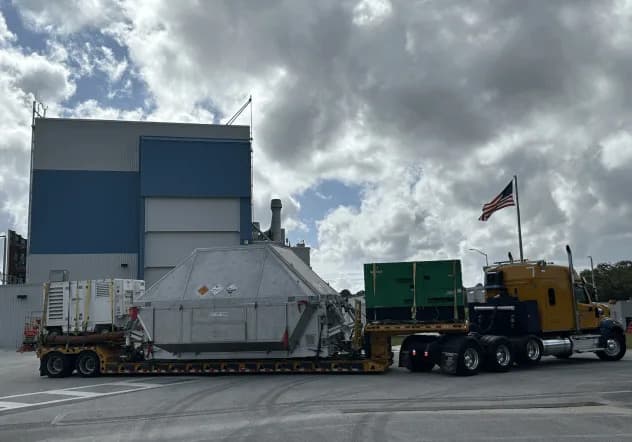
NASA’s Orion spacecraft for the agency’s Artemis II mission arrives at the Kennedy Space Center Multi Payload Processing Facility in Florida, on Tuesday, April 28, 2026. (Image credit: NASA/Tiffany Fairley)
NASA's Orion crew capsule has returned to Kennedy Space Center in Florida less than a month after its historic crewed lunar flyby, arriving as additional Artemis III rocket hardware reaches the center in preparation for the next phase of the agency's plan to return humans to the Moon.
Orion launched on April 1 carrying NASA astronauts Reid Wiseman, Victor Glover and Christina Koch, along with Canadian Space Agency astronaut Jeremy Hansen. After traveling nearly 700,000 miles, the Artemis II mission concluded with a successful splashdown off the coast of San Diego on April 10.
The Artemis II Orion spacecraft arrived Tuesday at Kennedy's Multi-Processing Payload Facility, where teams will remove onboard payloads and recover flight data to evaluate spacecraft performance. Engineers will remove and examine the capsule's heat shield and other hardware, and offload any remaining hazards such as excess propellant for safe handling.
Artemis III Hardware Arrives
Meanwhile, Kennedy teams are preparing for Artemis III. The Space Launch System (SLS) core stage for that mission has arrived at the center and will be moved into the Vehicle Assembly Building (VAB) to be lifted into High Bay 2 for stacking.
NASA also confirmed that the first shipment of booster motor segments for Artemis III arrived earlier this month. These segments will form the rocket's twin solid rocket boosters, which provide more than 75% of the thrust at liftoff. A second shipment of segments is expected this summer.
What Comes Next
Artemis III, currently scheduled to launch next year, will not be a lunar landing mission. Instead, the mission will test rendezvous and docking procedures in Earth orbit — including an Orion rendezvous with a commercial spacecraft — a critical demonstration ahead of a planned human lunar landing during Artemis IV, currently targeted for 2028.
NASA: "Orion's heat shield and other elements will be removed for extensive analysis, and remaining hazards such as excess propellant will be offloaded."
The return of Orion and the arrival of Artemis III components mark steady progress in NASA's multi-step approach to sustainable human exploration of the Moon.
Help us improve.





















