
The 250th anniversary of the Declaration of Independence produced a rare bipartisan moment when King Charles III addressed a joint session of Congress. Members from both parties applauded and laughed together, and no major boycotts occurred as had in 1991. Yet the moment also exposed a worrying reality: a foreign monarch’s visit can elicit more cross-party civility than many domestic institutions, prompting questions about the durability of such unity.
King Charles’s Address Produced a Rare Bipartisan Moment — And Why That Should Worry Us
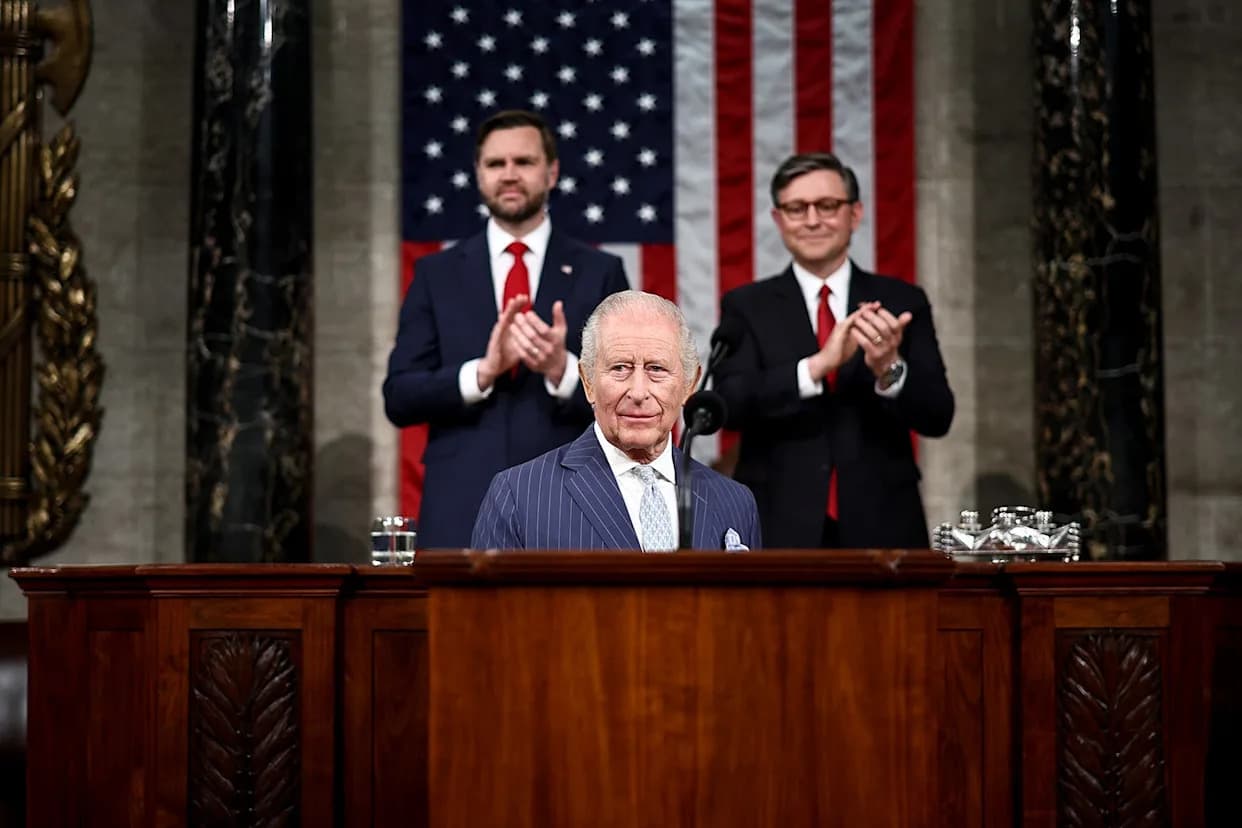
America feels deeply fractured: Congress struggles to pass major legislation, the military remains entangled in a Middle East conflict, and the president has reportedly faced multiple assassination attempts in recent years. Political polarization now colors everything from entertainment feuds to sports rivalries. Against that turbulent backdrop, the 250th anniversary of the Declaration of Independence produced an unexpected unifier: the British monarchy.
King Charles III’s address to a joint meeting of Congress offered one of the clearest displays of bipartisan harmony on Capitol Hill in some time. Lawmakers from both parties applauded many of the same lines, laughed at the same well-timed royal quips, and—on a bipartisan basis—could not resist photographing and videotaping the visiting sovereign.
Why the Moment Stood Out
Even by the standards of past royal visits, this was striking. When Queen Elizabeth II visited Capitol Hill in 1991, about two dozen members boycotted over Britain’s role in Northern Ireland. Three decades later, after the Good Friday Accords and the subsidence of the Troubles, no comparable protests emerged. For many observers, the contrast emphasized how certain international symbols now cut across America's partisan lines in ways domestic institutions no longer do.
At times Democrats rose first and more enthusiastically — for example, when the King said that 'executive power is subject to checks and balances.' At other moments Republicans led the applause — notably when he observed that 'the Christian faith is a firm anchor.'
The most visible break with unanimity came during the King’s call for 'unyielding resolve' in defense of Ukraine: a handful of Republicans remained seated, most prominently Rep. Lauren Boebert, who had earlier said she would not meet the monarch because '1776... I am an American first.' Despite that stance, Boebert attended the speech.
Pageantry, Protocol and a Touch of Theatrics
The monarchy still carries an aura that television dramas and tabloid scrutiny have not fully erased. Reporters and cameras lined Statuary Hall; a ripple of excitement greeted the King’s arrival as he walked alongside Speaker Mike Johnson. Protocol prohibited questions, and the scene was dominated by the constant click of cameras.
One mildly irreverent moment came from Mark Collins, a Texas pastor who attended dressed as George Washington — a costume he has worn for Fourth of July events for 25 years. Rep. Michael Cloud, who invited Collins, said he thought it would be fitting to have 'George Washington come' to the celebration.
Why This Unity Raises Concern
That royals can generate civility where democratic institutions often cannot invites uncomfortable questions. If a foreign monarch can produce bipartisan applause more readily than domestic leaders, what does that say about shared civic identity and trust in American institutions? Moments of collective applause — however heartening in the moment — do not substitute for sustained civic repair.
For now, the British monarchy managed to sidestep the partisan chasms that afflict much of American life. But observers should ask whether such fleeting unity reflects genuine reconciliation or merely the power of spectacle to momentarily paper over deeper divisions.
’That’s what brought us together originally, right?’ Rep. Michael Cloud’s wry observation captures the irony at the heart of the episode: a ceremony meant to celebrate American independence ended with a reminder of the strange ways unity can be manufactured.
Help us improve.





















