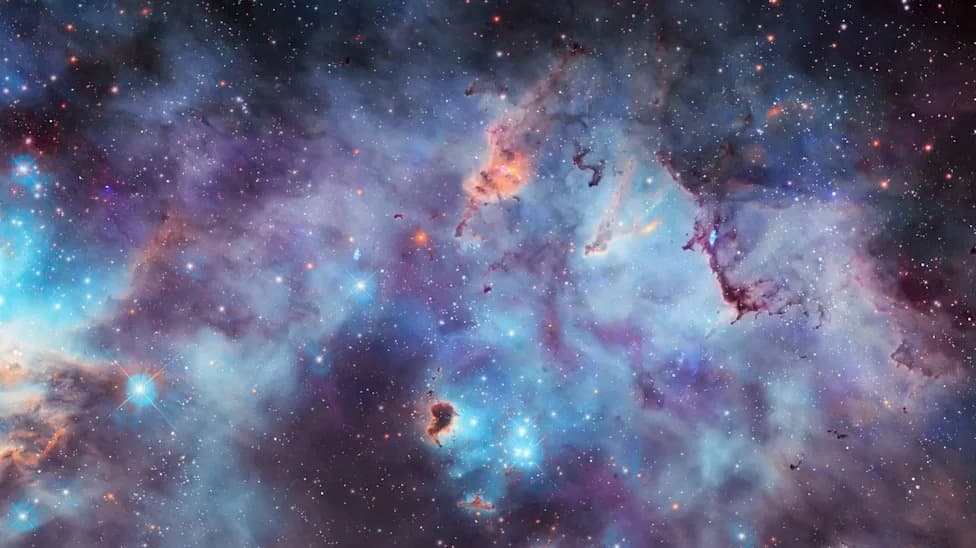
The Vela Supercluster — first detected in 2016 behind the Milky Way’s dusty disk — has now been mapped in much greater detail by an international team using SALT and the MeerKAT radio telescope. The researchers estimate Vela spans ~300 million light-years and has a mass of about 30 quadrillion suns. These results, reported in a paper pending peer review, help refine models of large-scale cosmic structure and motivate more sensitive future radio surveys.
Hidden Giant Revealed: Astronomers Map the Vela Supercluster Spanning ~300 Million Light-Years
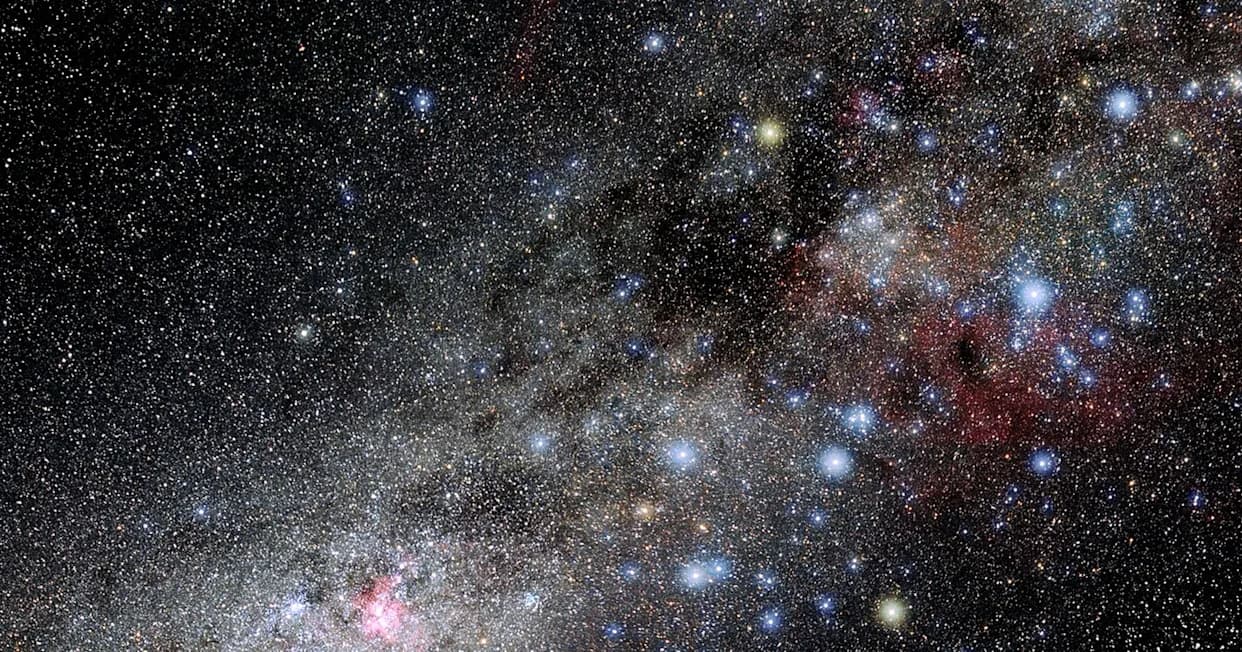
Researchers say it has mapped a supercluster of galaxies hiding behind the Milky Way ten years after it was first discovered.
In 2016 astronomers first identified a vast supercluster of galaxies in the constellation Vela that had been largely hidden behind the disk of our own Milky Way. Now, a decade later, an international team has produced the most detailed map yet of the Vela Supercluster, revealing it to be larger and more massive than earlier estimates.
What Is the Vela Supercluster?
The Vela Supercluster is a coherent large-scale structure made up of at least 20 galaxy clusters, each of which likely contains hundreds of thousands of galaxies. It lies roughly 800 million light-years from Earth inside the so-called "Zone of Avoidance," a region of the sky obscured by the Milky Way’s dense stars, gas, and dust that hides background objects from optical view.
New Map and Key Findings
In a paper that is yet to undergo peer review, the research team estimates the Vela Supercluster spans roughly 300 million light-years across — about 3,000 times the diameter of the Milky Way — and has a mass equivalent to approximately 30 quadrillion suns. Those figures suggest Vela is more massive than earlier assessments indicated and places it between known structures such as the Laniākea Supercluster (which contains the Milky Way) and far larger features like the Hercules–Corona Borealis Great Wall.
How Astronomers Peered Through the Milky Way
The team combined optical and radio observations from two South African facilities: the Southern African Large Telescope (SALT) and the MeerKAT radio telescope. SALT provided optical spectroscopy where possible, while MeerKAT detected 21-centimeter radio emission from neutral hydrogen — radio wavelengths that can pass through the Milky Way’s dusty disk and reveal galaxies otherwise hidden in the Zone of Avoidance.
"The millions and billions of stars in the disk are so dense and so close to the galactic plane that we cannot easily see through it," said coauthor Renee Kraan-Korteweg of the University of Cape Town. "Where we have stars, we also have lots of minuscule dust particles, and like the stars this dust layer gets thicker and thicker as you approach the plane."
Why This Matters
Mapping Vela more accurately improves our picture of the largest structures in the nearby universe and helps refine cosmological models that describe how matter is distributed on the largest scales. Better maps also inform studies of local flows of galaxies and how mass concentrations influence cosmic expansion measurements.
Looking Ahead
While the new map is a significant advance, the authors note that next-generation, more sensitive radio arrays and continued multiwavelength follow-up will produce higher-resolution maps of Vela and similar hidden structures. Those improvements will further refine estimates of mass, extent, and the supercluster's role in shaping the local cosmic environment.
For additional context, see coverage titled: "Meet Vela, the Huge Supercluster Just Detected by Astronomers."
Help us improve.