New research finds that the classic sideways gait of true crabs likely evolved once in a common ancestor about 200 million years ago. By observing locomotion in 50 species and mapping results onto a genetic family tree, investigators conclude the sideways walk was inherited rather than repeatedly reinvented. The trait may have provided a defensive advantage that helped Brachyura diversify into roughly 7,904 species. Authors note limitations (one individual per species, a 60° classification cutoff) and call for broader sampling, anatomical studies and fossil-informed analyses.
Study: Crabs' Iconic Sideways Scuttle Evolved Once — About 200 Million Years Ago
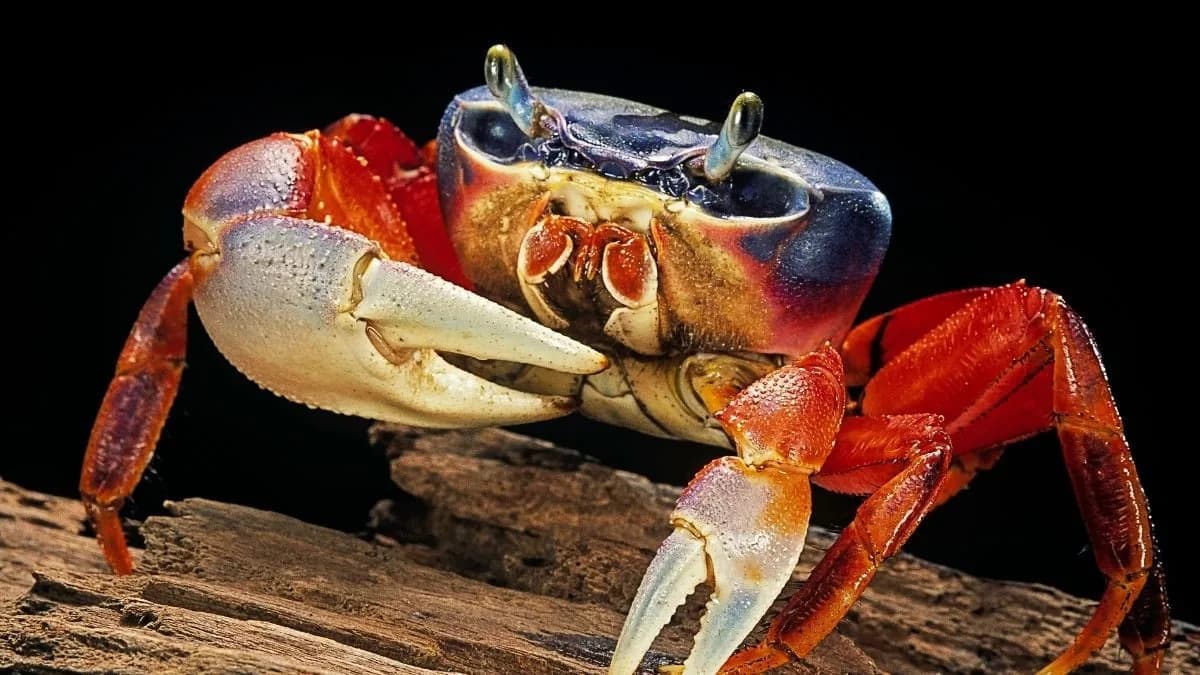
Only the truest of crabs move sideways. (Paul Starosta/Stone/Getty Images)
New research suggests the distinctive sideways gait of true crabs (Brachyura) evolved a single time in their evolutionary history, roughly 200 million years ago. The finding helps explain how crabs became ecologically successful and diversified into thousands of species worldwide.
Study and Methods
Behavioural ecologist Yuuki Kawabata of Nagasaki University and collaborators from Japan, Taiwan and the United States combined direct laboratory observations of crab locomotion with a recently compiled genetic phylogeny of true crabs. The team recorded walking behaviour for one individual from each of 50 species and classified locomotion as primarily sideways or primarily forward based on a 60° angular cutoff from the crab's bilateral axis.
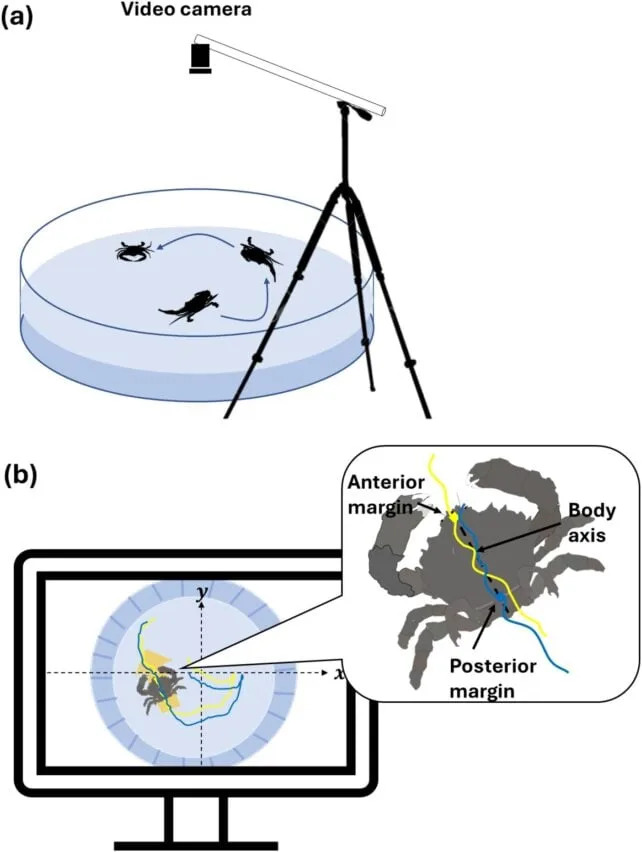
(a) Experimental setup used to record each crab's behavior. (b) Extraction of two-dimensional position coordinates from video frames. (Taniguchi et al.,eLife, 2026)
Key Findings
The experiments showed that 35 of the 50 species sampled were predominantly side-walkers and 15 were predominantly forward-walkers. When mapped onto the genetic tree, the data indicate that the archetypal sideways walk arose in a single common ancestor of true crabs and was then inherited by many descendant lineages. The authors estimate this locomotory innovation appeared roughly 200 million years ago, soon after the Triassic–Jurassic extinction, a period that expanded shallow marine habitats favored by crabs.
Importantly, the analysis suggests that forward-walking in some modern true-crab species is a secondary reversion from an ancestral sideways gait rather than a retained ancient trait.

Subscribe to ScienceAlert's free fact-checked newsletter
Why Sideways Walking Matters
The researchers propose that sideways locomotion could have provided a defensive advantage: it enables rapid lateral escapes from predominantly forward-moving predators (humans, seabirds, otters, octopuses and others). This behavioural innovation may have opened new ecological opportunities and contributed to the remarkable diversification of Brachyura, a group now numbering about 7,904 species occupying terrestrial, freshwater and deep-sea habitats.
Limitations and Future Directions
Peer reviewers and the authors note several important caveats. The behavioural trials used a single individual per species, which risks misrepresenting species-level tendencies if individuals are atypical. The choice of a fixed 60° cutoff to separate sideways from forward walking was used as a convention but may not capture biologically equivalent behaviours across diverse taxa. Reviewers also requested more anatomical detail to evaluate whether body-plan changes or locomotory shifts were primary drivers of crab diversification.
Kawabata and colleagues recommend follow-up work that samples multiple individuals per species, includes detailed morphological comparisons, applies trait-dependent diversification models with fossil-calibrated timelines, and conducts performance experiments directly linking sideways movement to survival or ecological performance.
Publication
The study is available as a peer-reviewed preprint in eLife.
Help us improve.