Mali is reeling after coordinated assaults on military installations over the weekend that killed Defence Minister Sadio Camara, his wife and two of their children, and left an uncertain number of additional victims. Intermittent explosions were still reported around Senou International Airport, south of the capital Bamako, late on Monday.
Authorities say at least 16 people were wounded in the offensives that began on Saturday, carried out jointly by Jama’at Nusrat al-Islam wal-Muslimin (JNIM) and fighters from the Azawad Liberation Front (FLA). Video footage circulating on social media showed large groups of armed men on motorcycles entering several cities with little visible resistance — including Kidal, Gao and Sevare in the north, as well as Kati and parts of Bamako.
What Is the FLA and What Does It Want?
The Azawad Liberation Front (FLA) is a Tuareg-led secessionist movement formed in November 2024 from components of earlier rebel groups. It is led by Alghabass Ag Intalla and is calling for self-determination and autonomy for northern Mali — the territory separatists call Azawad. The FLA traces its roots to decades of Tuareg rebellions and to the 2012 declaration of Azawad’s independence by the National Movement for the Liberation of Azawad (MNLA).
Historical Context
Tuareg and Arab communities in northern Mali have long-standing grievances over political marginalisation and economic neglect. Insurgencies date back to at least the 1960s, with major uprisings again in the 1990s and a dramatic resurgence in 2012 when the MNLA briefly seized large parts of the north.
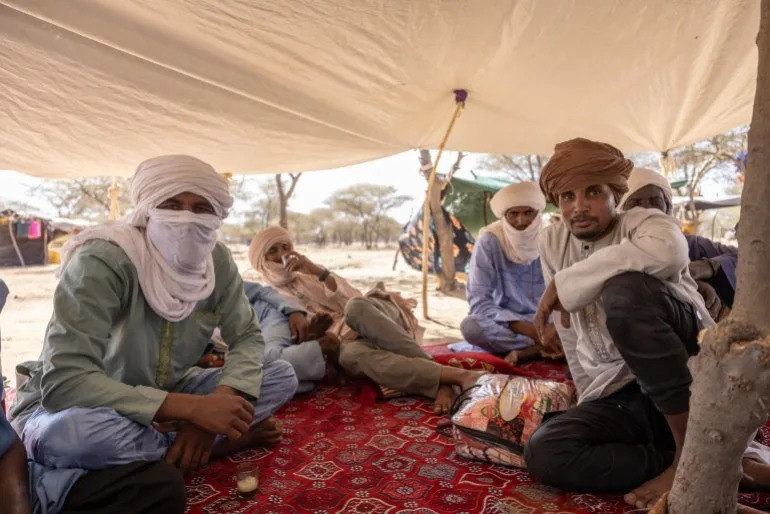
Men from northern Mali who fled attacks by the Malian army and the Russian paramilitary Africa Corps sit in a makeshift camp in Douankara, Mauritania, on November 8, 2025 [Caitlin Kelly/AP]
Initial cooperation between the secular MNLA and the Islamist group Ansar Dine fractured in 2012 as Islamist factions, some affiliated with al‑Qaeda in the Islamic Maghreb (AQIM), sought to impose strict religious rule. France deployed roughly 4,000 troops in 2013 at Bamako’s request, and the Algiers Accords of 2015 aimed to provide greater autonomy for the north and integrate former combatants. A UN peacekeeping mission of about 11,000 personnel was also deployed.
Rise of JNIM and Shifting Alliances
In 2017, four al‑Qaeda‑aligned groups — Ansar Dine, AQIM, Katiba Macina and al‑Mourabitoun — merged to form Jama’at Nusrat al-Islam wal-Muslimin (JNIM), led by Iyad Ag Ghaly. JNIM operates across border regions of Mali, Niger and Burkina Faso and is estimated to draw thousands of fighters.
Political changes in Bamako — including a military coup in 2020, withdrawal of French forces, and the arrival of Russian mercenaries linked to the Wagner Group from 2021 — reshaped the security landscape. In 2023 Mali requested UN peacekeepers leave, citing failure to restore stability; by then some 310 peacekeepers had been killed during the broader crisis.
Why Are the FLA and JNIM Working Together?
Although Tuareg separatists historically sought to avoid formal ties with Islamist groups after 2012, growing pressure, shared grievances and overlapping recruitment pools in northern communities have pushed them toward pragmatic cooperation. Analysts say the FLA’s alliance with JNIM is a tactical move: the FLA lacks the manpower and reach to confront the Malian armed forces alone, and JNIM benefits politically from softening some of its strict rhetoric to focus on military and governance grievances.
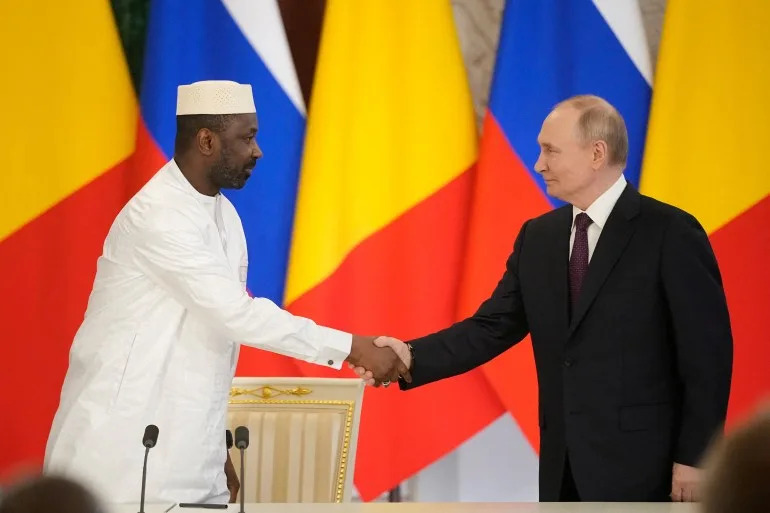
Malian President Assimi Goita, seen here meeting with Russian President Vladimir Putin at the Kremlin in June 2025, has not been seen since last weekend’s attacks [File: Pavel Bednyakov/Reuters]
"FLA cannot defeat the Malian army alone," said Beverly Ochieng, a West Africa analyst at Control Risks, describing the alliance as tactically advantageous for both actors.
Recent Developments and Regional Implications
Last weekend’s offensive appears to be the first confirmed, coordinated campaign between JNIM and the FLA. Reports say FLA fighters now claim control of Kidal, a Tuareg stronghold, while JNIM says it shares control of Kidal and parts of Mopti. Video posted online purportedly shows FLA fighters disarming Malian soldiers in Kidal.
Russia’s role remains consequential: Russian-linked fighters were reportedly allowed to withdraw from Kidal after negotiations brokered by Algeria, and JNIM said it seeks a "balanced future relationship" with Moscow. Observers caution that while outside powers such as Russia may pursue pragmatic relations with whoever controls territory, JNIM lacks broad political legitimacy to govern in Bamako or the south.
Regional Tensions and Uncertain Outcomes
The assault has intensified regional friction. Mali has accused Algeria and Mauritania of sheltering rebels — charges both countries deny — and repeatedly blamed France for allegedly supporting rebel leaders abroad. The violence has displaced thousands and exacerbated humanitarian pressures, notably in Mauritania, which hosts hundreds of thousands of Malian refugees.
President Assimi Goita, the head of Mali’s military government, has not been seen publicly since the weekend attacks; his whereabouts and status remain unclear. The evolving FLA–JNIM alignment raises urgent questions about whether the north will move toward separatist control, greater Islamist influence, or provoke a harsher military response from Bamako and its international backers.
The crisis remains fluid. The coming weeks will be critical in determining whether the alliance consolidates territorial control, fractures under competing agendas, or triggers intensified external intervention.