University of Melbourne researchers traced how the Twelve Apostles formed: sedimentary rocks deposited in the Miocene were later folded, tilted and faulted by tectonic compression (from ~12 Ma), then sculpted into stacks by wave erosion after the Last Glacial Maximum. The study narrows limestone ages to 8.6–14 million years, maps >40 km of cliffs, and highlights the fragile, short-lived nature of the stacks—only eight remain today. These layers preserve evidence of a warmer interval ~13.8 Ma and serve as a valuable archive for past climate and sea-level change.
How the Twelve Apostles Formed: New Study Revises Their Age and Geological History
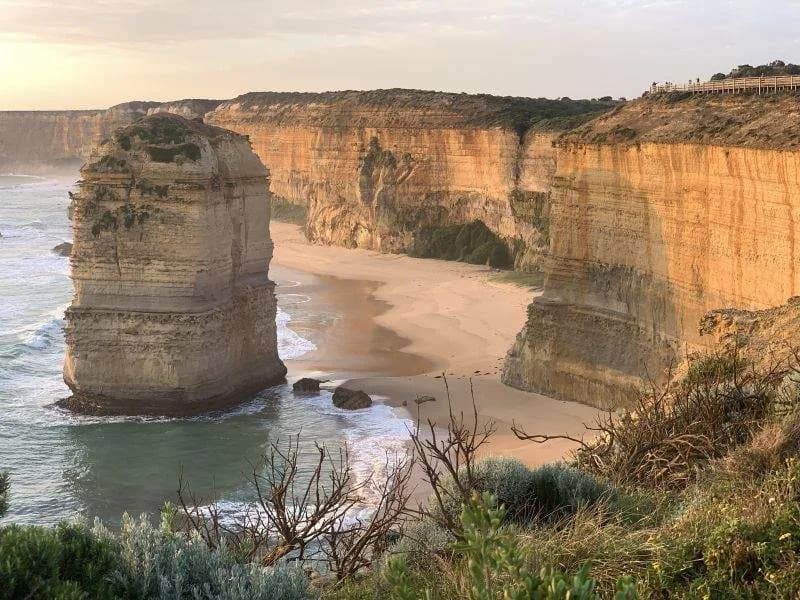
One of the Twelve Apostle sea stacks. (CREDIT: Stephen Gallagher)
The iconic Twelve Apostles along Victoria’s Great Ocean Road are more than postcard scenery: they preserve a deep geological story that spans millions of years. New research led by the University of Melbourne, published in the Australian Journal of Earth Sciences, traces how the limestone beds were deposited, tilted by tectonics and finally sculpted by the sea into the stacks visitors see today.
New Timeline and Age Revision
The team narrowed the age of the limestone using foraminiferal biostratigraphy, revising earlier broad estimates (7–15 million years) to a tighter range of about 8.6–14 million years. Different units record changing marine environments through the middle to late Miocene, including a warmer interval around 13.8 million years ago.
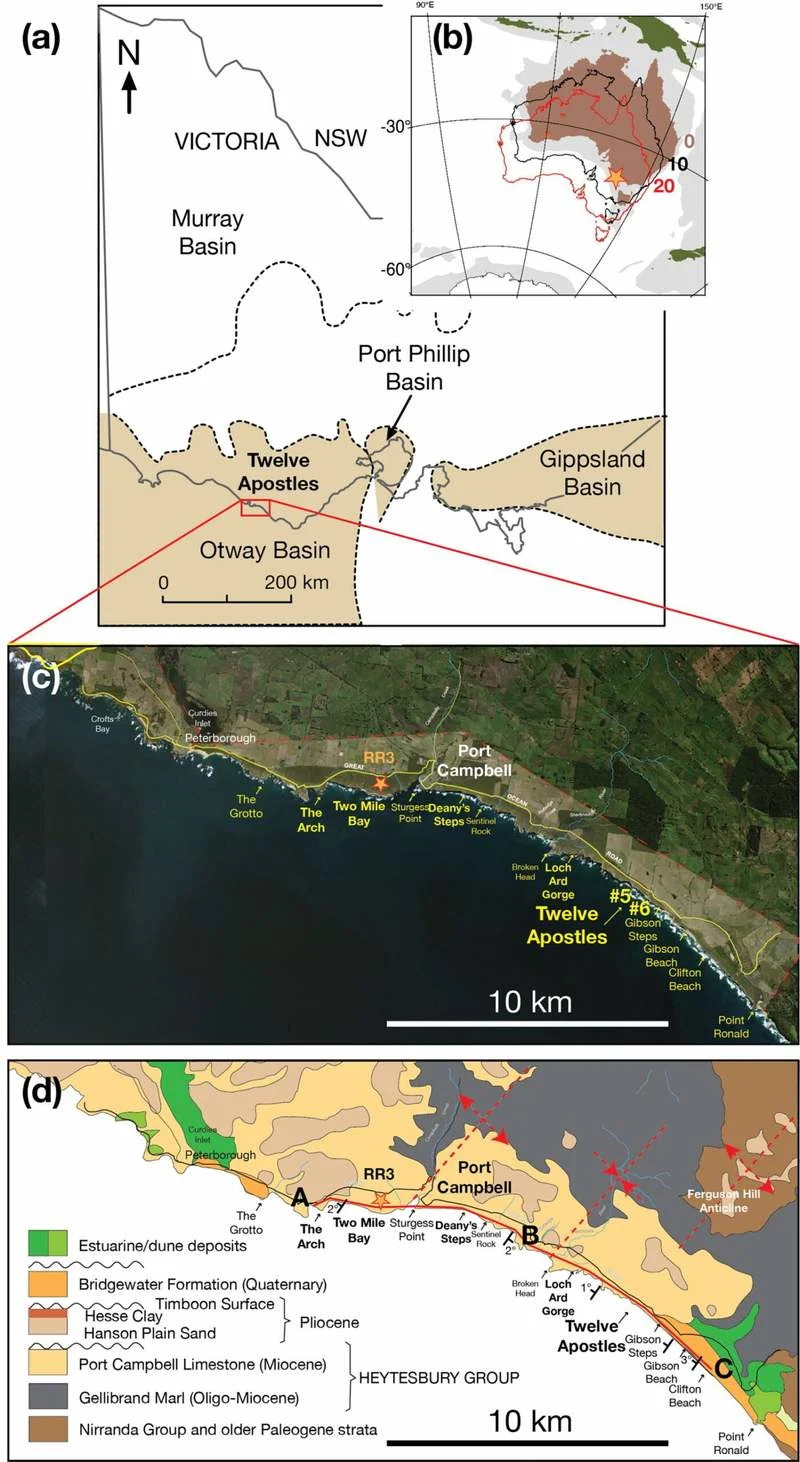
This four-panel figure (a-d) details the Twelve Apostles region, Victoria, Australia, from regional context to local geology. (CREDIT: Australian Journal of Earth Sciences)
How the Rocks Formed
Deposition began with the deeper-water Gellibrand Marl during the middle Miocene (parts younger than 14.1 Ma), followed by the overlying Port Campbell Limestone deposited in shallower shelf settings. The lower grey limestone shows evidence of sea-level changes and soft-sediment slumping; higher yellow limestone accumulated in inner-shelf conditions and persisted until at least 8.6 Ma.
Tectonic Uplift, Tilting and Faulting
From roughly 12 million years ago, a shift in the Australian Plate produced northwest–southeast compression in the Otway region. That compression folded strata into broad anticlines and synclines and produced minor reverse faults. Beds now commonly dip about 1–5°, with a seaward tilt east of Two Mile Bay of roughly 1–2°. As Associate Professor Stephen Gallagher notes, these small tilts and faults are visible in the cliffs and record ancient tectonic movement.
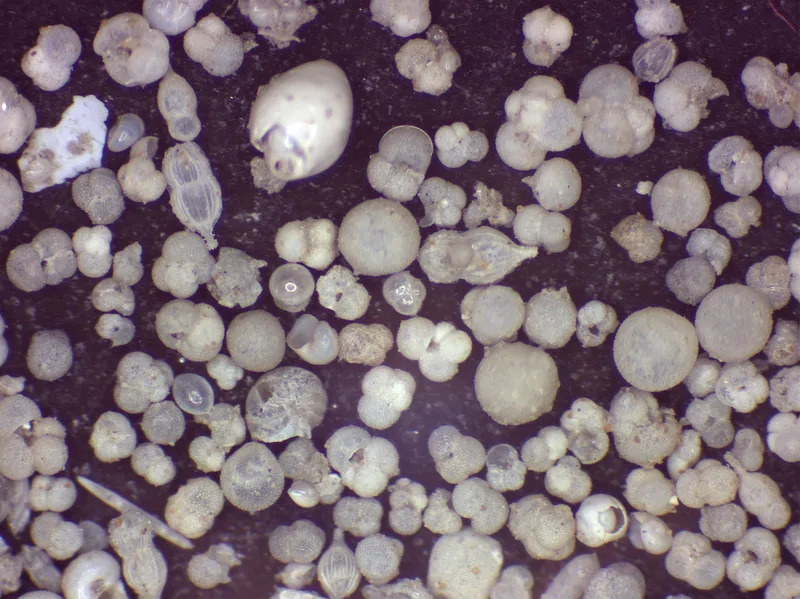
Microfossils from within layers of Twelve Apostles. (CREDIT: Stephen Gallagher, University of Melbourne)
Recent Coastal Sculpting: Sea Stacks Are Young
Although the rocks are millions of years old, the dramatic cliffs, arches and stacks are geologically recent. Following the Last Glacial Maximum (about 23,000–20,000 years ago), a global sea-level rise of roughly 125 metres established the modern shoreline. Over the last several thousand years, wave erosion undercut headlands in brittle Port Campbell Limestone, creating arches that later collapsed to leave sea stacks. Today, only eight stacks remain in the area commonly called the Twelve Apostles.
Why These Formations Are Vulnerable
The study emphasizes the limestone’s brittleness and inherited weaknesses (tilts, bedding planes and fault lines), explaining why stacks continue to collapse and the coastline keeps changing. These structural features also control erosion patterns today.
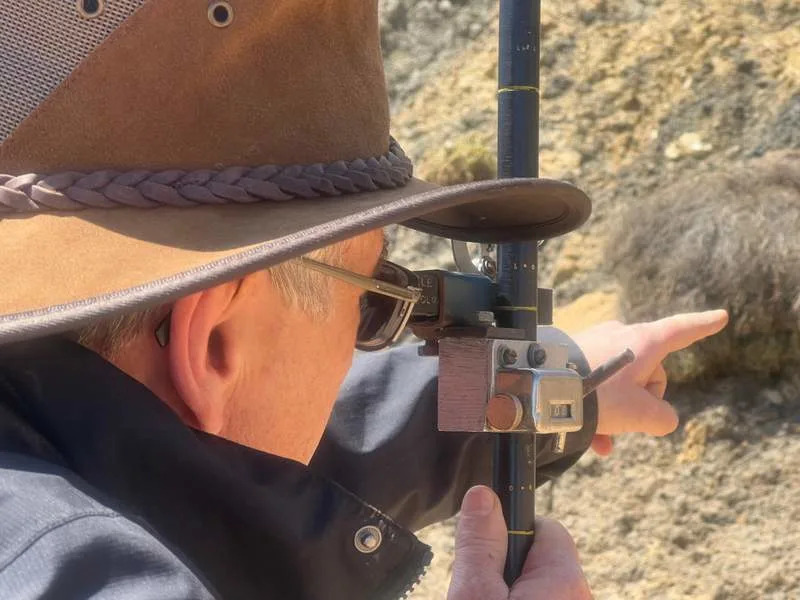
Associate Professor Stephen Gallagher uses a Jacob’s staff to measure the rock layers. (CREDIT: Mark Cuthell)
How the Researchers Reconstructed the History
The team combined detailed field mapping and stratigraphic logging with carbonate analyses, natural gamma logs, archival photography, 3D photomesh imagery from the Great Ocean Road project and foraminiferal biostratigraphy. They mapped more than 40 km of near-continuous sea cliffs across the Port Campbell Embayment and correlated local outcrops (Gibson Steps, Gibson Beach, Deany’s Steps, Two Mile Bay, The Arch and Loch Ard Gorge) to build a regional cross-section.
Open Questions and Next Steps
The paper notes remaining uncertainties: estimating the strike of beds remains challenging, some engineering bore cores were not fully available (only five samples retained), and more microfossil and sediment analyses are needed to test whether cyclic bedding relates to orbital (Milankovitch) cycles. The team is already examining individual beds to reconstruct past climates, ocean conditions and sea levels and to link those findings to modern coastal erosion.
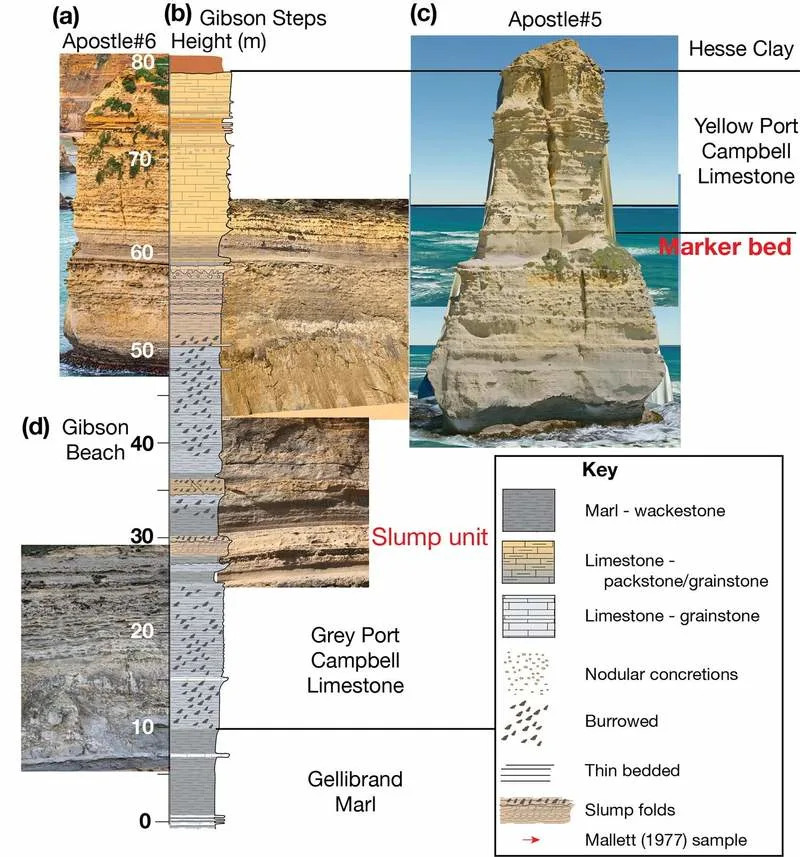
This multi-panel figure illustrates geological formations through photographs and stratigraphic columns, accompanied by a key. (CREDIT: Australian Journal of Earth Sciences)
Why This Matters
“We are using this ‘window back in time’ to understand where temperatures and sea levels may be heading on our current path of climate change,”
— Associate Professor Stephen Gallagher. Because the limestone records a warmer period around 13.8 Ma, it offers a natural laboratory for studying how oceans and shorelines respond to warmer conditions—insights that can inform models of future change.
The full research article is available online in the Australian Journal of Earth Sciences. The reporting version of this story appeared in The Brighter Side of News.
Help us improve.