Researchers have produced the most detailed map yet of the Vela Supercluster, a vast structure hidden behind the Milky Way’s "Zone of Avoidance." By combining about 65,000 existing distance measurements with 8,000 new redshifts — including ~2,000 from South Africa’s MeerKAT telescope — they find Vela spans roughly 300 million light-years and contains mass equivalent to ~30 quadrillion suns. The supercluster comprises at least 20 galaxy clusters and features two massive cores that are converging, making Vela one of the most massive nearby structures. The team nicknamed it Vela-Banzi ("revealing widely" in Xhosa) and expects future radio surveys to refine the map further.
Astronomers Map the Hidden Vela Supercluster — A Giant Structure Revealed Behind the Milky Way
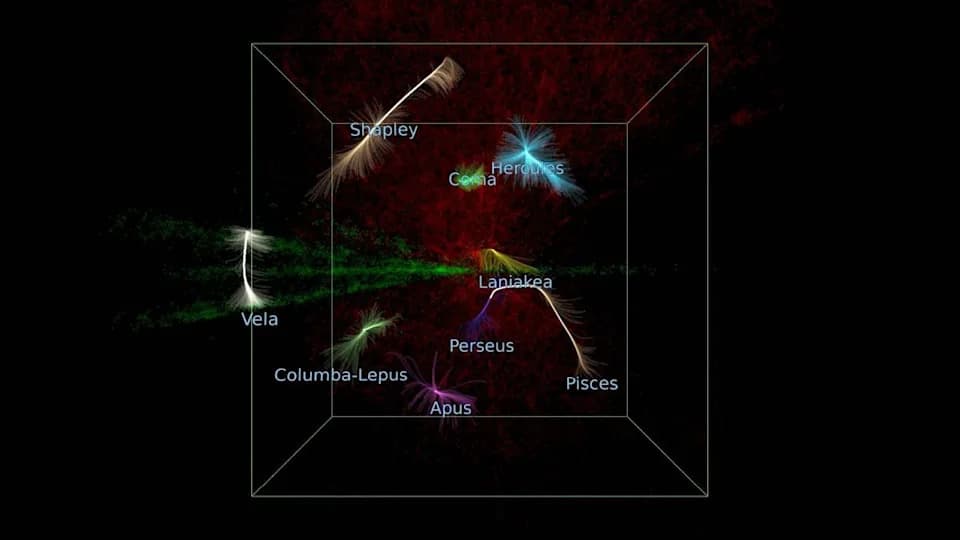
A map showing the relative sizes of galaxy superclusters in the universe. Vela, recently mapped for the first time, is at the far left. | Credit: Jérôme Léca, RSA Cosmos
A team of astronomers has produced the most detailed map yet of the Vela Supercluster, a vast collection of galaxy clusters long concealed behind the Milky Way’s dense disk in the so-called "Zone of Avoidance." First identified in 2016 and informally called Terra incognita, new observations now show the structure to be far larger and more massive than initially thought.
Key findings: The Vela Supercluster spans roughly 300 million light-years across, contains mass equivalent to about 30 quadrillion suns, and includes at least 20 galaxy clusters. Most of its mass is concentrated in two cores that appear to be converging toward one another, making Vela one of the most massive nearby structures — more massive than the Laniakea supercluster that contains the Milky Way and a close second to the Shapley Supercluster.
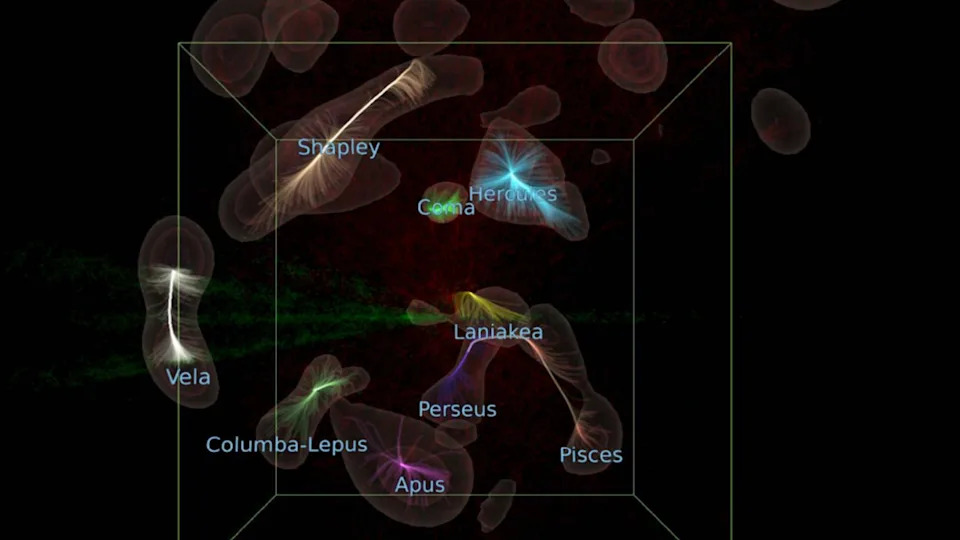
A 3D illustration showing the size of the Vela Supercluster compared to other galaxy clusters | Credit: Dr Jérôme Léca/RSA Cosmos/SARAO
How the Team Revealed What Hides Behind the Milky Way
Because Vela sits about 800 million light-years away behind the Milky Way’s crowded disk, optical observations alone struggle to see it. To penetrate this obscuring veil, the researchers combined roughly 65,000 previously published galaxy distance measurements with about 8,000 new redshift observations. Crucially, nearly 2,000 of those new redshifts came from South Africa’s MeerKAT radio telescope, which detects emission from large clouds of hydrogen gas inside galaxies. These radio measurements allowed direct mapping of galaxy motions in regions that are effectively invisible in optical light.
What This Map Shows
The resulting velocity and position data trace a coherent, large-scale structure roughly 300 million light-years across — approximately 3,000 times the Milky Way’s diameter. The team estimates the total mass in the structure is equivalent to on the order of 3 × 10¹⁶ solar masses (about 30 quadrillion suns). The distribution of that mass into two sizeable, converging cores hints at a dynamic environment and helps explain peculiar motions of nearby galaxies.
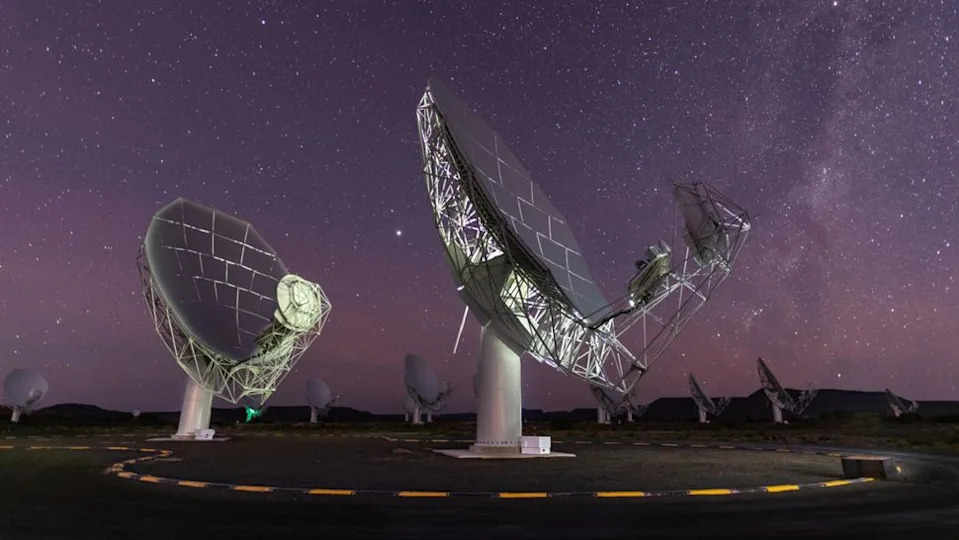
South Africa's MeerKAT telescope is made up of an array of 64 radio dishes and was able to spot clouds of hydrogen within galaxies obscured by the Milky Way. | Credit: SARAO/MeerKAT
“To understand the one, we need to know the other,” said study co-author Renee Kraan-Korteweg of the University of Cape Town, referring to the need to measure both size and velocity when testing cosmological models. “If we have both, we will be able to check if we can reconcile these observations with the models of the universe.”
A New Name: Vela-Banzi
The team has adopted the local nickname Vela-Banzi, meaning “revealing widely” in Xhosa, in recognition of the South African facilities and researchers pivotal to the new map. While future, more powerful radio telescopes should refine the picture, the authors note that parts of the supercluster may remain partly obscured because not every galaxy contains the large reservoirs of hydrogen that radio telescopes detect.
Why This Matters
Better maps of the largest cosmic structures help astronomers confirm or challenge cosmological models and improve our understanding of how matter is distributed on the grandest scales. Establishing both the size and motion of massive structures like Vela-Banzi is an important step in explaining the motions of galaxies across our local universe and tracking the growth of structure since the Big Bang.
Study status: The analysis was uploaded to the preprint server arXiv on March 10. Further observations and deeper radio surveys are expected to refine the map in coming years.
Help us improve.