The EMBERS I survey carried out a uniform census of atomic and molecular gas in post-starburst galaxies to probe why some systems abruptly stop forming stars. Using FAST for atomic hydrogen and 188.9 hours on the IRAM 30-metre telescope to trace CO, researchers studied 114 candidates and obtained CO data for 61 galaxies (52 new, 9 archival). On average, post-starbursts contain ~0.3–0.6× the molecular gas of similar star-forming galaxies, indicating fuel exhaustion often drives rapid quenching, though gas fractions vary widely (~2%–250%), implying multiple shutdown pathways and possible rejuvenation for some systems.
When Galaxies Stop the Party: EMBERS I Reveals Why Starbursts Suddenly Quit
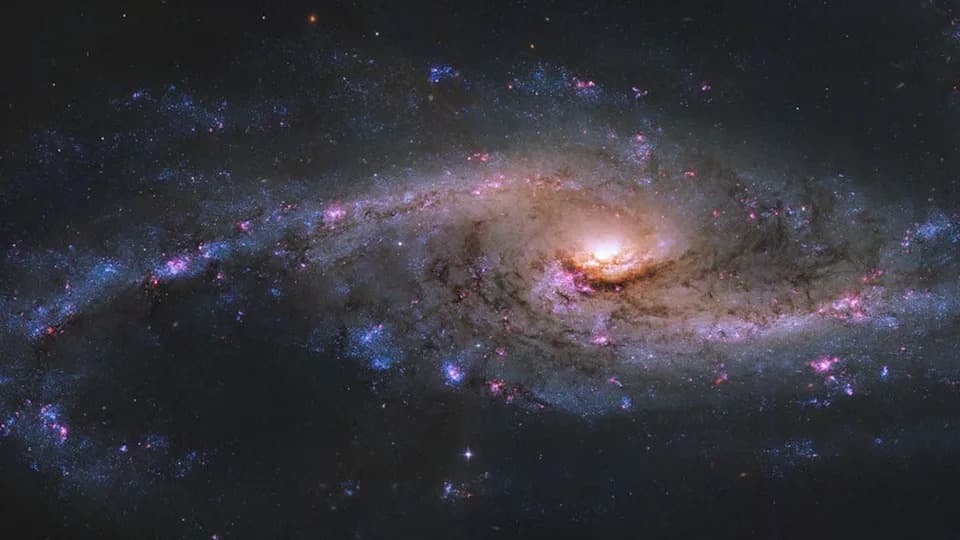
The starburst galaxy NGC 4536, seen here in a photo by the Hubble Space Telescope, has bright blue clusters of baby stars and pink clumps of ionized hydrogen gas speckled throughout its sweeping spiral arms. . | Credit: NASA, ESA, and J. Lee (Space Telescope Science Institute); Processing: Gladys Kober (NASA/Catholic University of America)
A galaxy’s death is rarely a gentle fade. Some galaxies that recently experienced intense bursts of star formation instead undergo a sudden shutdown — a process astronomers call rapid quenching. These “post-starburst” galaxies show clear evidence of a recent stellar party but now form almost no new stars, leaving researchers to ask: how does such an abrupt transition happen?
The Challenge
Post-starburst galaxies are rare (well under 1% of all galaxies), making them difficult to study in large, consistent samples. Early optical-selection methods — looking for strong absorption lines from A-type stars combined with weak emission lines — sometimes missed true post-starbursts or misidentified dusty, still-star-forming systems. Past studies also used varied selection rules, instruments with different sensitivities, and small, heterogeneous samples, producing conflicting conclusions about whether these galaxies lost their cold gas or simply failed to convert it into stars.
The EMBERS I Survey: A Uniform Look at Cold Gas
To resolve these issues, the EMBERS I team, led by Ben F. Rasmussen (University of Victoria) with collaborators at institutions including the Space Telescope Science Institute and the University of St. Andrews, performed a uniform census of cold gas in a large, well-selected sample of post-starburst galaxies.
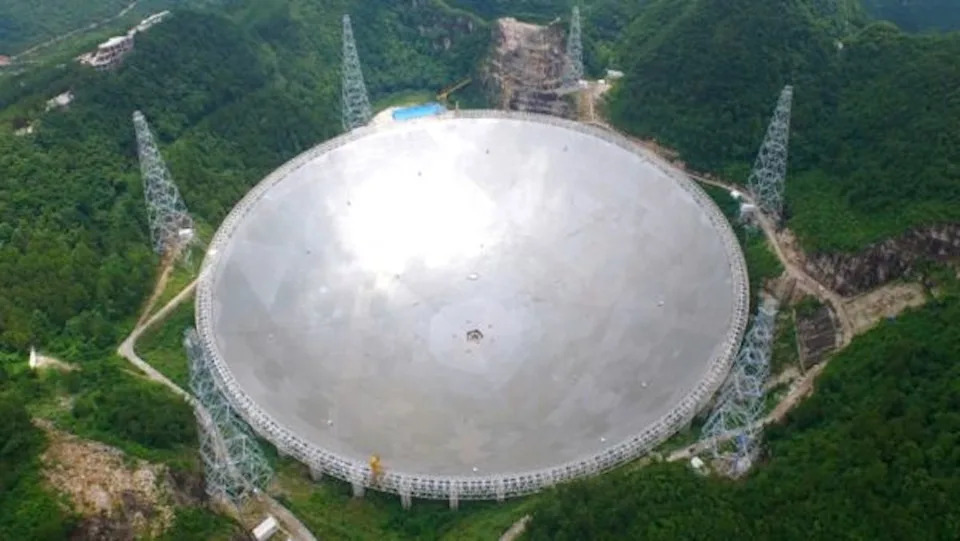
The Five-hundred-metre Aperture Spherical radio Telescope (FAST), in southwest China's Guizhou Province. | Credit: NAO/FAST
The team started from 114 candidate galaxies drawn from the Sloan Digital Sky Survey (selected by stellar mass and distance). They probed atomic hydrogen (the diffuse reservoir) using China’s Five-hundred-metre Aperture Spherical Telescope (FAST) and traced molecular hydrogen — the immediate raw material for stars — via carbon monoxide (CO) emission with the IRAM 30-metre telescope. Rasmussen and colleagues devoted 188.9 hours across four observing proposals on the IRAM 30-metre telescope, collecting 52 new CO observations and combining them with nine archival measurements for a CO sample of 61 galaxies.
Key Findings
- On average, post-starburst galaxies are depleted in molecular gas relative to star-forming galaxies of the same stellar mass: they host roughly 0.3–0.6× the molecular gas mass of active counterparts. This points to fuel exhaustion as a common driver of rapid quenching.
- However, there is substantial diversity. Among CO-detected systems, molecular gas fractions range from ~2% up to ~250% of the stellar mass in extreme cases, showing that many post-starbursts retain significant cold gas.
- These results imply multiple quenching pathways: some galaxies appear to have lost or removed their gas (permanent shutdown), while others retain fuel that could enable future rejuvenation if conditions allow the gas to re-collapse into stars.
What This Means
EMBERS I provides a clearer, statistically consistent picture of the cold-gas content of post-starburst galaxies. While fuel exhaustion is a key mechanism in many cases, the wide spread in molecular gas fractions demonstrates that rapid quenching is not a single, universal process. Future work that combines kinematics, environment, and AGN activity will help determine why some galaxies permanently shut down while others may reignite.
Bottom line: Many post-starbursts stop forming stars because their molecular gas supply is reduced, but a significant minority keep enough cold gas that their shutdown may be temporary.
Help us improve.