
JWST has captured new high-resolution images of the planetary nebula Tc 1, about 10,000 light-years away in Ara, showing hot and cool gas layers, a central white dwarf, and an unexplained upside-down question-mark structure. The data clearly map buckyballs (C60) concentrated in a roughly spherical shell around the star. Using JWST's imaging and integral-field spectroscopy, researchers can now connect the nebula's visible structures directly to their underlying chemistry and physics, shedding light on how dying stars seed the cosmos with complex molecules.
JWST Reveals Buckyballs and an Upside‑Down Question‑Mark in Planetary Nebula Tc 1
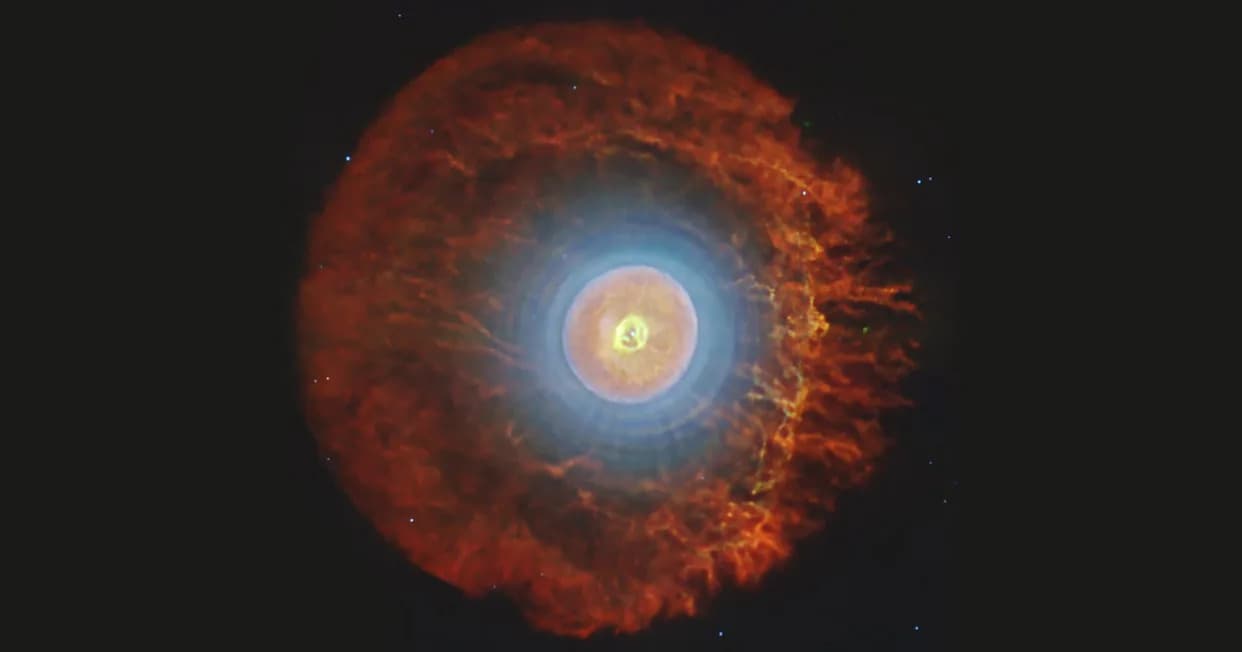
An image shows planetary nebula Tc 1 as observed by the James Webb Space Telescope’s Mid-Infrared Instrument (MIRI), combining nine filters spanning wavelengths from 5.6 to 25.5 microns, well beyond what the human eye can detect. Blue tones represent hotter gas at shorter mid-infrared wavelengths; red tones trace cooler material at longer wavelengths. The image was processed by Katelyn Beecroft using PixInsight.(NASA/ESA/CSA/Western University/J. Cami)
New observations from the James Webb Space Telescope (JWST) have produced striking, high-resolution images of the planetary nebula Tc 1, revealing an unexpected large-scale feature and a clear map of complex carbon molecules known as buckyballs (C60).
Tc 1 lies roughly 10,000 light-years away in the constellation Ara. The JWST imagery maps hotter gas in blue and relatively cooler gas in red, and it shows a bright white dwarf at the nebula's center — the compact remnant of the star that shed the nebula. Around that core the telescope reveals a curious, upside-down question-mark–shaped structure whose origin remains unexplained.
“Tc 1 was already extraordinary, as it was the object that told us buckyballs exist in space, but this new image shows us we had only scratched the surface,” said Jan Cami, principal investigator of the JWST program studying Tc 1 and lead author of the 2010 study that reported the first astronomical detection of buckyballs. “The structures we’re seeing now are breathtaking, and they raise as many questions as they answer.”
Planetary nebulae are shells of gas and dust blown off by stars in the final stages of their evolution; their progenitors typically range from about 0.8 to eight times the mass of the Sun. Although the name can be misleading, these objects are not related to planets — early observers used the term because some nebulae looked planet-like through modest telescopes.
“As beautiful as this image is, for me it is first and foremost a dataset,” said Charmi Bhatt, a Ph.D. candidate at Western University in Ontario who contributed to the new analysis. “The sharpness and sensitivity of JWST are unlike anything I have worked with before. Structures that were completely invisible to us are now laid out with stunning clarity: the shells, the rays, the fine details in the outer halo. And crucially, through the integral field unit spectroscopy, we can now connect everything we see morphologically in the image directly to the chemistry and physics happening throughout the nebula.”
In the JWST data, buckyballs (molecules made of 60 carbon atoms arranged like a soccer ball) stand out clearly. They are concentrated in an approximately spherical shell around the central white dwarf. Mapping the spatial distribution of C60 and related molecules helps researchers probe how such complex carbon species form in stellar ejecta and how they survive to seed interstellar space.
“We painstakingly measured the properties of the buckyballs throughout our dataset and then put together a map of where they all are,” said Morgan Giese, another Ph.D. candidate at Western who led the analysis. “Funnily enough, these microscopic hollow spheres are actually distributed in the shape of a hollow sphere as well. Buckyballs arranged like one giant buckyball. We’re still working on why they’re located here, but it’s really fun to see all these small things pop up in our data.”
These JWST observations mark an advance in linking visible structure to chemistry and physics: the telescope’s imaging and integral-field spectroscopy let scientists trace emission lines and molecular signatures across the nebula. That capability should clarify how dying stars contribute complex molecules to the galaxy and refine models of molecule formation and survival in harsh space environments.
Help us improve.





















