The University of Oslo used 400 million years of plate and seafloor reconstructions to show continents act like thermal blankets while seafloor and overlying oceans let heat escape. Their model — built on a half-degree global grid — finds the Pacific hemisphere has cooled by about 50 Kelvin more than the African hemisphere. The results reveal a long-term thermal asymmetry that helps explain present-day differences in tectonic activity.
One Side of Earth Is Cooling Faster — Pacific Interior Has Lost About 50 K More Heat, Study Finds

Why One Side of Earth Is Rapidly Getting Colderaleksandarstudio - Getty Images
Researchers at the University of Oslo report that one hemisphere of Earth’s deep interior has been losing heat substantially faster than the opposite side — and the pattern stretches back hundreds of millions of years.
What the Study Did
The team published their results in Geophysical Research Letters after building a global, half-degree grid and combining multiple reconstructions of seafloor age and continental positions over the last 400 million years. They divided the planet into a Pacific hemisphere and an African hemisphere and estimated the long-term heat content and cooling rate of every grid cell. Their calculations show the Pacific hemisphere has cooled far more rapidly than the African hemisphere.
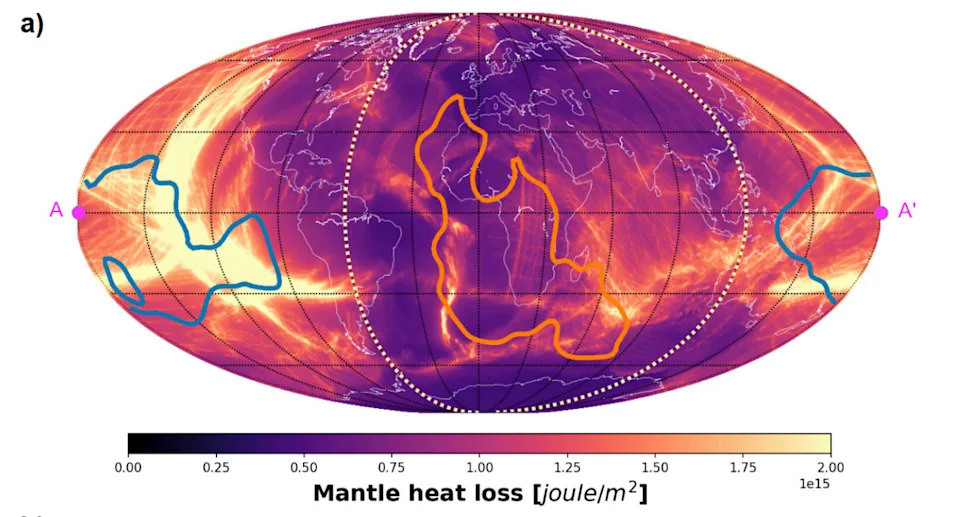
Accumulated mantle heat loss (oceanic + continental) over the past 400 Myrs. Regions above the Pacific and African large low shear velocity provinces are shown using blue and orange lines. Dashed, light-colored meridians indicate the separation of the Pacificand African hemispheres.Karlsen, et. al./Geophysical Research Letters
Why Continents Change Heat Loss
Earth’s interior is hot and slowly convecting; that convective motion helps drive plate tectonics and — through motion of the electrically conducting outer core — sustains the planet’s magnetic field. Gravity, by contrast, arises from mass rather than rotation. The key finding here relates to insulation: thick continental crust traps internal heat much more effectively than thin oceanic lithosphere. Exposed seafloor sits beneath vast volumes of cold ocean water that rapidly quench heat rising from below, so ocean-dominated hemispheres shed interior heat more efficiently.
Main Findings and Paradox
Using the extended 400-million-year window (previous work had reached ~230 million years), the researchers estimate the Pacific hemisphere has cooled by roughly 50 Kelvin more than the African hemisphere. At the same time, the Pacific has exhibited consistently higher plate velocities over that interval — a paradox because faster plate motion is usually associated with a hotter, more vigorously convecting mantle. This suggests either the Pacific mantle was much hotter at certain times, continental configurations changed the insulation pattern, or other processes (such as mantle plumes and variable heat production) contributed to the observed differences.
Why It Matters
The result reveals that Earth’s thermal evolution is not globally uniform: the arrangement of continents over geological time creates long-lived hemispheric differences in how interior heat escapes. Those thermal asymmetries can influence tectonic activity, volcanic behavior, and mantle dynamics on multi‑hundred‑million‑year timescales.
Bottom line: Continental “blankets” and vast oceans have left a lasting imprint on how heat leaves Earth’s interior, producing a measurable thermal imbalance between the Pacific and African hemispheres.
Help us improve.