Analyses of Hayabusa2 samples reveal a 10-nanometer sodium layer and other micro-scale features on Ryugu's surface consistent with a micrometeorite bombardment. Based on sodium abundance and lab depletion rates, researchers estimate Ryugu traversed a dense micrometeorite swarm about 1,000 years ago — very recent compared with the asteroid's 4.6-billion-year age. Additional evidence includes glassy impact deposits, microcraters and solar-wind-induced microstructures, and the team plans lab experiments to reproduce these chemical changes.
Ryugu’s Surface Shows Signs of a Micrometeorite Swarm About 1,000 Years Ago
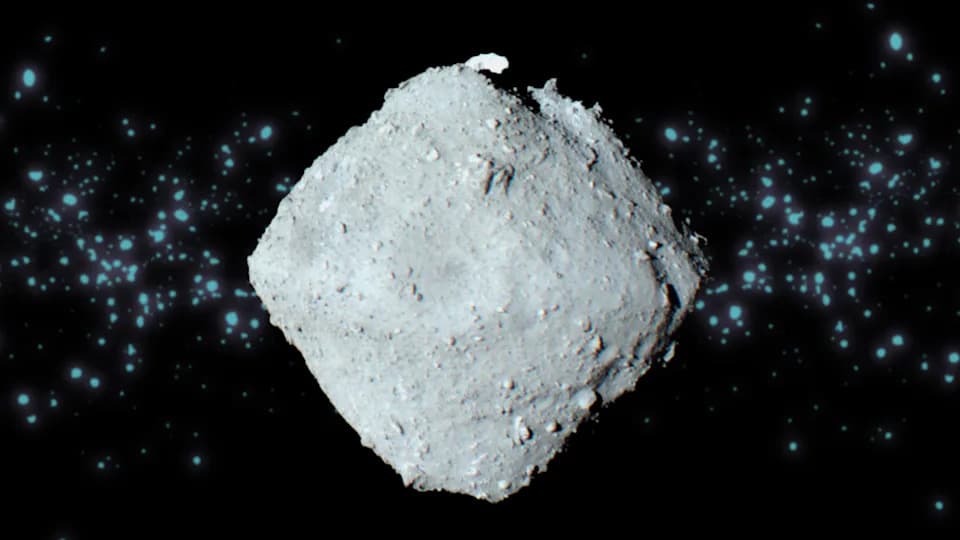
An illustration shows the asteroid Ryugu passing through a swarm of micrometeorites. | Credit: Jaxa, UTokyo & collaborators/Robert Lea
In 2020, Japan’s Hayabusa2 mission returned material from the near-Earth asteroid Ryugu. New laboratory analyses of two millimetre-thin fragments reveal that parts of Ryugu's surface carry an unusually thin layer of sodium and other features consistent with a relatively recent micrometeorite bombardment.
Key Findings
Researchers identified a roughly 10-nanometer-thick sodium coating on the outermost layers of some fragments. Volatile elements such as sodium can be exposed by high-speed micrometeorite impacts, but they are normally removed over time by the solar wind and other space-weathering processes.
Using the measured sodium abundance and laboratory data on depletion rates, the team estimates Ryugu passed through a dense cloud of micrometeorites about 1,000 years ago — a strikingly recent event given Ryugu's 4.6-billion-year age.
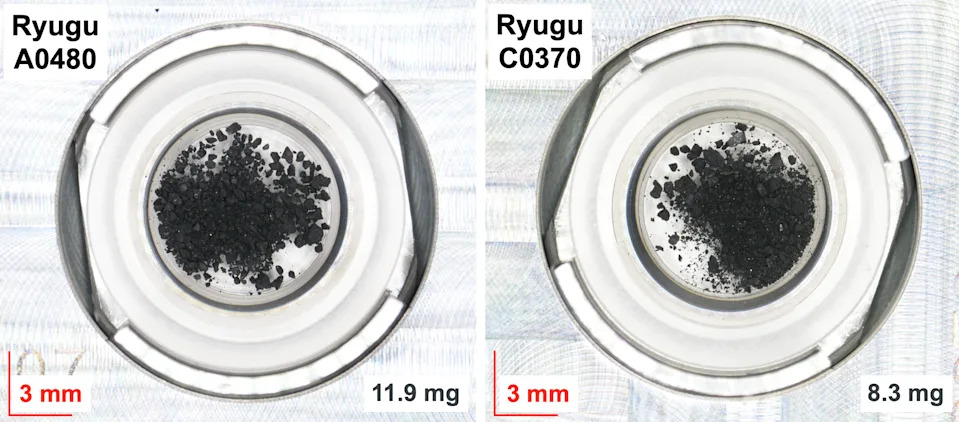
Samples of asteroid Ryugu brought back to Earth. | Credit: JAXA/JAMSTEC
Lead researcher Ernesto Palomba (Italian National Institute for Astrophysics, INAF) said the team used techniques capable of studying morphology and chemistry at scales of billionths of a meter to detect these changes. He added that experiments show sodium can be depleted by up to 50% on timescales of a few hundred years, supporting a conservative maximum window of about 1,000 years for the observed sodium accumulation.
Supporting Evidence
The analyses also revealed additional signs of space-weathering and microimpacts: tiny glassy deposits formed by high-speed impacts, microcrater-like features, and lattice-pattern microstructures produced by ongoing interaction with the solar wind. Particles that were exposed on the surface show iron enrichment consistent with solar-wind implantation and continuous microimpacts, while subsurface material remains less altered.
Why It Matters
These results show that near-Earth asteroids can have their surface chemistry and microstructure altered by relatively recent encounters with swarms of meteoroids. On Earth, our atmosphere largely shields us from such direct effects, producing spectacular meteor showers instead; airless bodies like Ryugu experience permanent surface changes.
The researchers plan targeted laboratory experiments on the specific chemicals identified in Ryugu material to reproduce and better understand the surface-chemistry changes observed in the samples. The study was published on April 16 in The Astrophysical Journal Letters.
Help us improve.