
JWST's mid-infrared images of the planetary nebula Tc 1, about 10,000 light-years away, reveal a distinct shell of buckyballs — spherical carbon molecules — surrounding a white dwarf. The observations expose unexpected structures (including an upside-down question-mark feature) and infrared emission patterns that current models do not predict. Follow-up spectroscopy and additional JWST observations of similar nebulae aim to clarify how radiation, temperature and density drive formation and emission of these organic molecules.
James Webb Reveals Breathtaking 'Buckyball' Shell Around a Dying Star — Scientists Puzzled by a Strange Structure
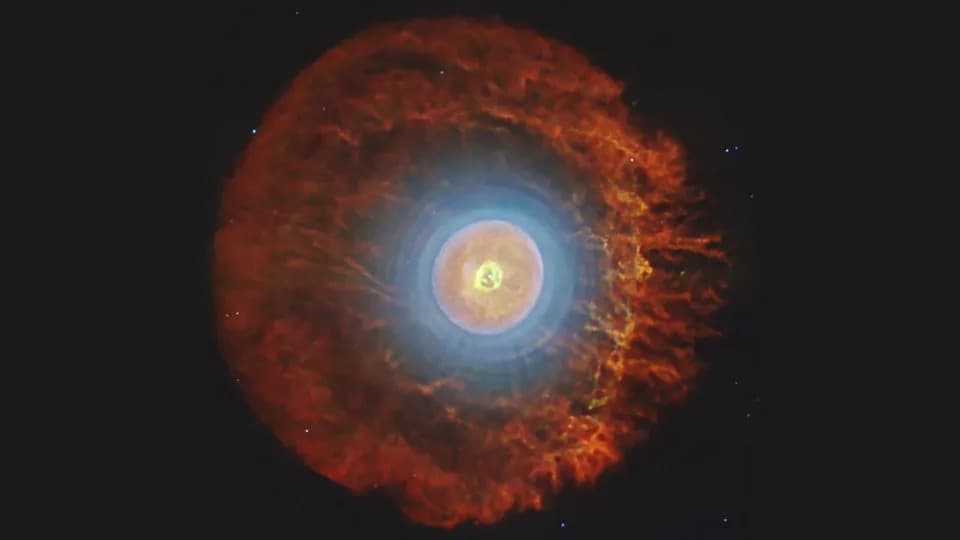
An image shows planetary nebula Tc 1 as observed by the James Webb Space Telescope's Mid-Infrared Instrument (MIRI), combining nine filters spanning wavelengths from 5.6 to 25.5 microns, well beyond what the human eye can detect. Blue tones represent hotter gas at shorter mid-infrared wavelengths; red tones trace cooler material at longer wavelengths. The image was processed by Katelyn Beecroft using PixInsight. | Credit: NASA / ESA / CSA / Western University, J. Cami
The James Webb Space Telescope (JWST) has produced stunning mid-infrared images of the planetary nebula Tc 1, revealing the birthplace and an unexpected shell-like arrangement of spherical carbon molecules known as buckyballs. Pointing roughly 10,000 light-years away toward the constellation Ara, Webb's observations expose detailed filaments, a puzzling upside-down question-mark feature, and a distinct shell of buckminsterfullerene surrounding the nebula's white dwarf.
New Detail on a Familiar Object
Tc 1 attracted attention when Jan Cami and colleagues first identified cosmic buckyballs there in 2010 using data from NASA's Spitzer Space Telescope. Spitzer's mission ended in 2020, and JWST — with a larger mirror and improved resolution — can now resolve far finer structure and spectra in the same infrared bands.
"Tc 1 was already extraordinary, as it was the object that told us buckyballs exist in space, but this new image shows us we had only scratched the surface,"
"The structures we're seeing now are breathtaking, and they raise as many questions as they answer,"
— Jan Cami, Professor of Physics and Astronomy, Western University
What Are Buckyballs and Why They Matter
Buckyballs, formally called buckminsterfullerene (C60), are hollow spherical molecules of carbon that resemble a soccer ball. They belong to a broader family of organic molecules called polycyclic aromatic hydrocarbons (PAHs), which produce distinctive infrared spectral fingerprints and are considered important components of interstellar organic chemistry.
Although buckyballs have been detected in a variety of cosmic settings — around dying and young stars, in interstellar clouds, star-forming regions and even in meteorites — their astrophysical origins and the exact conditions needed for their formation remain unclear.
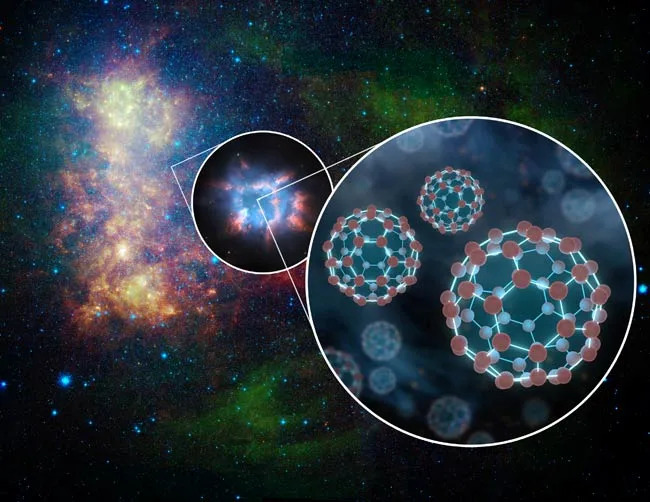
Artist's concept of buckyball molecules against the backdrop of the Small Magellanic Cloud, which was imaged by NASA's Spitzer Space Telescope. Spitzer discovered huge quantities of buckyballs in space, and a new study further suggests that these molecules are common across the universe. | Credit: NASA/JPL-Caltech/MSSS
New Findings From JWST
Key results from the JWST imaging and early analysis include:
- The buckyballs in Tc 1 appear concentrated in a discrete shell that largely encircles the nebula's white dwarf, a geometry described by team member Morgan Giese as "buckyballs arranged like one giant buckyball."
- JWST's MIRI instrument captured unexpected infrared emission behavior from these molecules — patterns that current models of ultraviolet absorption and infrared re-emission do not predict.
- A striking upside-down question-mark-shaped filament or structure appears in the image; its origin is not yet understood and will be the subject of further study.
Why Models Fall Short
According to Cami, none of the existing emission models correctly predict the observed infrared output from the buckyballs. That mismatch suggests either missing physical or chemical processes in the models, or that laboratory measurements used as model inputs need refinement. Understanding these differences will require more detailed spectroscopic analysis — some of which is pending publication — and further laboratory work.
Follow-Up Work
The JWST team has secured additional observing time to study Tc 1 in greater detail and to compare it with two other planetary nebulae that also show strong buckyball signatures but have different radiation environments. By comparing nebulae with distinct radiation fields, astronomers hope to isolate how temperature, density and photochemistry shape the formation and emission of these complex carbon molecules.
The MIRI image of Tc 1 was processed by K. Beecroft, a science teacher active in amateur astronomy and outreach. Spectroscopic results and a series of peer-reviewed papers are expected to follow once journal embargoes lift.
Broader Implications
Beyond revealing where buckyballs form, JWST's images are helping scientists map how a dying star's environment evolves — including temperature, composition, density and gas motions — offering what researchers describe as one of the most detailed views yet of a planetary nebula. These insights could improve our understanding of how organic molecules form and survive in space, and how light-driven (photo-)chemical and physical processes shape cosmic environments.
Help us improve.





















