
Look west-northwest after sunset on April 23, 2026, to see Venus pass just a few degrees below the Pleiades in Taurus — a striking naked-eye sight as twilight fades. Binoculars will likely reveal blue-green Uranus just lower-left of Venus, the closest apparent pairing this year. Venus will dominate the evening sky through October 2026 and is visible for roughly 90 minutes after sunset. The Pleiades (M45) sit about 440 light-years away and contain around 1,000 stars formed together.
Watch Venus Sweep Past Uranus and the Pleiades Tonight — Best Night to Spot Uranus in 2026
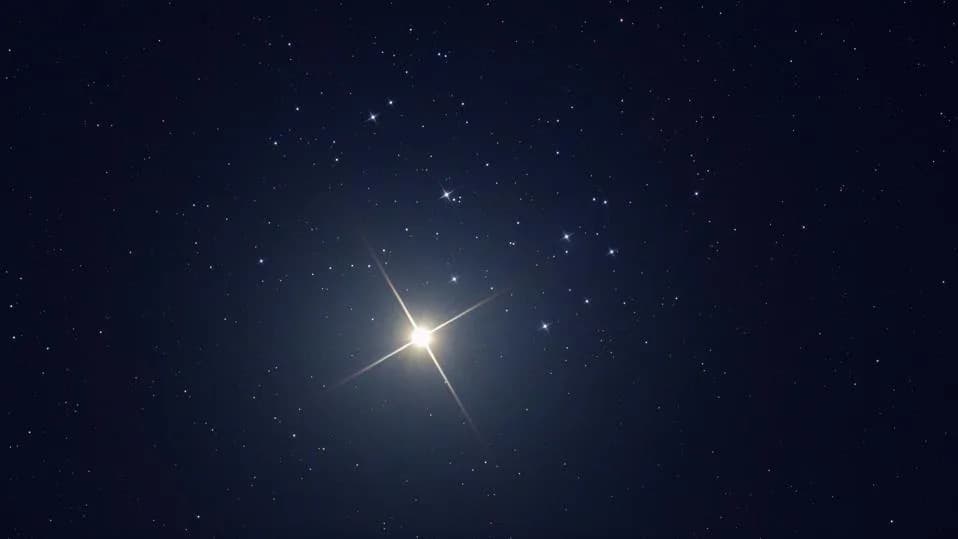
Venus in the Pleiades, as seen on April 3, 2020. (Costfoto/Barcroft Media via Getty Images)Barcroft Media via Getty Images
Look west-northwest after sunset on Thursday, April 23, 2026 (and again on April 24) for a striking celestial show: brilliant Venus sliding a few degrees below the Pleiades star cluster in Taurus. This is an attractive naked-eye sight as twilight fades, and it marks the start of Venus's long run as the evening's dominant planet through October 2026. With binoculars or a small telescope, you can also try to glimpse blue-green Uranus tucked just lower-left of Venus — the closest apparent pairing of the two planets this year.
How To See It
After sunset, face west-northwest. Venus will be the brightest object in that direction and will sit about three degrees below the compact Pleiades cluster (M45), a separation small enough to fit inside a single binocular field of view. Uranus lies just lower left of Venus; because it is faint, binoculars greatly improve your chances of spotting it. Look for a faint, steady bluish-green point close to Venus rather than a twinkling star.
Viewing Tips
- Pick a spot with a clear western horizon and low light pollution.
- Use 7x to 10x binoculars to keep Venus and the Pleiades in one view.
- Let your eyes adapt to the dark for 10–15 minutes; avoid looking at bright screens.
- Binoculars or a small telescope are recommended for confirming Uranus, which appears as a faint, small disc or steady bluish point.
Why This Pairing Is Interesting
The apparent closeness of Venus and Uranus is a line-of-sight effect: Venus orbits the sun at roughly 67 million miles (108 million km), while Uranus is far beyond at about 1.8 billion miles (2.9 billion km). The planets only look near each other from our vantage point on Earth. Venus will remain a prominent evening object through October 2026, visible for up to about 90 minutes after sunset and climbing higher each night, reaching its greatest altitude above the horizon in August 2026.
About the Pleiades (M45)
The Pleiades cluster, commonly called the Seven Sisters, lies in Taurus about 440 light-years away. The cluster contains roughly 1,000 stars born from the same cloud of gas and dust, but typically only six or seven of the brightest members are visible to the unaided eye. At about 100 million years old, the Pleiades stars are young compared to most stars in the night sky, including our 4.6-billion-year-old Sun.
Quick Planet Facts
Venus is the hottest planet, with surface temperatures near 864 degrees Fahrenheit (462 degrees Celsius), and it has a very slow retrograde rotation that takes about 243 Earth days. Uranus, by contrast, can reach some of the coldest measured temperatures around -371 degrees Fahrenheit (-224 degrees Celsius) and is tilted on its side with an axial tilt of roughly 98 degrees, producing extreme seasonal effects where polar regions can be without direct sunlight for decades.
Tip: The pairing is best seen on the night of April 23, 2026, when Venus and Uranus reach their closest apparent separation. Even if clouds or city lights obscure the view that night, Venus will remain an excellent evening target through October.
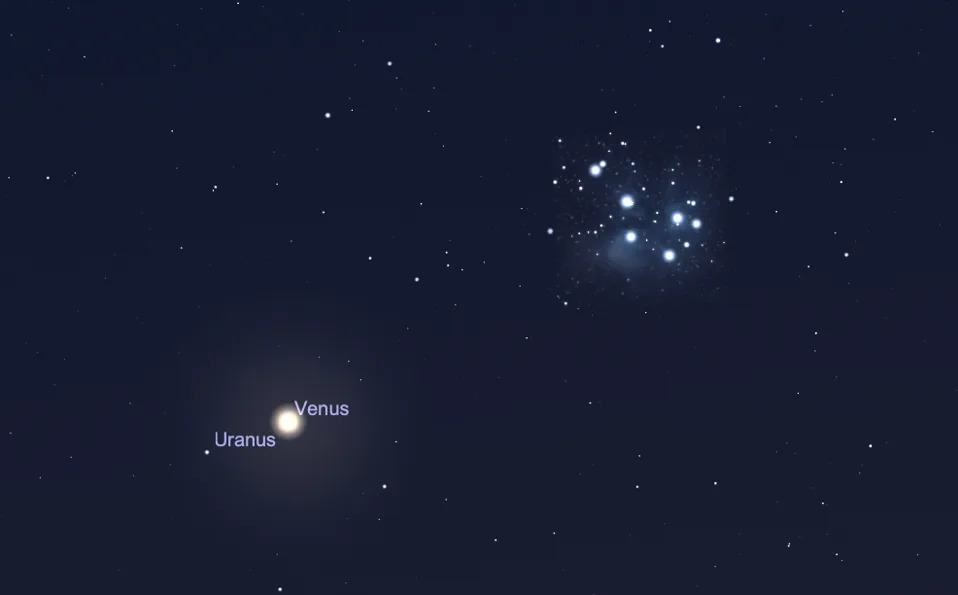
Looking west-northwest after sunset on April 23, 2026, Venus will be close to the Pleiades — and even closer to distant planet Uranus.Stellarium
Help us improve.





















