Three African countries — Seychelles, Mauritius and Madagascar — revoked overflight permission for Taiwan President Lai Ching-te’s aircraft, forcing him to postpone a visit to Eswatini. China praised the nations for upholding the one‑China principle, while Taiwan accused them of acting "in servitude of China" and alleged economic coercion. U.S. lawmakers voiced concern that the move amounted to pressure aimed at isolating a democratic partner. The incident follows recent Chinese incentives offered to Taiwan after a Kuomintang leader met President Xi Jinping.
China Praises African States After Overflight Denials Force Taiwan President To Postpone Eswatini Trip
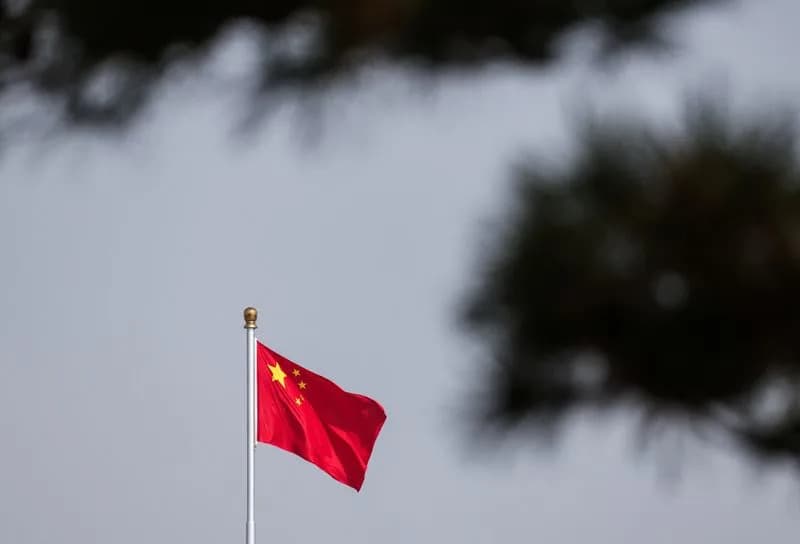
The national flag of the People's Republic of China flutters in the wind at Tiananmen Square, ahead of the annual meeting of the National People’s Congress (NPC), which begins this week, in Beijing, China, March 3, 2026. REUTERS/Maxim Shemetov
China on Wednesday publicly applauded three African nations that revoked overflight permission for the aircraft of Taiwan President Lai Ching-te, a move that forced him to postpone a planned visit to Eswatini and prompted sharp criticism from Taipei.
What Happened
Lai had been due to travel to Eswatini — one of just 12 countries that maintain formal diplomatic relations with Taiwan — but Taipei said late the previous night that the trip would be delayed after Seychelles, Mauritius and Madagascar revoked permission for his aircraft to transit their airspace.
Official Reactions
China’s Taiwan Affairs Office thanked the three countries for adhering to the one-China principle. Spokesperson Zhang Han praised their position and quoted the ancient philosopher Mencius:
"A just cause enjoys abundant support, while an unjust cause finds little support."
China’s foreign ministry issued a separate statement asserting that "there is no longer a so‑called Republic of China president in the world anymore," rejecting the title used by Taiwan’s leader and saying anyone who uses it "acts against history."
Madagascar and the Seychelles said they made their decisions because they do not recognise Taiwan diplomatically. Mauritius was also reported by Taipei to have revoked overflight permission.
Taiwan's Response
Taiwan condemned the denials and accused Beijing of using economic coercion to influence other countries. Its foreign ministry criticised Seychelles and Madagascar as acting "in servitude of China," and reaffirmed Taiwan’s claim that it is a sovereign state with the right to engage internationally.
International Reaction and Context
Several U.S. lawmakers expressed concern about the episode. The U.S. House Select Committee on China called the move "not diplomacy; it is economic pressure aimed at isolating a democratic partner." The U.S. State Department had not issued an immediate comment.
Analysts and officials noted the incident came shortly after Beijing offered new incentives to Taiwan — including eased food import rules — following a meeting between Kuomintang (KMT) chairwoman Cheng Li-wun and President Xi Jinping. The KMT, often at odds with Lai’s administration, urged Beijing to exercise restraint and give Taiwan more diplomatic space.
Eswatini’s acting government spokesperson, Thabile Mdluli, said the cancellation would not alter the kingdom’s longstanding two-way ties with Taiwan and reiterated Eswatini’s sovereign right to pursue its own foreign policy.
Why It Matters
The episode is notable as a rare instance in which airspace denials directly interrupted a state visit by Taiwan’s president, highlighting Beijing’s use of diplomatic and economic levers to limit Taiwan’s international engagements. It underscores ongoing tensions across the Taiwan Strait and the competing diplomatic pressures faced by smaller states.
(Reporting by Ryan Woo and Ben Blanchard; additional reporting by Lunga Masuku in Mbabane; edited by Himani Sarkar and Clarence Fernandez.)
Help us improve.