
High-resolution magnetohydrodynamic simulations on the Fugaku supercomputer challenge a longstanding prediction that slowly rotating Sun-like stars reverse their differential rotation from solar-like to anti-solar. By using roughly 5.4 billion grid points per star, researchers found that lower-resolution models had artificially weakened magnetic fields and produced a spurious reversal. The new results show magnetic fields remain strong enough to preserve the solar-like rotation pattern.
Supercomputer Simulations Upend Long-Held Idea About Rotation of Sun-Like Stars
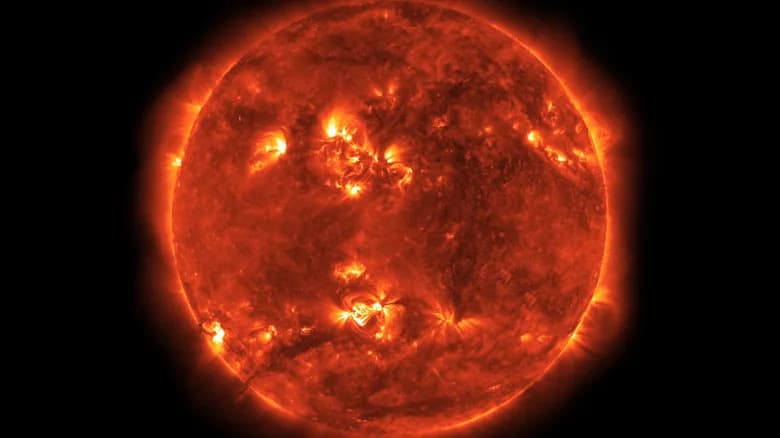
A picture of the sun with a black background - Nasa/bryan Allen/Getty Images
New high-resolution simulations run on Japan's Fugaku supercomputer challenge a decades-old prediction about how Sun-like stars change their rotation as they age. Researchers Hideyuki Hotta and Yoshiki Hatta show that earlier low-resolution models produced a spurious reversal in stellar differential rotation by artificially weakening magnetic fields. Their results were published in Nature Astronomy in February.
What Is Differential Rotation?
Differential rotation refers to the fact that different latitudes of a star can rotate at different speeds. In the Sun and similar stars, the equator typically spins faster than the poles—a pattern called solar-like rotation. For roughly 50 years, theorists predicted that when such a star spins down past a certain threshold, the pattern would flip to an anti-solar state, with the poles rotating faster than the equator.
What The New Simulations Did
To test the prediction, Hotta and Hatta ran extremely high-resolution magnetohydrodynamic simulations on Fugaku. Earlier numerical studies used relatively coarse computational grids that could not resolve small-scale magnetic and fluid structures. On Fugaku, the team increased the resolution dramatically, using about 5.4 billion grid points per simulated star to capture subtler interactions between flows and magnetic fields.
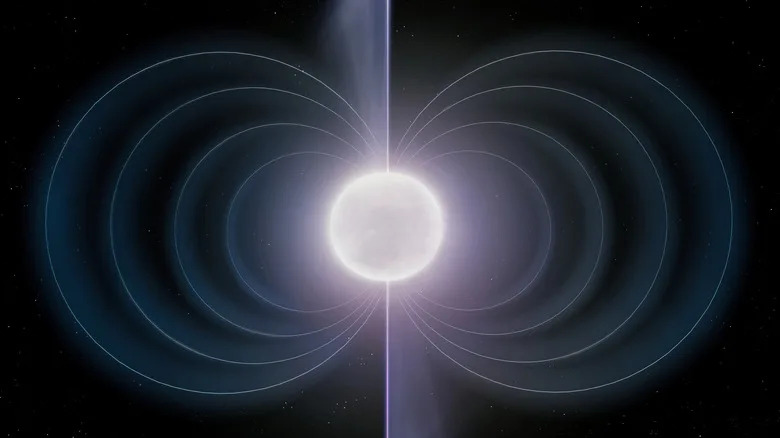
A star shining bright white with magnetic fields around it - Nazarii_Neshcherenskyi/Shutterstock
Key Result
The higher-resolution models reveal that lower-resolution runs tended to weaken stellar magnetic fields artificially. That weakening allowed a false transition to anti-solar differential rotation in the coarse models. In the new simulations, magnetic fields remained stronger and more stable, and they prevented the expected flip. In short: stars do slow down with age, but the predicted switch to anti-solar rotation does not occur in these better-resolved models because magnetic fields maintain the solar-like pattern.
Professor Hideyuki Hotta summarized the finding: the switch does not happen because magnetic fields, which previous simulations missed, prevent it.
Why This Matters
The result affects our theoretical understanding of stellar spin-down, magnetic dynamos, and stellar evolution. It highlights how numerical resolution and properly modeling magnetism are critical for reliable predictions about stars. While direct observation of distant stellar interiors remains out of reach, more realistic simulations like these reduce reliance on low-resolution assumptions and guide future observational tests.
Publication: H. Hotta & Y. Hatta, Nature Astronomy, February.
Help us improve.





















