
New research on the juvenile Neanderthal specimen Amud 7 suggests Neanderthal infants and toddlers showed accelerated bodily growth compared with modern human children, likely as an adaptation to cold, demanding environments. Dental development in Amud 7 indicates an age of about six months, while bone development corresponds to a 14-month-old modern human, revealing a mismatch in growth timing. The pattern points to faster early-life somatic growth in Neanderthals that later evens out in childhood, but the authors warn that more juvenile specimens are needed to confirm this was a common trait.
Neanderthal Toddlers Grew Faster Than Human Infants — Likely an Adaptation to Harsh Environments
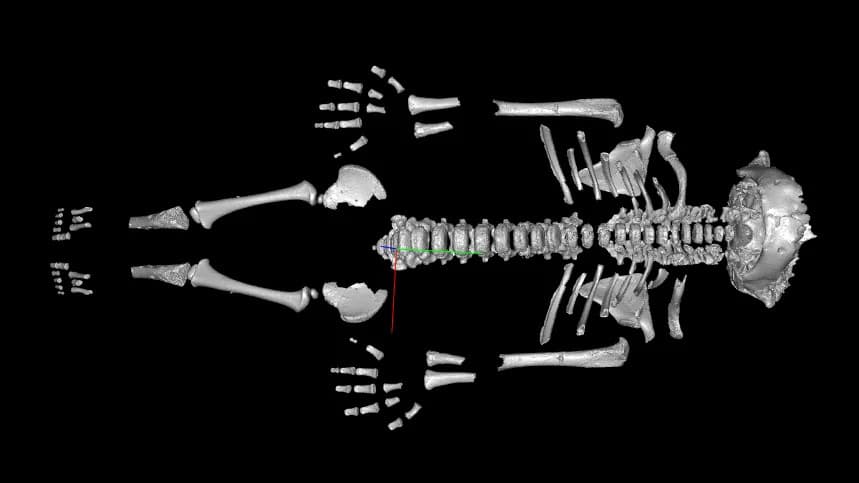
The researchers made a 3D model of the Amud 7 Neanderthal skeleton. | Credit: Been et al. (CC BY 4.0)
New analysis of a juvenile Neanderthal skeleton suggests Neanderthal infants and toddlers developed their bodies faster than modern human children, probably as an evolutionary response to the cold, demanding environments they occupied.
Key Evidence From Amud 7
Researchers based their conclusions on a partial juvenile skeleton, catalogued as Amud 7, recovered from Amud Cave in northern Israel during the 1990s. The remains were found in more than 100 fragments and were discovered in a niche with a red deer (Cervus elaphus) jaw placed on top, a context some archaeologists interpret as a burial or offering. Associated stone tools and bone morphology date the remains to roughly 51,000–56,000 years ago and identify the specimen as Neanderthal.
Mismatch Between Teeth and Bones
When the team compared dental development with skeletal indicators they found a striking mismatch: the lower front teeth suggested an age of about 6 months, while the postcranial bones matched those of a modern human roughly 14 months old. The authors interpret this as evidence that Neanderthal bodily growth outpaced dental development during early childhood.
Growth Stages and Life-History Implications
The study finds that newborn Neanderthals resembled modern human neonates in early tooth formation and initial limb lengths, although they had relatively larger skulls. During the second growth stage — infancy through early childhood (about 1–6 years) — Neanderthal bodies appear to have grown more rapidly than their teeth, unlike modern human infants where dental and somatic growth are more synchronous. Later in childhood, Neanderthal growth rates converged with those of Homo sapiens, producing more similar developmental trajectories.
The researchers wrote that these results "suggest an evolutionary strategy emphasizing accelerated development in the early years of life, likely advantageous in the harsh environments Neandertals inhabited."
Limitations And Future Work
The authors emphasize that Amud 7 represents a single juvenile data point. Juvenile Neanderthal skeletons are rare, and larger samples of non-adult remains are needed to determine whether this growth pattern was widespread across Neanderthals or reflects a localized ecological adaptation.
Published April 15 in Current Biology, the study adds a new dimension to how researchers reconstruct Neanderthal life histories and adaptative strategies in Pleistocene environments.
Help us improve.





















