
A new study in Science finds warm-bodied "mesothermic" fishes — including great white and basking sharks and some large tunas — are increasingly at risk of overheating as oceans warm because they expend far more energy than cold-blooded fish. Researchers used tiny implanted sensors to measure heat production and loss and estimate that a one-ton warm-bodied shark may struggle in waters above 62.6°F (17°C). Scientists warn that warming, combined with overfishing and bycatch, could shrink habitat, heighten competition for prey and disrupt marine ecosystems.
Warming Oceans Could Turn Great Whites' Advantage Into a Liability — Mesothermic Sharks Risk Overheating
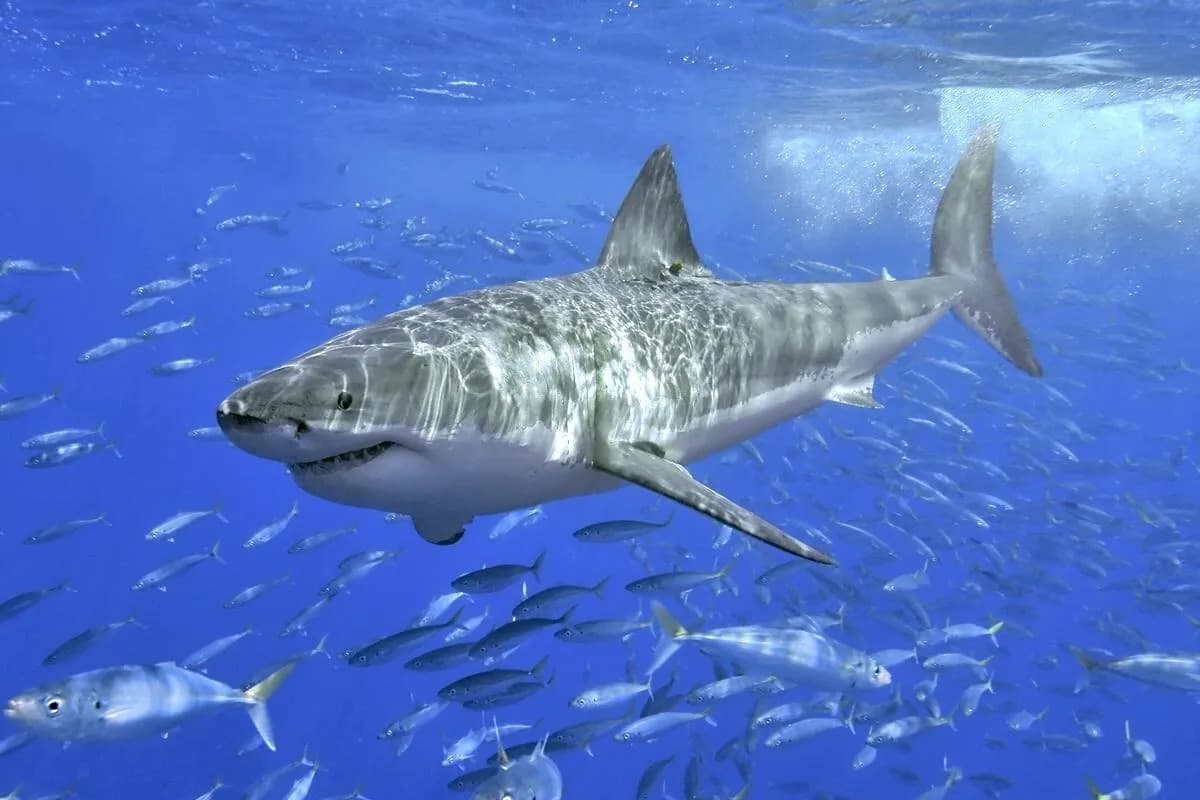
A great white shark off the coast of Isla Guadalupe, Mexico. Terry Goss via Wikipedia
The evolutionary advantage that has kept great white and other mesothermic sharks dominant for millions of years may be turning into a vulnerability as the world’s oceans warm. A new study published in Science shows that warm-bodied fishes that maintain elevated internal temperatures face increasing danger of overheating, with serious ecological and conservation consequences.
Why Mesotherms Are Vulnerable
Mesothermic fishes — including great white, basking, thresher and porbeagle sharks, and several large tunas — trap metabolic heat to run warmer than the surrounding seawater. That physiology supports faster swimming, powerful predation and long migrations, but it also requires far more energy. Compared with cold-blooded fish, mesotherms burn nearly four times as much energy to maintain body temperature, leaving them on a tight energy budget.
Heat Budgets and New Measurements
Researchers implanted tiny sensors in a range of species (including basking sharks weighing over three tons) to measure heat production and loss in real time. From those measurements the team estimated thermal limits: a one-ton warm-bodied shark may struggle to remain in waters warmer than about 62.6°F (17°C) without resorting to behavioral or physiological countermeasures such as slowing down, diverting blood flow, or diving to cooler depths.
Range Shifts, Competition, and Ecosystem Impacts
As ocean temperatures rise, suitable habitat for mesotherms is likely to shrink, forcing animals to move toward cooler waters. That range compression — most acute in summer months — could increase competition for scarcer prey and disrupt food webs because these species often act as apex predators and exert outsized control over marine ecosystems.
Human Threats Remain Immediate
Although climate-driven thermal stress is growing, the researchers emphasize that fishing pressures and bycatch are the most immediate threats. Overfishing reduces available prey and amplifies the energy crisis for large warm-bodied predators. "If we had to say what is the one thing that we need to urgently address for these animals, it's the fishing problem," said lead author Nick Payne.
Local Signals and a Cautionary Past
In places such as South Africa, changes in great white movement and abundance act as a sentinel for broader ecosystem changes and affect ecotourism and conservation narratives. Fossil records—such as the giant Megalodon—suggest that large warm-bodied species were especially vulnerable during past episodes of ocean warming, likely because their huge energy demands could not be met as conditions changed.
"Today’s oceans are changing at unprecedented speeds. The alarm bells are ringing loudly at this point," said Payne.
Protecting mesothermic species will require combining climate-aware habitat protection with urgent fisheries management to reduce bycatch and rebuild prey populations. Understanding the "hidden heat budgets" of these animals can help policymakers identify climate refuges and prioritize conservation actions.
Help us improve.





















