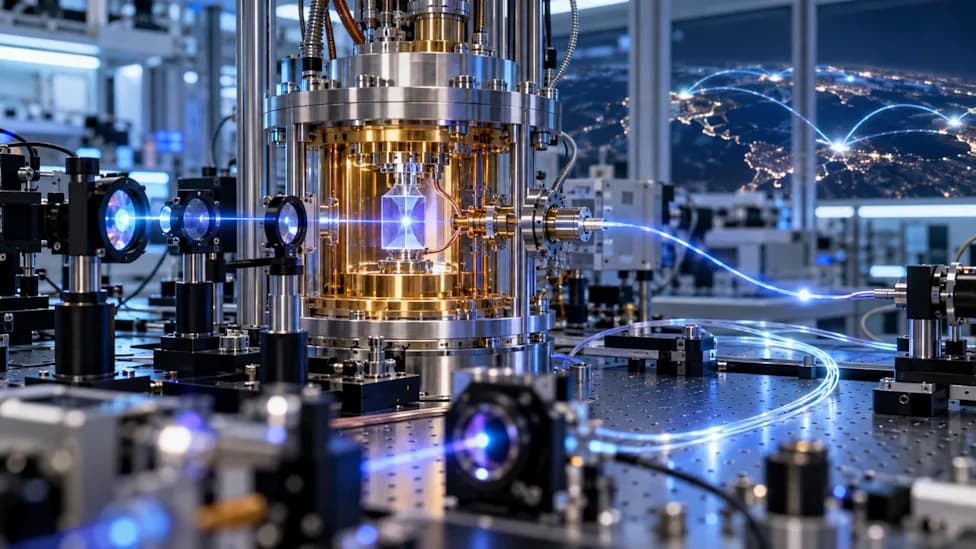
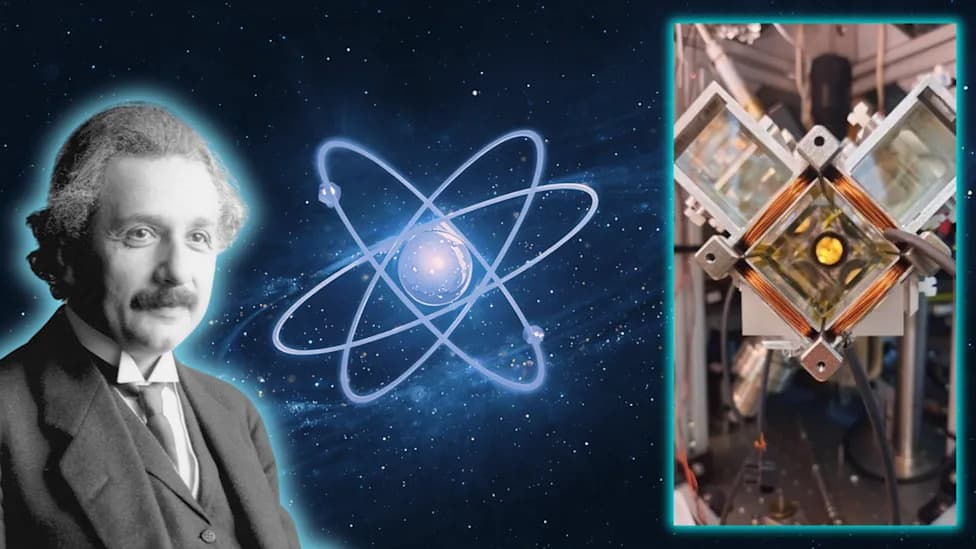
Physicists propose using ultra-precise optical atomic clocks to search for quantum properties of time, including temporal superposition and entanglement between time and motion. The team argues some effects could be measurable at the scale of tens of attoseconds and recommends quantum metrology techniques such as squeezing to amplify tiny signals. Successful detection would provide experimental access to the quantum–relativity interface and inform theories of quantum gravity.
Optical Clocks Could Reveal Time’s Hidden Quantum Nature

(bymuratdeniz/iStock/Getty Images Plus)
Time feels continuous and unambiguous in everyday life: it flows forward at a single rate and orders events. But recent theoretical work suggests time may carry quantum features—superpositions and entanglement—that would make it far stranger than this common-sense view. A new proposal shows how ultra-precise optical atomic clocks might be used to search for those effects experimentally.
How Optical Clocks Can Test Quantum Time
Optical atomic clocks use optical-frequency transitions in atoms (rather than microwave signals) and are currently the most precise timekeepers ever built. In a paper published in Physical Review Letters, Igor Pikovski and colleagues outline experimental strategies that could allow ion-based optical clocks to probe quantum aspects of time.
YouTube Thumbnail
What The Theory Predicts
In standard quantum mechanics, systems can exist in superpositions of different states. Pikovski and co-authors argue that, in a quantum theory of gravity or in regimes where quantum mechanics and relativity overlap, the flow of time itself could be in superposition: a clock might effectively evolve at more than one rate simultaneously. Relatedly, time could become entangled with motion or other degrees of freedom, so that measurements of one affect the other.
"There can be instances where time does not simply change steadily at one rate. Instead, there are 'many times in superposition'," the authors explain.
Proposed Experiments
The team suggests specific measurements using current-generation ion-based optical clocks. Some predicted signatures—such as a single clock registering multiple readings separated by vanishingly small intervals—could lie within reach of modern instruments. The relevant timescales are extremely short: effects might appear at the level of tens of attoseconds (10-17–10-18 seconds).
YouTube Thumbnail
To boost sensitivity, the researchers recommend quantum metrology techniques such as squeezing, which reshapes atomic quantum noise to enhance the signal-to-noise ratio for targeted observables. Squeezing is already used in precision measurements and could amplify tiny temporal quantum signals inside an optical clock.
Why This Matters
Detecting quantum features of time would be a landmark result. It would provide experimental input at the interface between quantum mechanics and general relativity, guiding efforts toward a quantum theory of gravity and reshaping our conceptual foundation for what time is. Even null results will constrain theoretical models and inform the next generation of experiments.

Subscribe to ScienceAlert's free fact-checked newsletter
Outlook
Some proposed signatures may be accessible with present or near-term optical-clock technology; others remain too small or fragile for current setups. Still, the paper lays out feasible paths for experimental teams to follow, and it connects concrete laboratory measurements with deep questions about space, time, and quantum reality.
Publication: The proposal appears in Physical Review Letters. Continued progress in ion-based optical clocks and quantum metrology will determine how quickly the ideas can be tested.
Help us improve.