
Short Answer: Stars usually don’t appear in spacecraft photos because cameras are exposed for bright foregrounds like the Moon or Earth, which makes faint stars vanish. During Artemis II’s April 6 far-side pass a nearly 54-minute total solar eclipse darkened the lunar disk, allowing dozens of stars and Venus to be captured. The mission (April 1–10, 2026) also set a new crewed distance record and returned striking images of the lunar far side.
Why Space Photos Rarely Show Stars — And How Artemis II Proved Why
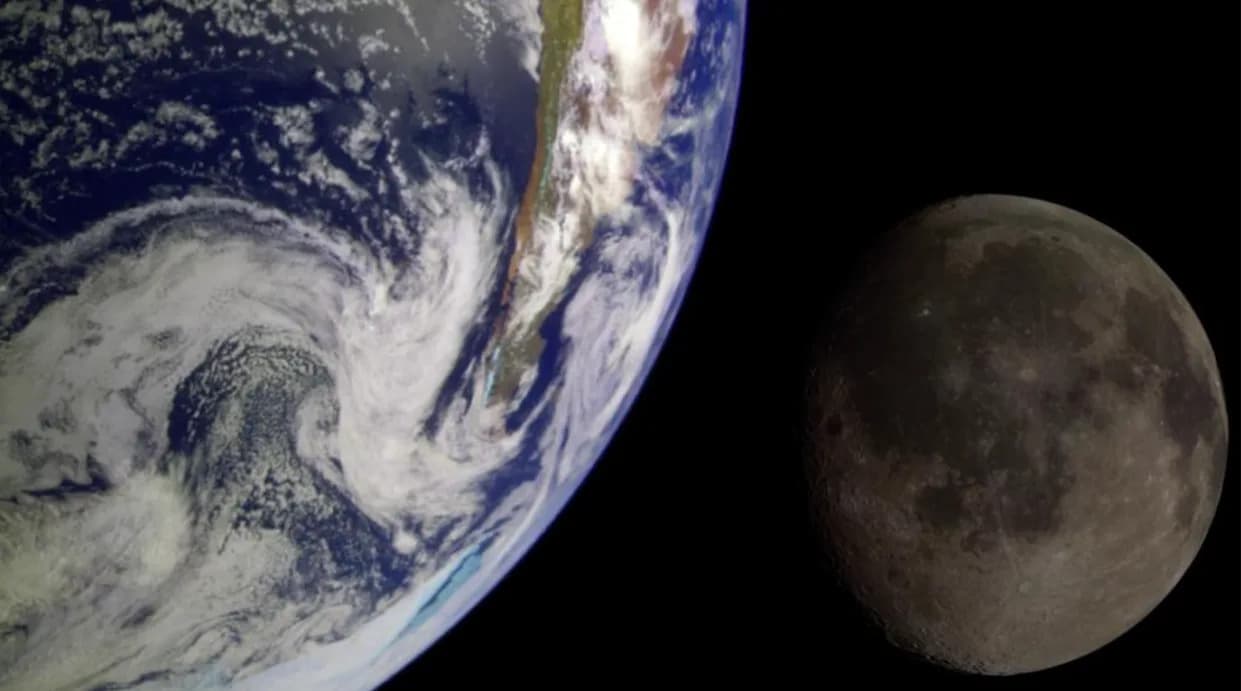
Image of the Earth and Moon taken from outer space
Images of a brightly lit Earth or the Sunlit Moon set against a pitch-black sky often prompt the same question: where are the stars? The answer is simpler than it seems — and a stunning photo from NASA's Artemis II mission provides a perfect demonstration.
Why Stars Vanish In Space Photos
Cameras capture a limited range of brightness (dynamic range). When the foreground — such as the Moon's sunlit surface or the Earth — is extremely bright while the stars are extremely faint, the camera must be set to expose for the bright object. That exposure makes the dim starlight too faint to register, so the background looks black.
Three main settings control exposure: shutter speed (how long the sensor collects light), ISO (sensor sensitivity) and aperture (how wide the lens opens). To photograph the Moon or Earth with crisp detail, photographers use short exposures, low ISO, and an appropriate aperture — the exact opposite of what you'd choose to capture faint stars. Attempting to expose both foreground and stars in a single shot usually produces an overexposed foreground or a noisy, blurry background.
Other practical limits matter too: long exposures needed for stars can introduce motion blur from spacecraft movement or rotate the background relative to the foreground, and higher ISO increases image noise. The same everyday example applies on Earth: point a camera at the night sky next to a bright streetlight and the stars near the light disappear.
Artemis II’s Eclipse Photo — A Clear Demonstration
On April 6, during a seven-hour pass of the Moon’s far side, the Artemis II crew observed a total solar eclipse: the Moon completely blocked the Sun and produced nearly 54 minutes of totality. With the Sun blocked, the bright foreground source disappeared, so the camera could be set to reveal faint starlight. In the resulting frame, dozens of stars are visible around the dark lunar disk, and Venus appears as a bright point on the rim — exactly what exposure physics predicts.
“The Moon really is its own unique body in the Universe. It’s not just a poster in the sky that goes by. It’s a real place.” — Christina Koch
About Artemis II
The Artemis II mission (launched April 1, 2026; splashdown April 10) marked humanity’s return to the Moon’s vicinity for the first time since Apollo 17 (1972). The four-person crew — commander Reid Wiseman, pilot Victor Glover, and mission specialists Christina Koch and Jeremy Hansen (Canadian Space Agency) — set several milestones:
- Christina Koch became the first woman to travel beyond low Earth orbit.
- Victor Glover became the first person of color to witness the lunar far side.
- Jeremy Hansen became the first person from a nation other than the United States to travel to the Moon.
- The mission set a new crewed distance record, reaching 406,771 kilometers from Earth, surpassing the Apollo 13 record from 1970.
During the flight the astronauts photographed an "Earthset" echoing Apollo 8’s Earthrise, documented far-side lava flows, impact craters and surface fractures, and observed six meteoroid impact flashes on the dark lunar surface.
Bottom Line
Space is full of stars, but whether they appear in a photo depends entirely on lighting and camera exposure. When the foreground is bright, cameras must be set to capture those details — and the faint stars will disappear. When the foreground is dark, as during the Artemis II eclipse image, the stars shine through exactly as expected.
Help us improve.





















