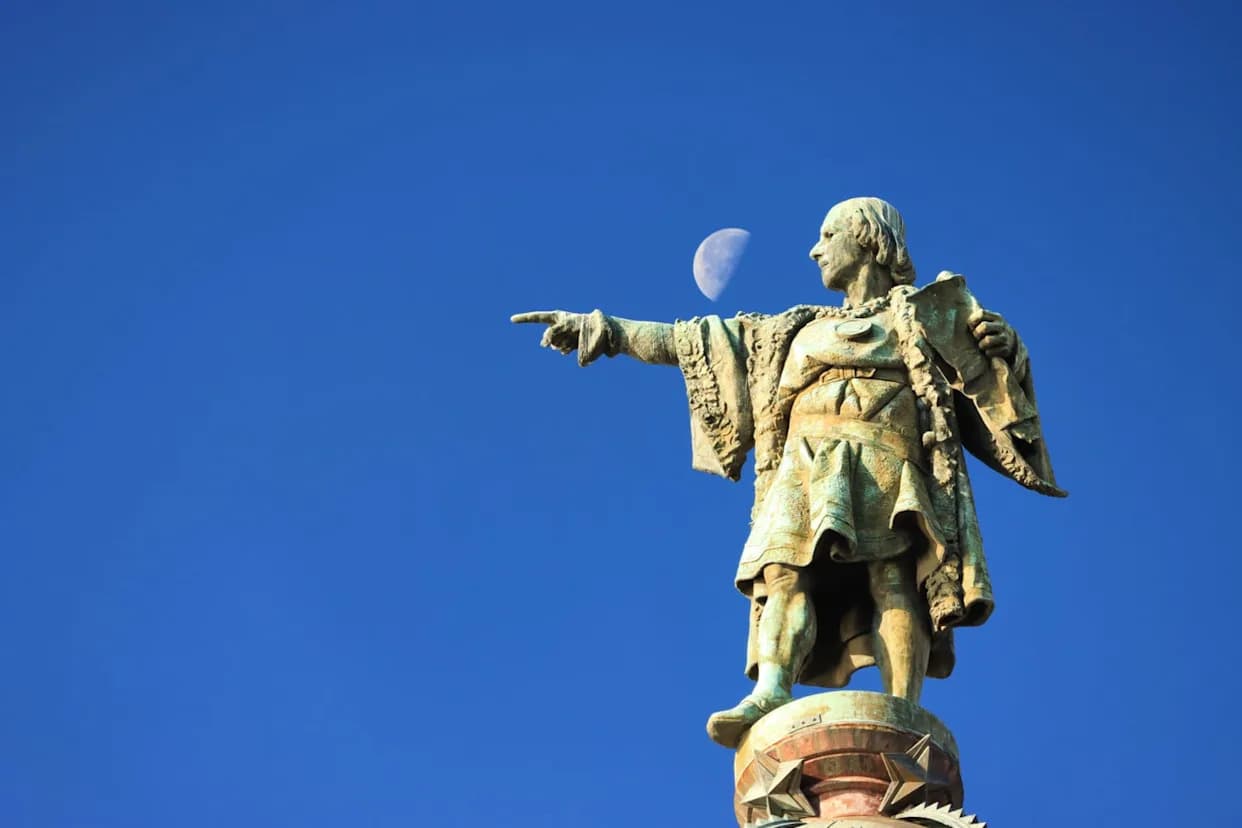
A team of researchers says new genetic evidence strengthens the case that Christopher Columbus’s family came from northern Spain rather than Italy. Using archival records and modern laboratory methods, the group exhumed remains from a family crypt outside Seville and compared DNA from individuals identified as relatives of Columbus.
The remains were recovered from the Santa Maria de Gracia church crypt in Gelves, a burial site associated with the Counts of Gelves that contains interments dating from the 16th to the 18th centuries. According to the study posted to the preprint server bioRxiv, researchers combined archival matching of age and sex profiles with radiocarbon and isotopic analyses, 3D scanning, paleo-chemical tests and DNA sequencing to authenticate the remains and reconstruct kinship ties within the tomb.
After sequencing and mapping genetic data, the team reported profiles for seven individuals whom archival evidence identified as direct relatives of Columbus. Two of those samples showed unexpectedly strong shared segments of DNA, most notably Jorge Alberto de Portugal—identified in the records as the third Count of Gelves and a great-great-grandson of Columbus—who carried a roughly 50-centimorgan shared segment with other samples.
Using a method the authors call a "virtual knock-out" analysis to test which ancestral figure best explained the shared genetic material, the researchers identified Pedro Alvarez de Sotomayor as a probable ancestral connector. When combined with other genetic evidence from the tomb, the results indicate a direct genetic link from Columbus’s line to the noble houses of Sotomayor in Galicia and Zúñiga in Navarre, both located in northern Spain.
"The results confirm that the remains deposited in the church of Santa Maria de Gracia's crypt are indeed those of the Counts of Gelves," the authors write, and add that their findings "establish a coherent framework linking the Columbus lineage to the elder Galician and Navarrese nobility."
Historically, many scholars have placed Columbus’s birth in 1451 in the Republic of Genoa (now part of Italy), and competing theories have variously suggested Portuguese, Spanish or even Scottish origins. The authors of this study present the DNA results as strong genomic support for a Galician provenance, but they also note that the work is currently available as a preprint and has not yet completed peer review.
While these findings add important new evidence to a long-standing debate, the paper’s preprint status means further peer review and independent replication will be necessary before historians and geneticists reach a consensus. Nevertheless, the study demonstrates how archival research, archaeology and genomics can combine to illuminate complex historical puzzles.