Teams from Drexel University and ExxonMobil found that some viscous liquids can abruptly fracture like solids when pulled beyond a critical stress per unit area. Experiments with tar-like hydrocarbon blends and a styrene oligomer produced audible snaps and cracks propagating at 500–1,500 m/s, a behaviour consistent with cavitation-related hypotheses. The discovery may influence technologies that handle viscous fluids, including 3D printing, inkjet printing, soft robotics and fibre-spinning.
Scientists Reveal Simple Liquids Can Snap Like Solids Under Critical Stress
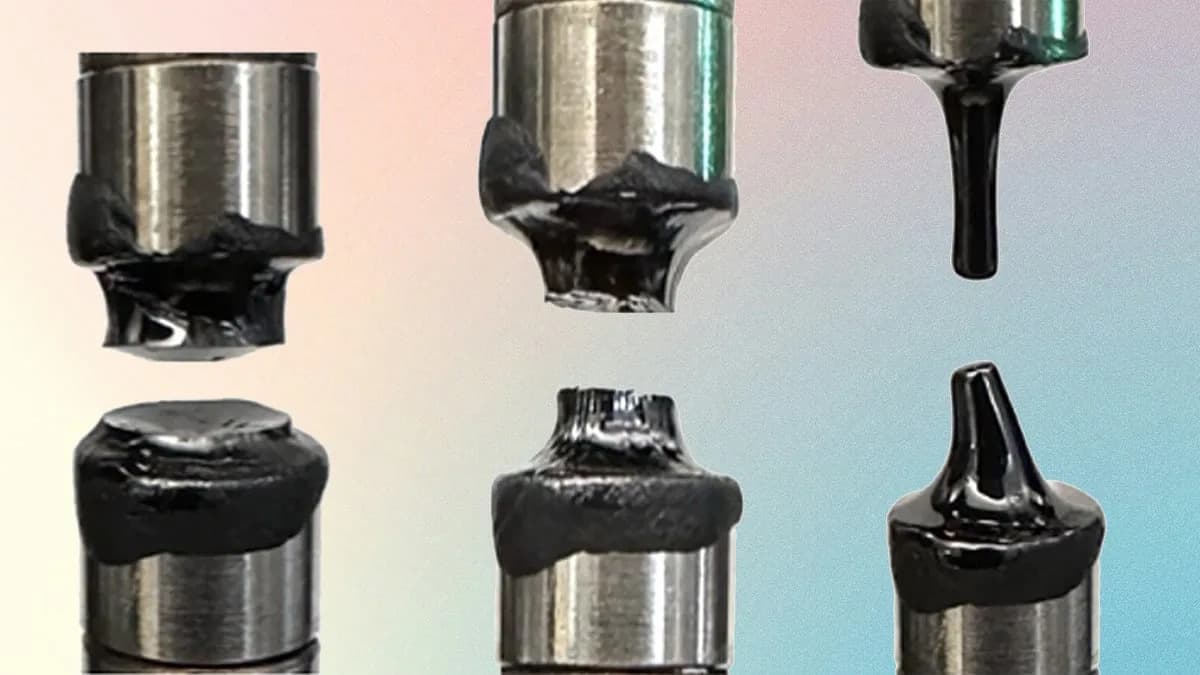
(Drexel University/Magic Pattern/Unsplash)
Researchers from Drexel University and ExxonMobil have discovered that some simple, viscous liquids can suddenly fracture like solids when pulled beyond a critical stress threshold. The unexpected behaviour — audible snaps and ultra-fast crack propagation — challenges traditional assumptions in fluid mechanics and could affect technologies that rely on viscous fluids.
How the discovery was made
The team sandwiched thick, tar-like liquids between two metal plates, applied increasing tensile forces, and recorded the response with high-speed cameras. When the applied force per unit area reached a certain level, the liquids produced a loud snap and a fracture propagated at extraordinary speeds.
"The fracture caused a very loud snapping noise that actually startled me," says Thamires Lima, chemical engineer at Drexel University.
Following repeated tests to rule out equipment failure, the researchers confirmed the phenomenon in a tar-like hydrocarbon blend and later in a styrene oligomer. Both materials are highly viscous, and the team concluded that viscosity plays a major role in how stress accumulates and is released.

Subscribe to ScienceAlert's free fact-checked newsletter
Key measurements and hypothesis
Once a fracture initiated, the crack tip moved at roughly 500–1,500 metres per second. These speeds are consistent with mechanisms linked to cavitation: intense tensile stress can nucleate microscopic vapor cavities or voids that then facilitate a rapid tear through the liquid. Because the fractures develop so quickly, capturing their initiation and evolution will require very high-frame-rate imaging and careful diagnostics.
Why it matters
The finding implies that simple liquids — potentially including common fluids such as water and oil — can behave like solids under sufficiently large force per area. This has potential implications for industrial and biological systems where viscous fluids are subjected to strong tensile stresses, including 3D printing, inkjet printing, soft robotics, and fibre-spinning.
"Now that we have reported this unanticipated behavior, the work of fully understanding why it happens and how the behavior manifests in other liquids is an important next step," says Lima. The research has been published in Physical Review Letters.
Help us improve.