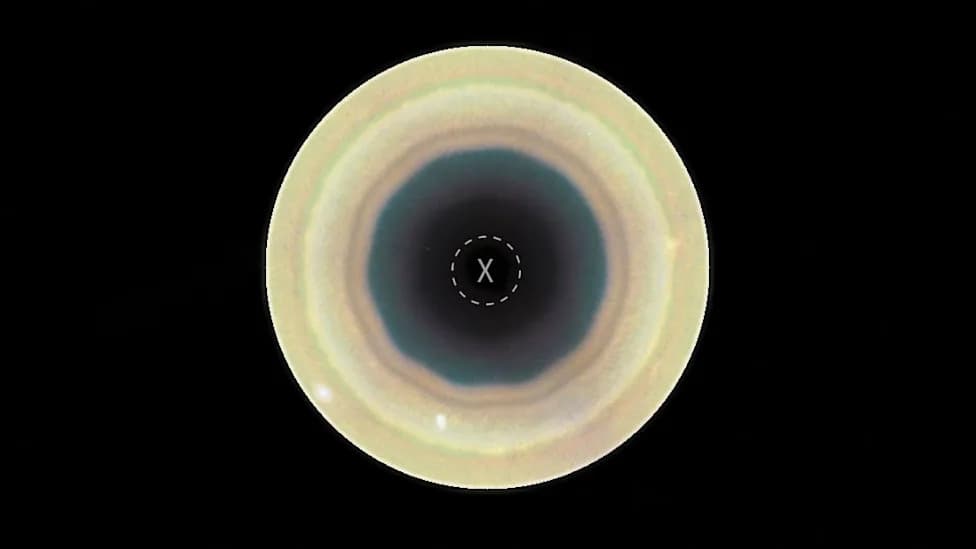
Cassini data show Saturn’s magnetospheric cusp is consistently shifted toward the afternoon and dusk sector (typically 13:00–15:00, sometimes to 20:00), rather than near local noon as at Earth. Analysis of 67 cusp events recorded from 2004–2010—normalized for Cassini’s dwell time—points to Saturn’s rapid 10.7-hour rotation and mass loading from Enceladus as the main drivers of this duskward displacement. Simulations indicate an expanded morning-side magnetopause and high-latitude reconnection, making Saturn’s behavior more like Jupiter’s than Earth’s. The result reshapes models of giant-planet magnetospheres and informs future missions to Saturn and Enceladus.
Cassini Reveals Saturn’s Magnetic Cusp Pulled Toward Dusk
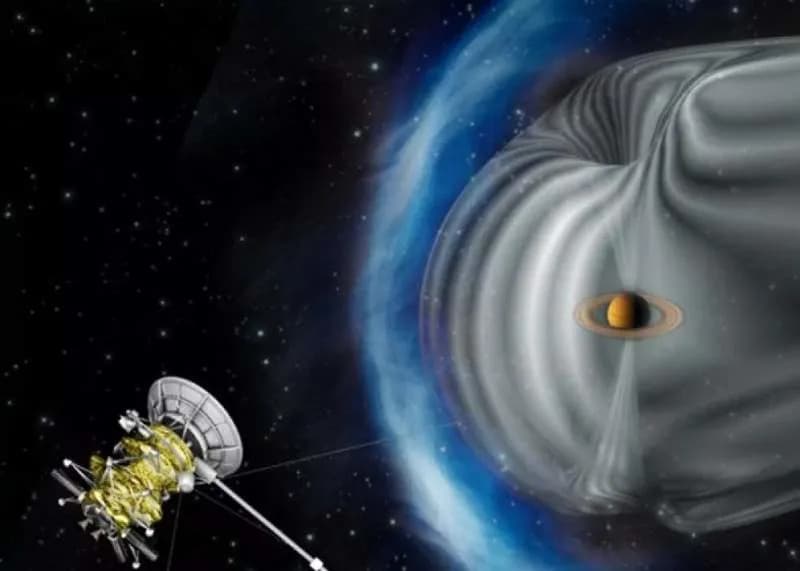
Artist's impression shows Cassini exploring the magnetic environment of Saturn. (CREDIT: NASA/JPL-Caltech)
Analysis of years of Cassini-Huygens data shows that Saturn’s magnetospheric cusp — the opening where solar-wind particles can enter a planet’s magnetic domain — is not centered near local noon as it typically is at Earth. Instead, the cusp is systematically displaced toward the afternoon and dusk sectors, most commonly between 13:00 and 15:00 local time and sometimes as late as 20:00.
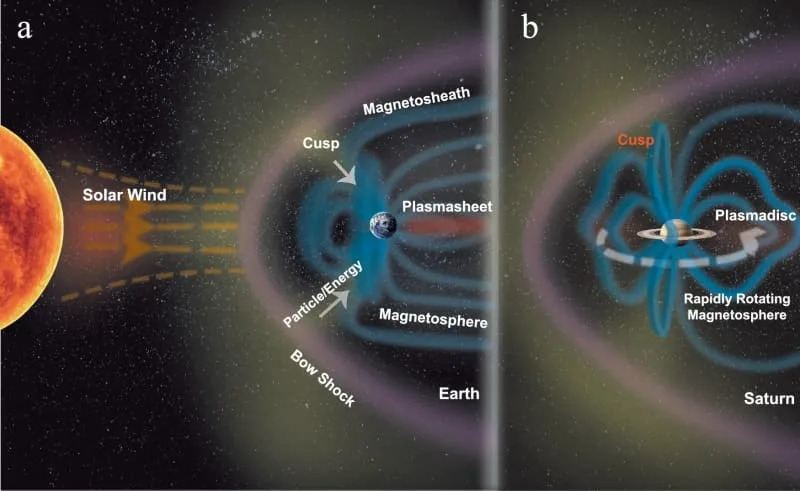
A simple schematic of the configuration of the solar wind-driven Earth magnetosphere and the rapidly rotating Saturn magnetosphere. (CREDIT: Nature Communications)
Data, Methods and Key Result
The result, reported in Nature Communications, is based on Cassini observations from 2004–2010 using the Magnetometer and the Cassini Plasma Spectrometer (CAPS). The team identified 67 cusp encounters by looking for magnetosheath-like electron energy signatures and other plasma indicators. To correct for Cassini's uneven sampling of local times, the researchers normalized event counts by the spacecraft's dwell time at each local time sector—revealing a clear duskward bias in cusp occurrence.
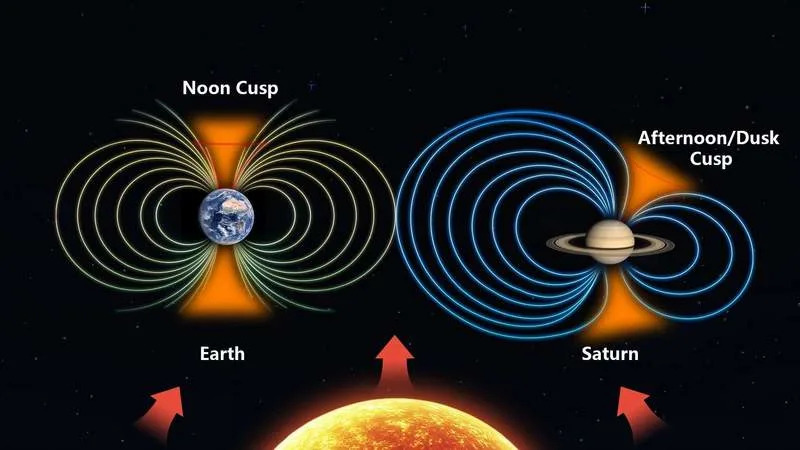
Schematic showing the position of Saturn’s cusp compared to Earth’s. (CREDIT: SUSTech)
Why Saturn Is Different
Two planet-scale factors explain the asymmetry. First, Saturn spins rapidly: a Saturn day lasts about 10.7 hours, which tends to drag magnetospheric plasma azimuthally. Second, heavy mass loading from ionized material—primarily water vapor from the moon Enceladus—adds plasma that is forced to corotate with the planet. Together these effects distort magnetic field lines and shift the magnetopause and cusp toward dusk.
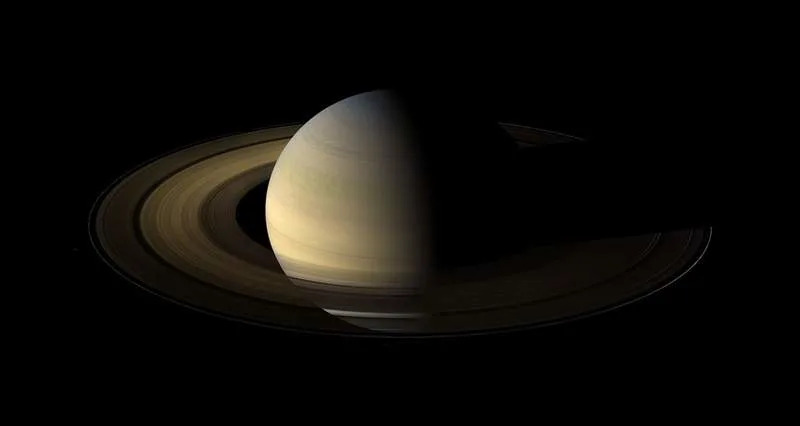
Saturn’s equinox captured by Cassini in 2009. (CREDIT: NASA/JPL/Space Science Institute)
"By combining Cassini observations with simulations, we found that Saturn’s rapid rotation and the plasma from its moon Enceladus together shape the asymmetric global distribution of the cusps," said lead author Dr Yan Xu.
Simulations and Comparative Planetology
Simulations included in the study indicate that Saturn's magnetopause is relatively expanded on the morning side and compressed on the afternoon side. Because the cusp is anchored to the magnetopause geometry, its peak occurrence shifts toward the dusk sector. The modeling also suggests that magnetic reconnection at Saturn is more active at high latitudes and suppressed at lower latitudes—behavior more similar to Jupiter than to Earth.
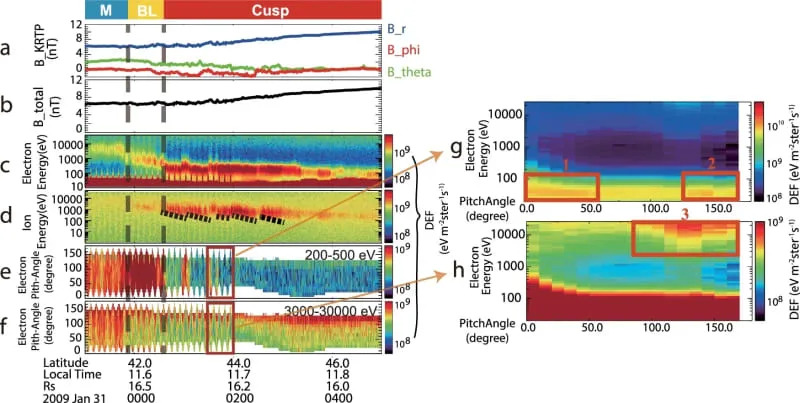
The Kronian cusp observations revealed by Cassini’s MAG and CAPS instruments on January 31, 2009. (CREDIT: Nature Communications)
Why It Matters
Shifting the picture of where solar-wind particles enter Saturn’s magnetosphere affects interpretations of auroral emissions, particle acceleration, and where reconnection-driven energy release is likely to occur. The finding strengthens the view that rapidly rotating giant planets with internal plasma sources follow a different magnetospheric regime than solar-wind-dominated terrestrial planets. That has implications for planning future missions to Saturn and Enceladus, where an accurate map of the near-space environment is critical for instrument design and science operations.
Limits and Next Steps
The authors note limitations: CAPS data after 2011 were excluded because the instrument no longer provided the same diagnostics, and Cassini's orbit left some local-time sectors sparsely sampled. The paper calls for additional simulations and further observations—especially global maps of cusp regions at Saturn and Jupiter—to test and refine the interpretation.
Cassini concluded its mission in 2017, but its dataset continues to reveal new insights. This work provides a clearer map of where solar-wind particles can enter Saturn’s magnetosphere and emphasizes that giant-planet magnetic environments can follow rules different from Earth’s.
Help us improve.