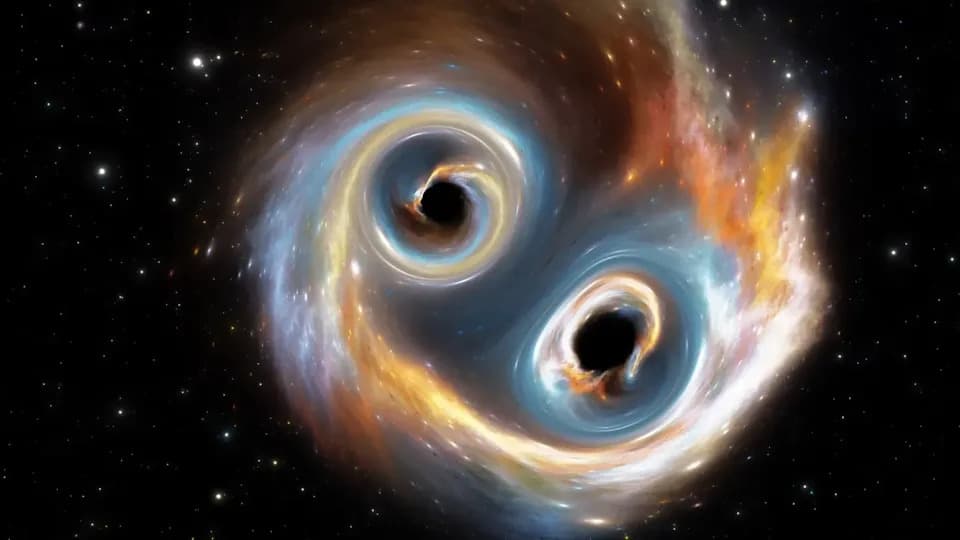
Long-term radio observations of Markarian 501 reveal two distinct jets from its core, interpreted as emissions from a pair of supermassive black holes. In June 2022 the system briefly produced an Einstein ring, consistent with gravitational lensing when the two jets became nearly aligned with Earth. The team estimates an orbital period of about 121 days and a separation of 250–540 AU, suggesting the pair could merge within roughly a century and eventually emit ultra–low-frequency gravitational waves.
Two Giant Black Holes in Markarian 501 Are Spiraling Toward Collision
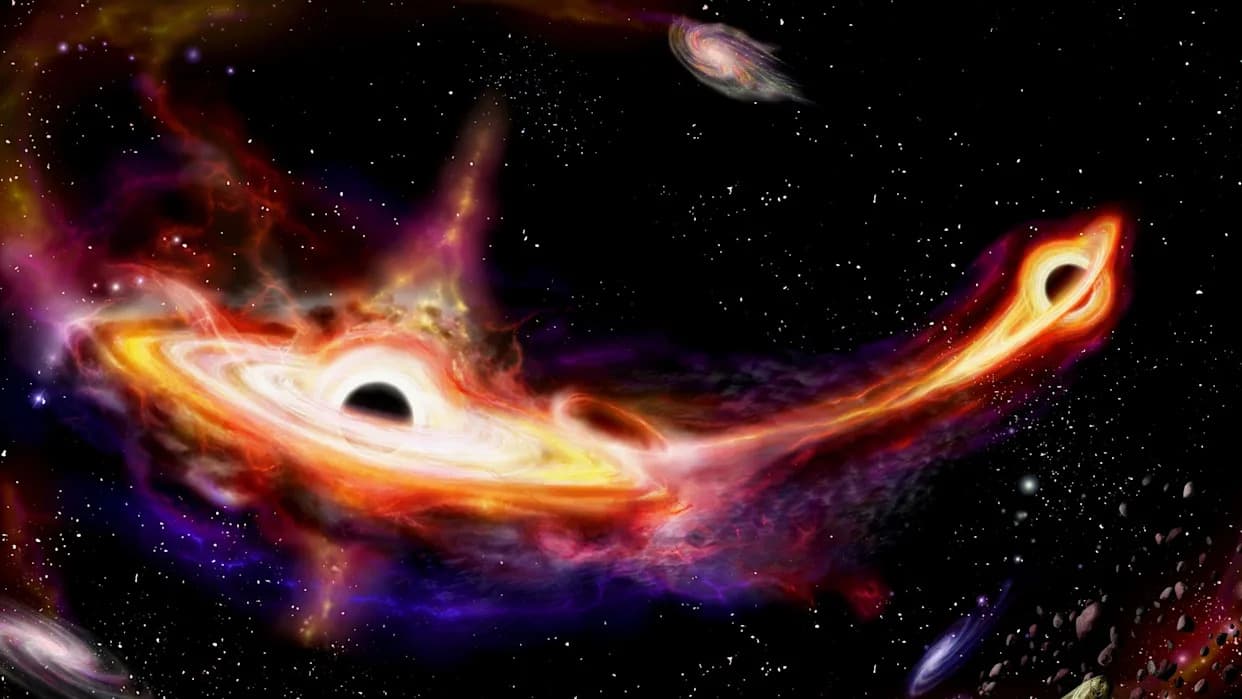
It's possible the two black holes could merge within the next century.
Supermassive black holes pose a long-standing puzzle: building their enormous masses by ordinary gas accretion can take longer than the age of the universe, yet these objects sit at the centers of nearly every large galaxy. One leading solution is that supermassive black holes grow when smaller black holes merge during galactic collisions. Until now, direct observational evidence for such close, pre-merger supermassive binaries has been limited.
A team at the Max Planck Institute for Radio Astronomy reports what it calls the clearest observation yet of two supermassive black holes orbiting one another inside the elliptical galaxy Markarian 501 (Mrk 501). The study, published in Monthly Notices of the Royal Astronomical Society, is based on a radio-frequency dataset compiled from dozens of observations spanning 23 years.
Observations and Evidence
Mrk 501 has a relativistic jet — a stream of charged particles launched at nearly the speed of light — and that jet is unusually bright because it points roughly toward Earth. Careful analysis of the long-term radio data revealed not a single jet but two distinct jets emerging from the galaxy's core on different trajectories. Over the course of weeks, astronomers tracked the second jet as it appeared behind the first and then moved counterclockwise around it.
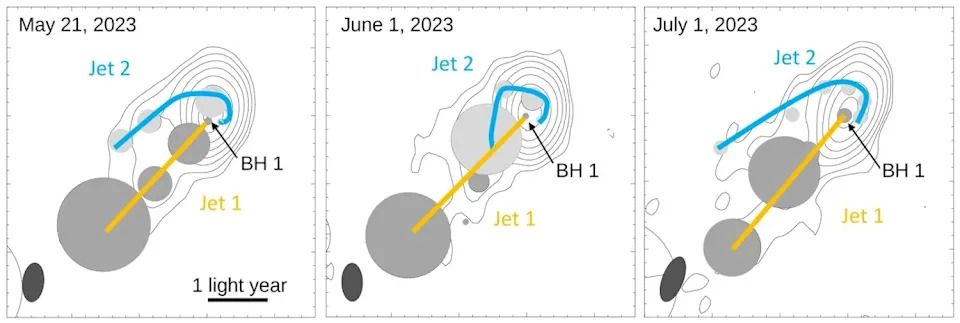
The graphical depiction shows the central region of the galaxy Mrk 501 at a frequency of 43 gigahertz on three different days. The contours indicate the intensity of the emission, while the grey circles mark bright regions within the jet, identified through model calculations. One can track the movement of the jets by following the movement of these regions. The previously known jet (Jet 1, orange guide line) pointing towards Earth is clearly visible. The newly discovered second jet (Jet 2, blue) changed its appearance within a few weeks. Both particle streams originate close to each other in the core of the galaxy. The position of the black hole (BH) associated with Jet 1 is marked with an arrow. Credit:Silke Britzen
In June 2022 the emission geometry became highly distorted, producing radiation that traced an almost circular pattern consistent with an Einstein ring. The team interprets this as a brief moment of near-perfect alignment in which gravitational lensing by the nearer black hole bent the light from the second jet.
“We searched for it for so long, and then it came as a complete surprise that we could not only see a second jet, but even track its movement,” said study coauthor and astronomer Silke Britzen.
Orbital Properties and Timeline
By tracking repeated brightness cycles, Britzen and colleagues estimate that the two black holes orbit each other with a period of about 121 days. Their separation is roughly 250–540 astronomical units (AU) — 250–540 times the Earth–Sun distance. While that sounds large by human standards, it is extremely compact for objects with estimated masses between 100 million and 1 billion times the mass of the Sun. Given these values, the researchers calculate the pair could coalesce within roughly a century.
Why This Matters
Mrk 501 lies more than 440 million light-years from Earth, so astronomers do not expect to visually resolve a final merger even with the most advanced telescopes. Still, the persistent detection of dual jets provides strong empirical support for the idea that supermassive black holes can grow through mergers. If the binary interpretation is correct, the system should eventually emit ultra–low-frequency gravitational waves that may be detectable by current or future pulsar timing arrays and related observatories, providing a further test of the discovery.
These observations mark an important step toward understanding how the universe builds its most massive black holes and underscore the value of long-term, high-precision radio monitoring.
Help us improve.