
Pete Hegseth said US strikes had shattered Iran's military capacity and that Tehran "begged" for a two-week ceasefire after 40 days of fighting. The pause, announced by Donald Trump after Pakistani mediation, brings a temporary halt to more than five weeks of conflict that left over 5,000 dead across the region. Key terms remain disputed — including nuclear enrichment rights and whether the truce covers Lebanon — and both sides warned they remain ready to respond if the ceasefire is breached.
Hegseth Says Iran 'Begged' For Two-Week Ceasefire After Devastating US Strikes
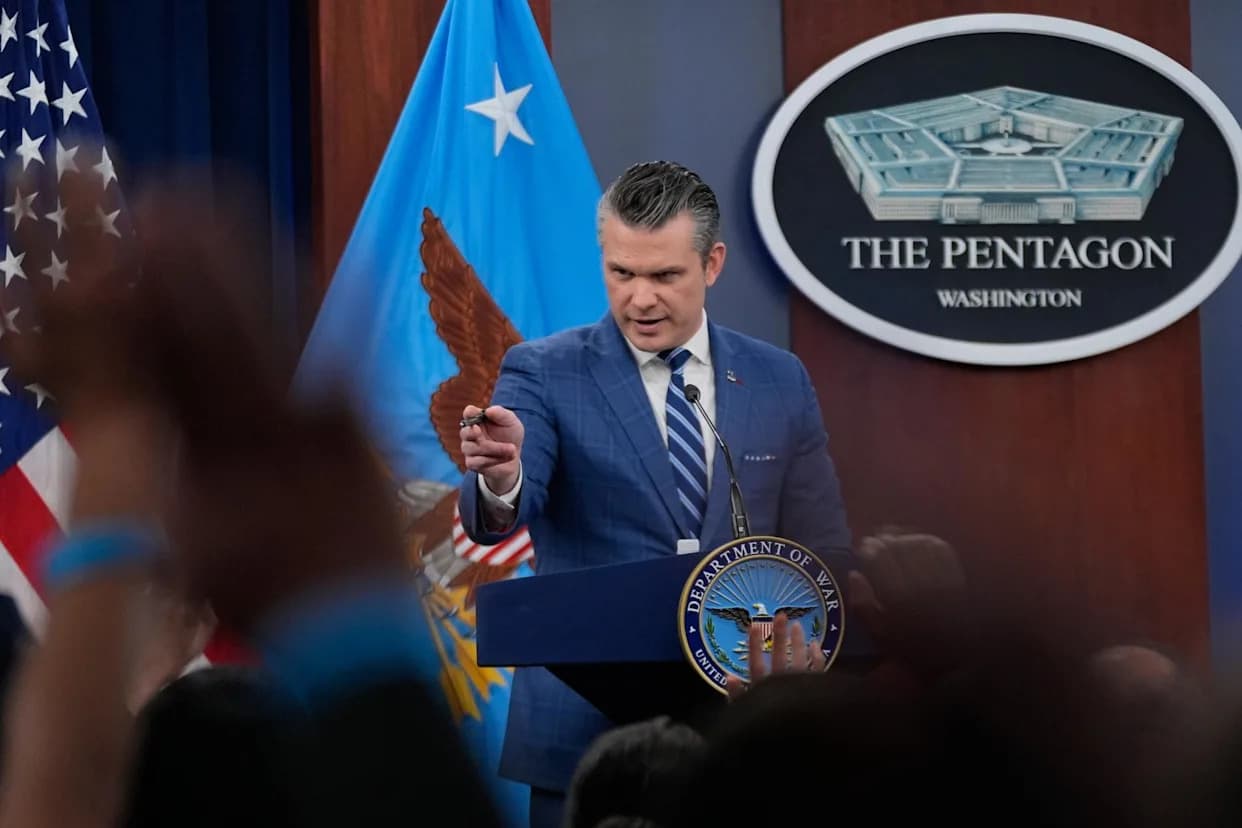
Pete Hegseth, the US defense secretary, speaks to members of the media during a press briefing at the Pentagon in Washington, on 8 April 2026.Photograph: Manuel Balce Ceneta/AP(Photograph: Manuel Balce Ceneta/AP)
After 40 days of sustained fighting, US Defense Secretary Pete Hegseth told reporters at the Pentagon that US strikes had severely damaged Iran's military capabilities and defense industry, and that Tehran had accepted a temporary ceasefire. Hegseth framed the pause as the result of overwhelming military pressure while acknowledging that some capabilities remain in Iranian stockpiles.
"Iran begged for this ceasefire, and we all know it," Hegseth said during the Pentagon's first briefing since former President Donald Trump announced a two-week suspension of hostilities. "Operation Epic Fury decimated Iran's military and rendered it combat ineffective for years to come."
Standing beside the chair of the joint chiefs, Dan Caine, Hegseth said the final wave of strikes before Trump's deadline had "completely destroyed Iran's defense industrial base." He conceded, however, that Tehran still retained weapons in reserve: "They can still shoot," he said, "but they lack the capacity to mass-produce replacements quickly."
Diplomacy and a Fragile Pause
Trump announced a two-week suspension of hostilities on Truth Social, saying he had agreed to the pause after last-minute mediation by Pakistan's prime minister Shehbaz Sharif and army chief Gen. Asim Munir. Iran's foreign minister, Abbas Araghchi, later confirmed Tehran had accepted the pause, and Iran's supreme national security council said it would send a delegation to Islamabad for formal talks starting Friday.
Iran framed the pause as a victory, with its security council stating that "nearly all the objectives of the war have been achieved." Officials on both sides, however, left significant terms unresolved.
Casualties, Costs and Contradictions
Caine confirmed that 13 US service members were killed during the hostilities. Regional death tolls reported by multiple sources exceed 5,000, including more than 1,600 Iranian civilians and heavy casualties in Lebanon. The US military reportedly spent roughly $12.7bn by day six of the conflict, with a supplemental funding request of about $200bn pending before Congress.
Conflicting post-war statements have left key issues unresolved. Trump asserted that Iran would hand over its enriched uranium and that there would be "no enrichment" going forward. Iran's published 10-point counter-proposal, however, explicitly insists on preserving the right to enrich uranium. The geographic scope of the ceasefire is also disputed: Israel says the pause does not apply to Lebanon, while Pakistan and Iran say it does. Reports of continued missile and drone activity in the region followed the ceasefire announcement.
Iran's supreme national security council warned: "Our hands are on the trigger, and the moment the enemy makes the slightest mistake, it will be met with full force."
When asked how long US forces would remain in the region, Hegseth gave a blunt answer: "We're not going anywhere."
Outlook
The two-week pause opens a narrow window for diplomacy but leaves major questions unanswered: the long-term fate of Iran's nuclear activities, the ceasefire's geographic scope, and the scale of reconstruction required after extensive strikes. Observers caution that many claims about battlefield outcomes and leadership casualties remain contested or unverified outside official statements, underscoring the fragile nature of the current lull in fighting.
Help us improve.





















