The BJP has formally recognised five Assamese Muslim subgroups as Indigenous and is courting their votes ahead of Assam's assembly election, even as demolitions and evictions have displaced hundreds. In March, bulldozers razed homes in Bongora, leaving around 400 families homeless, including Goriya residents who say they were evicted despite their Indigenous identity. Analysts say the outreach is an electoral strategy to soften the party's communal image and win decisive seats, but many Indigenous Muslims distrust the BJP due to broader exclusionary policies and cultural moves they view as erasure.
‘We’re the New Miyas’: Can the BJP’s ‘Indigenous’ Label Protect Some Assamese Muslims?
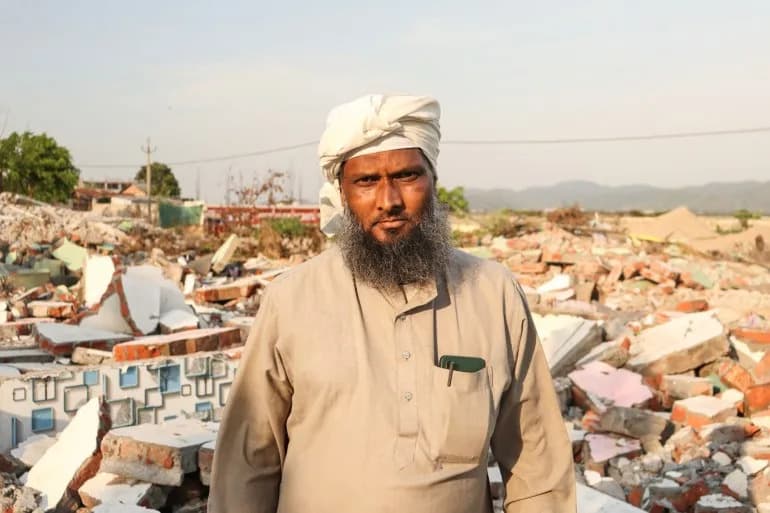
Akram Ali stands at the ruins of his four-room house in Bongora [Arshad Ahmed/Al Jazeera]
Akram Ali stood amid the rubble of his four-room house under the fierce April sun, sifting through debris he said he had spent decades building. 'This was my home built more than 45 years ago,' the 50-year-old told reporters, wiping away tears. 'Now it's all rubble.'
On the morning of March 14, bulldozers moved into Islampur, a largely Muslim neighbourhood in Bongora on the outskirts of Guwahati. Over roughly four hours, more than three dozen machines demolished houses across 177 hectares (437 acres) of land the state says is reserved for Assam's Indigenous people, leaving about 400 families homeless.
Ali, a daily-wage worker who now sleeps in a tarpaulin shelter a few kilometres away, insists his home was razed despite his community's recognised Indigenous status. 'I am Goriya, son of the soil, but my home was still flattened,' he said. 'It was my entire life's hard work.'
Who Are The Goriyas And Why Does Recognition Matter?
The Goriyas are an Assamese-speaking Muslim community concentrated in the tea-growing belt of eastern Assam. In 2022, the ruling Bharatiya Janata Party (BJP) recognised five Muslim subgroups — Goriya, Moriya, Syed, Deshi and Julha — as native or Indigenous to the state. That recognition distinguishes them politically and culturally from Bengali-speaking Muslims, derogatorily labelled 'miyas' and long accused of being outsiders or illegal migrants despite many families having lived in Assam for generations.
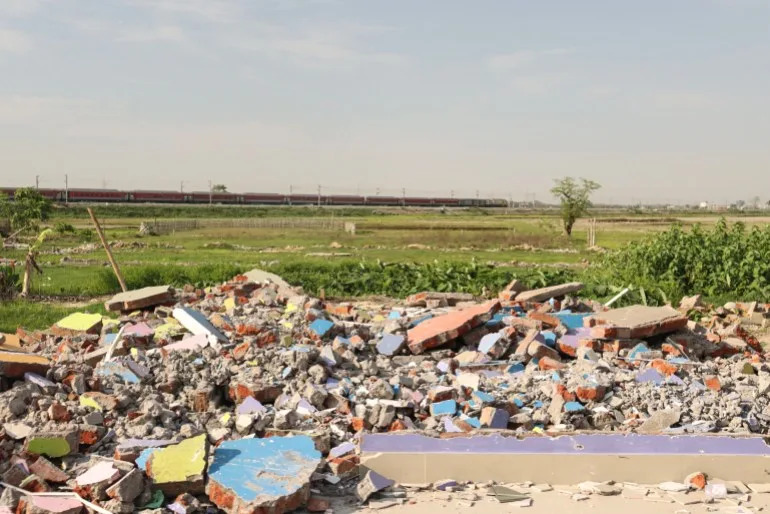
The ruins of Akram Ali’s house after it was demolished in Bongora [Arshad Ahmed/Al Jazeera]
According to the 2011 census, Muslims make up more than a third of Assam's roughly 31 million people. Of them, nearly 6.3 million are Bengali-speaking, while about 4 million are counted as Indigenous Assamese Muslims.
Politics, Strategy And Local Impact
As Assam prepares for a legislative assembly election, the BJP has actively courted Indigenous Muslim votes. Chief Minister Himanta Biswa Sarma, a polarising leader who has led efforts targeting what his administration calls the influence of 'miyas', has repeatedly distinguished Indigenous Assamese Muslims from Bengali-origin communities. At a rally on March 6 he declared Indigenous Muslims 'support the BJP', while party officials say they are seeking as many votes as possible from Assamese Muslim voters.
Analysts say the outreach is motivated by two central factors: softening the BJP's communal image and capturing decisive votes in constituencies where Indigenous Muslim turnout can change results. Bonojit Hussain, a political analyst in Assam, warned that stoking division between Hindus and Muslims could puncture Assam's shared social fabric, since Assamese Hindus and Muslims share much of the same culture beyond religion.
In several northern and eastern assembly constituencies, analysts estimate Assamese Muslim voters often number between 30,000 and 50,000 — enough to swing close races. For example, Nalbari's electorate of more than 195,100 voters includes over 25 percent Assamese Muslim voters; Barkhetri's roll of about 217,028 includes roughly 80,000 Assamese Muslim voters.
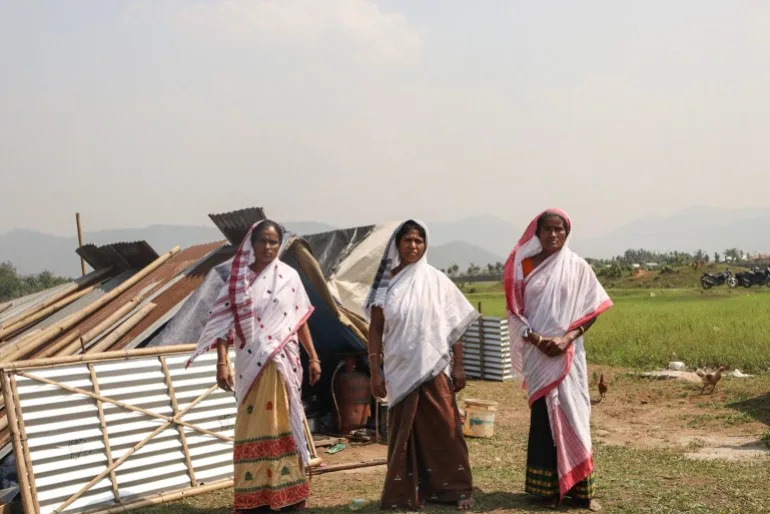
Three Indigenous Muslim women clad in traditional Assamese attire [Arshad Ahmed/Al Jazeera]
Trust, Evictions And Cultural Fears
Despite official recognition and outreach, many Indigenous Muslim leaders and residents remain sceptical. Community groups say evictions, voter-list objections, demolitions and high-profile cultural decisions have undermined trust. Before the Bongora demolitions, hundreds of Goriyas were evicted from land in Lakhimpur and Golaghat districts, and thousands faced objections on electoral rolls.
Activists also point to cultural moves they say erode the community's legacy: the renaming of a medical college in Barpeta that honoured former president Fakhruddin Ali Ahmed, debates over the combined commemorative name Sankar-Azan, and public questioning of historical Indigenous Muslim figures such as Ismail Siddique (Bagh Hazarika).
'Any allegations of Assamese Muslims being evicted and pushed across to Bangladesh is malicious, biased and politically motivated,' BJP spokesman Kishore Upadhyay told reporters, rejecting claims of expulsions and punitive actions.
But for residents like Ali, policy distinctions have offered little protection. 'After we were evicted, the chief minister said we are illegal immigrants. He has already broken our backbones by demolishing our homes,' he said. 'We are the new miyas.'
What This Means Going Forward
The BJP's selective recognition and outreach may win some votes or soften perceptions in certain regions, but deep mistrust remains among many Indigenous Muslims who have experienced eviction, administrative challenges and what they see as cultural erasure. Whether the party's moves translate into durable protection for these communities — or merely an electoral strategy — will be tested at the ballot box and in how the state addresses land, voter rights and cultural recognition going forward.
Help us improve.