
During the Artemis II lunar flyby, astronauts reported six brief meteorite impact flashes on the Moon, describing them as "pinpricks of light" lasting about a millisecond and appearing white to bluish white. Ground teams will correlate the crew's observations with lunar-orbiter data to confirm impact sites and timings. Scientists say the eyewitness reports help estimate impact frequency and projectile size and underscore the need to monitor meteoroid flux before building permanent lunar bases.
Artemis II Astronauts Spot Meteorite 'Pinpricks' on Moon — Six Flashes Seen During Historic Flyby
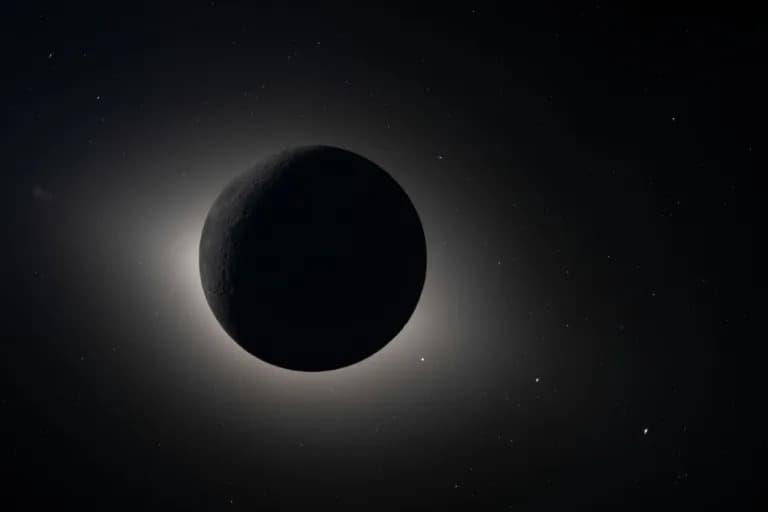
NASA photograph showing the lunar eclipse witnessed by Artemis astronauts during their flight around the moon on April 6, 2026 (Handout)(Handout/NASA/AFP)
During NASA's milestone Artemis II lunar flyby, the crew reported seeing multiple meteorites strike the Moon's rugged surface — brief flashes that captured the attention and excitement of scientists back on Earth.
Mission commander Reid Wiseman radioed, "That was definitely impact flashes on the moon. And Jeremy (Hansen) just saw another one," as the spacecraft circled the Moon — the first human lunar loop in more than half a century. Kelsey Young, the mission's lunar science lead, monitored the events from more than 250,000 miles (400,000 kilometers) away and said she was surprised and delighted by the sightings.
Backup astronaut Jenni Gibbons told reporters the phenomenon is "something that we have not witnessed often," and noted that these observations were high-priority science for the mission. According to NASA's preliminary tally, the crew reported a total of six impact flashes during their nearly seven-hour observation window.
What the Crew Saw
Canadian crew member Jeremy Hansen described the events as "a pinprick of light," adding, "I would suspect there were a lot more of them." Wiseman estimated each flash lasted roughly a millisecond — "like the fastest a camera shutter can open and close" — and described their color as "white to bluish white." He added, "To me there was no doubt we were seeing it, and we were all seeing it."
Scientific Follow-Up
Ground teams in Houston are now working to correlate the crew's visual reports with data from a lunar-orbiting satellite to confirm locations and times of the impacts. Many of the sightings occurred while the Moon was in front of the Sun — a configuration that can make brief flashes easier to spot against bright terrain.
Experts say these eyewitness accounts are valuable for estimating how often meteoroids strike the Moon and for constraining the sizes of the impacting objects.
Why It Matters
Bruce Betts, chief scientist at the Planetary Society, noted the descriptions can help scientists estimate impact frequency and projectile size — likely larger than dust but smaller than meter-scale boulders. Peter Schultz, Professor Emeritus of Geological Sciences at Brown University, said the findings emphasize the need to monitor the "daily flux" of meteoroids more closely before establishing permanent lunar infrastructure. Unlike Earth, the Moon lacks an atmosphere to burn up small meteoroids, so even relatively small impacts can reach the surface.
These observations — eyewitnessed from roughly 250,000 miles away by a trained crew — provide a unique dataset that mission scientists will combine with orbital and ground-based measurements to refine models of lunar impact rates and hazards.
Help us improve.





















