The sanctioned Russian tanker Anatoly Kolodkin delivered about 700,000 barrels of oil to Matanzas shortly before Cuba released 2,010 prisoners—moves many observers link to discreet talks between Washington and Havana. The U.S. oil blockade has severely damaged tourism and daily life, leaving an estimated 9.5 million people coping with shortages and frequent blackouts. Diplomats say the shipments and prisoner releases may be reciprocal confidence-building gestures, while a growing private sector tied to Gaesa could shape any negotiated economic opening—even if regime figures retain influence.
Oil Shipments and Prisoner Releases Fuel Speculation of Quiet U.S.–Cuba Talks
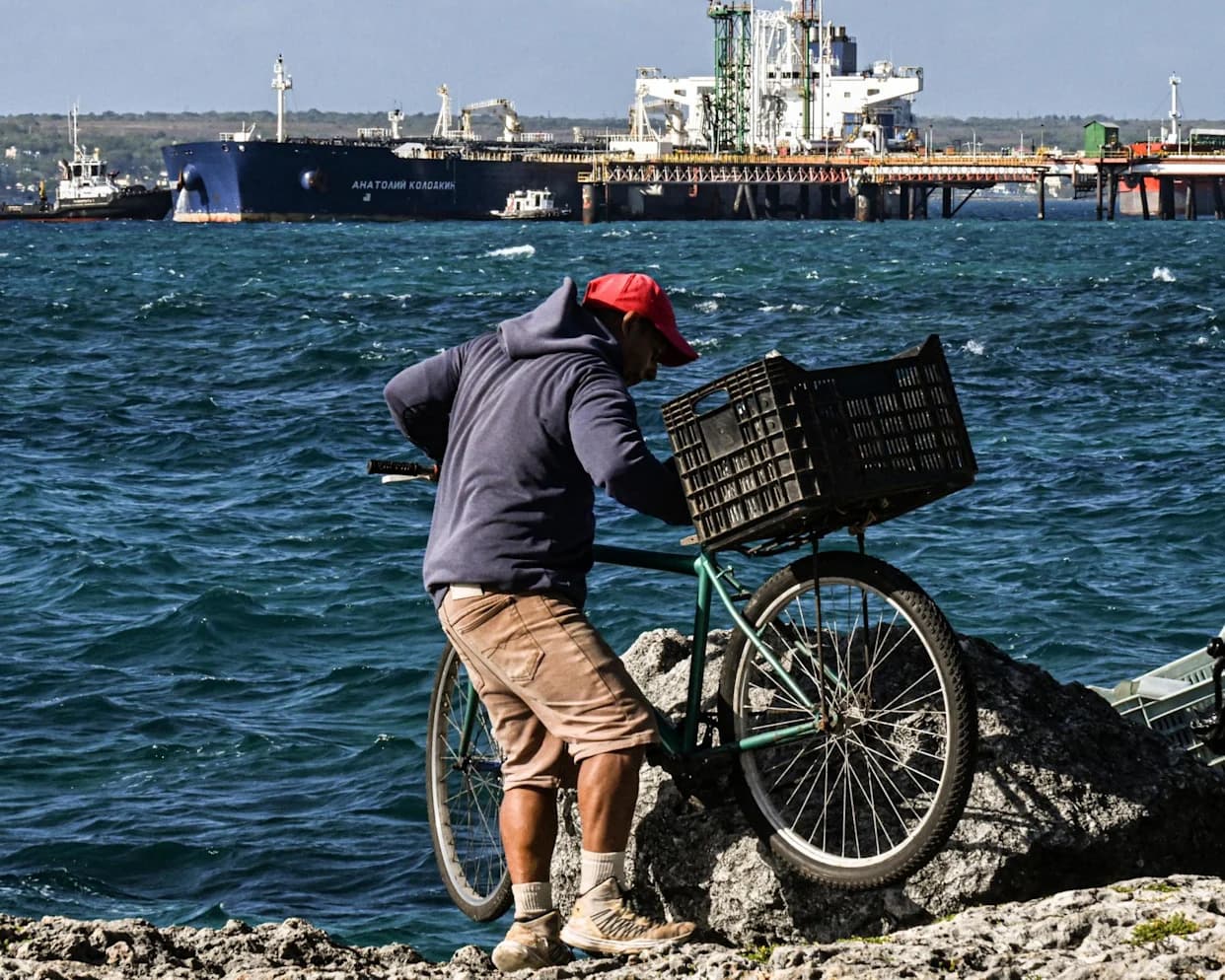
A man holds a bike as the Russian oil tanker Anatoly Kolodkin is seen at the oil terminal in the port of Matanzas, north-western Cuba, on 31 March.Photograph: Yamil Lage/AFP/Getty Images(Photograph: Yamil Lage/AFP/Getty Images)
When the sanctioned Russian tanker Anatoly Kolodkin docked at Cuba’s Matanzas terminal and unloaded roughly 700,000 barrels of crude, many on the island were left asking why the vessel had been allowed through what had been described as an American oil blockade.
In January, President Donald Trump posted on social media: “THERE WILL BE NO MORE OIL OR MONEY GOING TO CUBA – ZERO!” Yet last week he told reporters, “If a country wants to send some oil into Cuba right now, I have no problem with it,” effectively allowing the Russian ship to proceed. Two days later, Havana announced the release of 2,010 prisoners. The government called it a humanitarian gesture for Holy Week; outside observers quickly linked the two moves and interpreted them as signs that discreet negotiations between Washington and Havana are ongoing.
Humanitarian Strain and Economic Collapse
The U.S. oil restrictions have deepened an already fragile Cuban economy. Tourism has virtually stalled after carriers from Canada, Russia, China and France suspended flights, and Spain’s Iberia has said it will end service at the end of May. Most petrol stations remain closed, and daily power outages—once episodic—are now common.
After an exodus of roughly 2 million people over the past five years, the island’s remaining population is estimated at about 9.5 million. Many residents report shortages and collapsing public services. “Everything is collapsing – health, education, transport, everything,” a man said outside a church in El Cobre, a well-known pilgrimage site in eastern Cuba.
Signals, Leaks and Diplomatic Reading
Information about the talks has been sparse and often stems from U.S. sources, leaving Cubans to parse fragments for meaning. Diplomats offer two broad readings of the sequence of events: one sees the ship’s arrival as a tactical move by Washington to point to a concrete action while the humanitarian crisis worsens; the other views it as a possible confidence-building measure in an ongoing dialogue.
“It suggests that the two sides may be making reciprocal gestures of good will to advance the conversations they have been having,” said William LeoGrande, a government professor at American University.
Another Russian tanker, the Sea Horse, has been reported loitering in the Atlantic with about 200,000 barrels on board. As the Anatoly Kolodkin entered Cuba, the Sea Horse moved toward Venezuela—suggesting a choreography of fuel shipments used as diplomatic leverage.
Economic Opening, Elite Continuity
Cuba’s small and medium private enterprises—known as Mipymes—have expanded rapidly since 2021. More than 10,000 Mipymes now operate across the island, creating a cadre of wealthy entrepreneurs, some of whom have ties to Gaesa, the military-run conglomerate that controls significant economic activity.
Prominent negotiators include Raúl Guillermo Rodríguez Castro, grandson of former president Raúl Castro and son of the late Gaesa chief Luis Rodríguez López-Calleja. Diplomats also note public comments by Sandro Castro, Fidel Castro’s grandson, who has criticized President Miguel Díaz-Canel and promoted a more market-oriented approach—remarks that in earlier years might have triggered security scrutiny but that have gone unanswered this time.
Those developments have led analysts to speculate about a transactional outcome: an opening of the economy to foreign investment and U.S. business while senior regime figures retain political influence. That scenario would align with President Trump’s stated preference for a “friendly” transition and could yield a high-profile diplomatic win.
Risks and Domestic Consequences
Any negotiated opening that preserves elite influence raises difficult questions about who benefits. Roughly 40% of Cubans do not work in the private sector or receive remittances; many are elderly and dependent on state services. With public services crumbling and shortages intensifying, these groups face the gravest risks.
How hardline critics—particularly in Miami and among influential U.S. policymakers—would react if prominent Castro-family figures retained power remains uncertain. For now, the island watches for further, often subtle signals that could indicate whether back-channel diplomacy is advancing toward a tangible deal.
Help us improve.