
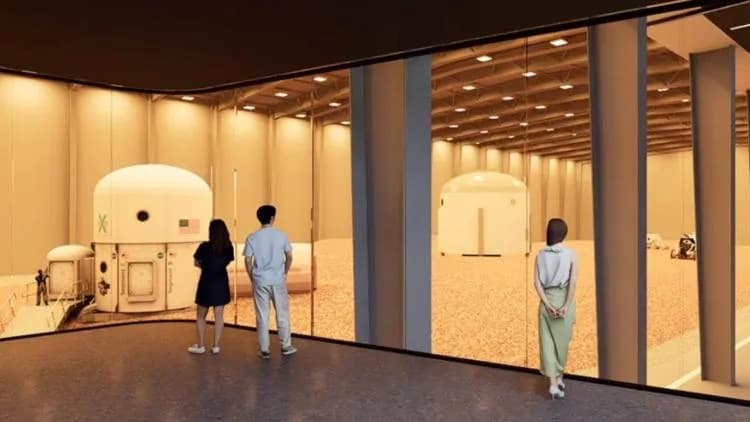
The Texas A&M University Space Institute at NASA’s Johnson Space Center has topped out, completing the structural frame of a 400,000-square-foot facility. NASA also released plans for 183.7 acres to be developed as Exploration Park, which will host the institute and other projects. Vaughn Construction said the next phase will build 234,000 square feet of indoor testing beds to simulate Moon and Mars terrain, creating what it calls the world’s largest indoor Moonscape and Marscape. The complex will support testing, crew training and workforce development for future space missions.
Texas A&M Space Institute Tops Out as NASA Unveils Exploration Park Plans
Texas A&M University
As crews prepare for a mission that will send astronauts circling the Moon this week, a Houston facility designed to recreate lunar and Martian terrain has reached a major construction milestone.
In late March, Houston-based Vaughn Construction announced the Texas A&M University Space Institute, located within NASA’s Johnson Space Center’s Exploration Park, has topped out, completing the structural frame of the 400,000-square-foot facility.
Next Phase: Realistic Moon and Mars Testing Beds
Vaughn said the next phase will build 234,000 square feet of indoor testing beds that will simulate the surfaces of the Moon and Mars. In a LinkedIn post, the company described the completed project as housing the world’s largest indoor Moonscape and Marscape for testing, crew training and workforce development.
Exploration Park Expansion
This week NASA detailed plans for the 183.7 acres it is opening to develop Exploration Park, the campus that will host the Space Institute alongside other research and commercial projects. The site is intended to support upcoming lunar missions and broader commercial and research activities near the Johnson Space Center.
“This 400,000-square-foot facility at (NASA Johnson Space Center’s) Exploration Park houses the world’s largest indoor Moonscape and Marscape for testing, training, and workforce development to support future space exploration missions,” Vaughn said in its announcement.
The complex is expected to be a central hub for testing new vehicles, training crews, and developing the workforce needed for future deep-space missions. For more details, continue reading on the Houston Business Journal website.
This story is published in partnership with the Houston Business Journal. For news tips or story ideas, email [email protected] with the best way to reach you.
Help us improve.





















