NASA released a photo of the Nancy Grace Roman Space Telescope undergoing acoustic and vibration testing at Goddard Space Flight Center. Engineers exposed the observatory to acoustic levels up to 138 dB and used a shaker table to simulate launch vibrations, validating its resilience. The $4B+ mission features a 2.4-meter mirror with a field of view about 100 times Hubble's and a coronagraph for exoplanet imaging; launch is targeted as early as fall 2026.
Roman Space Telescope Survives 138 dB Acoustic Blasts and Shaker Tests Ahead of 2026 Launch
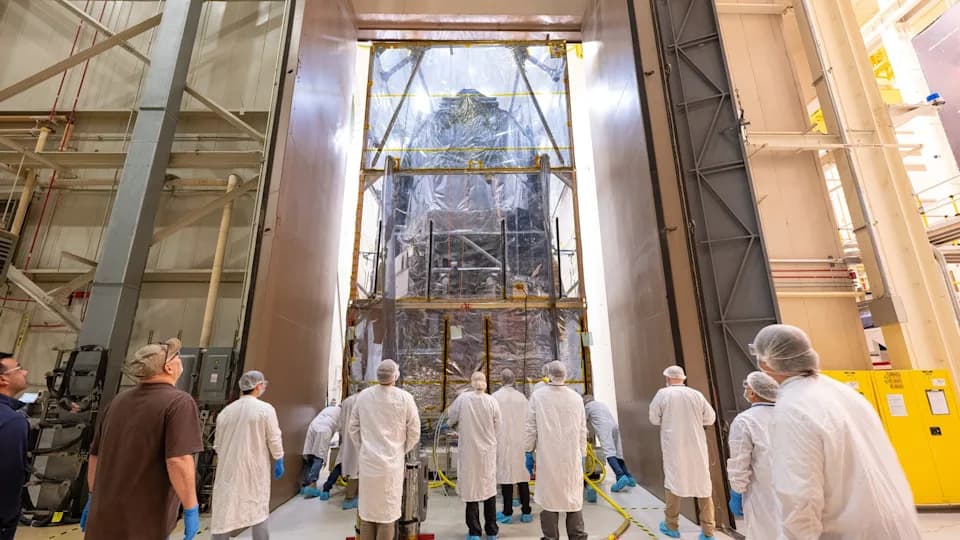
Technicians move NASA's Nancy Grace Roman Space Telescope into an acoustics chamber for environmental testing at the agency's Goddard Space Flight Center. | Credit: NASA/Jolearra Tshiteya
NASA has released a striking photo of the next-generation Nancy Grace Roman Space Telescope undergoing environmental testing at the agency's Goddard Space Flight Center (GSFC) in Maryland. The image offers a behind-the-scenes look at the rigorous verification campaign designed to ensure the observatory survives the extreme noise and vibration of launch.
Engineers placed Roman inside a sound booth and subjected it to acoustic energy up to 138 decibels — roughly the intensity of a jet engine heard from about 100 feet (30 meters) away — to reproduce the powerful sound environment during liftoff. "If you've ever been at a concert with an extremely loud bass, that load you felt was acoustic energy," said Cory Powell, lead Roman structural analyst at Goddard. "Now think about how loud a launch is. The acoustics can produce very high loads on a large structure like Roman."
"If you've ever been at a concert with an extremely loud bass, that load you felt was acoustic energy. Now think about how loud a launch is. The acoustics can produce very high loads on a large structure like Roman." — Cory Powell, Lead Roman Structural Analyst, GSFC
In parallel, technicians mounted Roman on a shaker table to simulate the intense vibration profiles experienced during ascent. These mechanical tests verify that the telescope's structure and scientific instruments remain intact and fully operational after launch stresses.
The Roman observatory carries a 2.4-meter (about 8-foot) primary mirror — similar in size to Hubble's — but its Wide Field Instrument will capture a field of view roughly 100 times larger than Hubble's, enabling far more efficient surveys. Roman also includes a coronagraph designed to block starlight so the telescope can directly image planets around other stars and test technologies for future exoplanet missions.
Estimated at more than $4 billion, the Roman mission aims to map large-scale cosmic structure, probe the nature of dark energy and dark matter, detect distant black holes, and potentially discover tens of thousands of exoplanets. The mission is currently targeted to launch as early as fall 2026.
This round of environmental testing is a critical step toward a successful deployment: validating hardware, uncovering potential weak points, and giving engineers confidence that Roman will reach orbit ready to begin its science program.
Help us improve.