
Artemis II will send four astronauts in an Orion capsule on a roughly 10-day mission to orbit the Moon, likely as soon as April 2026. Scott Pace explains how post-shuttle choices after Challenger and Columbia favored a capsule architecture and the SLS heavy-lift rocket. Key risks include solid rocket booster performance, a pre-translunar life-support check, and Orion’s heat-shield performance during reentry. The long-term possibility of permanent lunar activity depends on local resources and economic viability.
Artemis II: NASA’s Crew Will Orbit the Moon — What’s at Stake and Why It Took Decades to Get Here
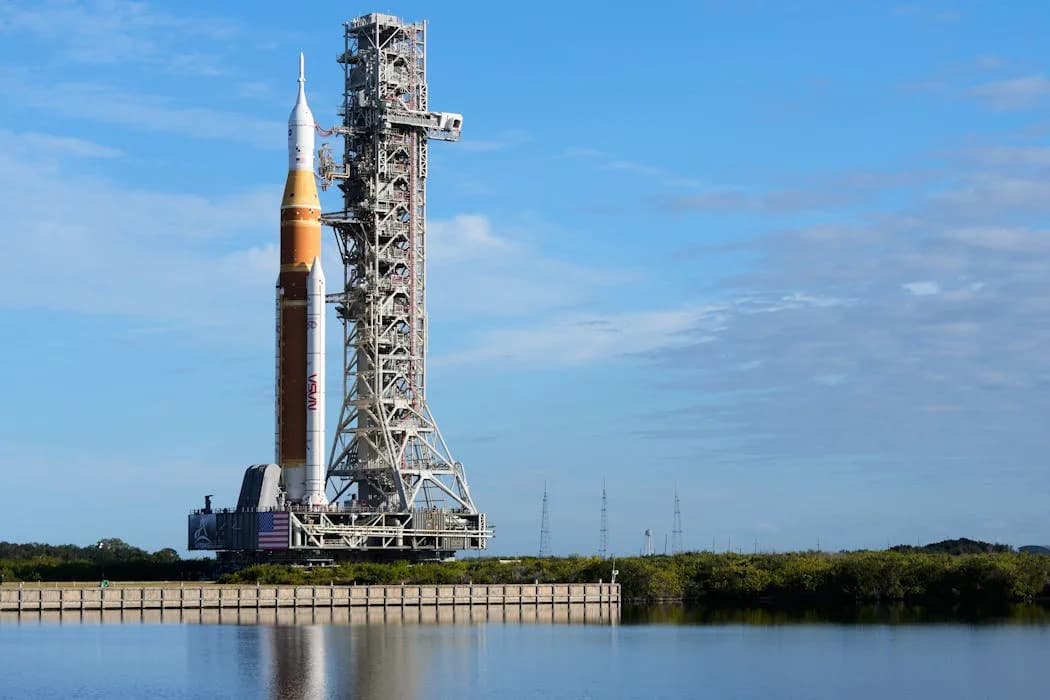
NASA's Space Launch System rocket will launch a crewed capsule into orbit and then on a mission around the Moon.AP Photo/John Raoux
NASA is preparing to return humans to lunar orbit for the first time since the 1970s. As early as April 2026, Artemis II is scheduled to lift off on the Space Launch System (SLS) heavy-lift rocket carrying an Orion crew capsule and a four-person crew on a mission that will last roughly 10 days. Crucially, Artemis II will orbit and loop around the Moon — it will not land.
How We Got Here
Scott Pace, director of the Space Policy Institute at George Washington University, traces the path to Artemis through decades of policy choices and engineering trade-offs. After the Challenger disaster in 1986 and the Columbia accident in 2003, NASA faced hard questions about safety, cost and the future architecture of human spaceflight.
Shuttle operations proved expensive on a per-flight basis, and ambitious alternatives (for example, single-stage-to-orbit spaceplanes) were high risk. In the wake of Columbia, NASA prioritized crew safety and transition plans that could reuse industrial capabilities from the shuttle era: solid rocket boosters and large tanks became elements in a new design, while a capsule with a launch escape system emerged as the safest near-term approach for crewed launches. Combined with long-range goals such as human missions to Mars, those choices led to development of the SLS heavy-lift rocket and the Orion capsule.

The crew members of the Artemis II mission are, counterclockwise from left NASA astronauts Christina Hammock Koch, Reid Wiseman and Victor Glover and Canadian Space Agency astronaut Jeremy Hansen.NASA
What To Watch On Artemis II
Artemis II is a test-focused mission with several critical checkpoints:
- Launch and Solid Rocket Boosters: Boosters must perform reliably; booster failures are infrequent but can be abrupt.
- Pre-Translunar Decision Point: While still in Earth orbit, controllers will verify the Orion environmental control and life support system (ECLSS) before committing to the translunar injection (TLI) burn that sends the vehicle toward the Moon.
- Translunar Injection and Trajectory: The planned trajectory loops around the Moon and uses lunar gravity to return to Earth — a profile Pace likens more to Apollo 13 than Apollo 8 because it requires fewer engine burns.
- Reentry and Heat Shield Performance: The Orion heat shield has a complex development history; Artemis II will provide valuable data on how it endures the high heating loads of Earth reentry.
Programmatic Challenges
Pace highlights two major program-level concerns: the high per-vehicle cost of SLS (each rocket costs on the order of billions of dollars) and questions about a sustainable flight rate. Those issues affect long-term planning and cost-efficiency for lunar and deep-space operations.
Geopolitics and the Question of 'Beating' China
Does it matter if the U.S. reaches the Moon before China? Pace says it matters mainly if one nation alone establishes the norms, standards and operating practices for lunar activity. He frames the current dynamic not as a short sprint or race but as a long-term strategic competition. While space is not as contentious as territorial disputes on Earth, behavior in other domains gives reason for vigilance and for shaping inclusive international norms.
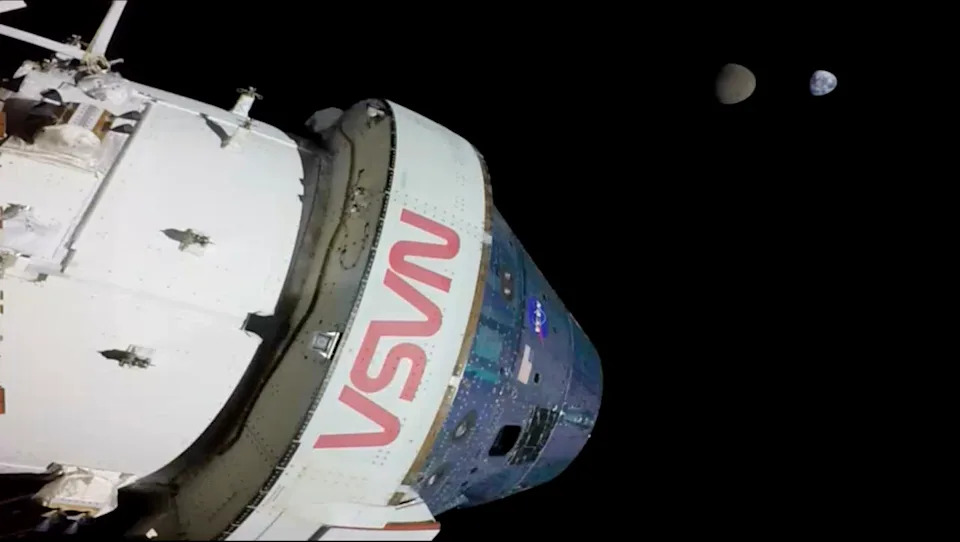
NASA’s Orion spacecraft had a view of both Earth and the Moon during the Artemis I mission.NASA via AP
Could Humans Stay on the Moon Permanently?
Pace distills the question of a lasting lunar presence into two practical points: Can people live off local resources? and How will operations be paid for? He outlines three plausible futures:
- Self-Sustaining Settlements: If local resources can be used and activities can generate a profit, private-led settlements could emerge.
- Commercial But Dependent Outposts: If economic activity is viable but the environment cannot support long-term habitation, operations might resemble offshore oil platforms — economically driven but logistically difficult.
- Government-Funded Scientific Presence: If neither in-situ resources nor profitable activity materialize, the Moon may host research stations funded by governments, similar to Antarctic bases.
Exploration’s role is to determine which of these models is feasible in practice.
Why Artemis Is Designed As Partnerships
Space today is far more global and commercial than during Apollo. NASA recognizes it cannot and should not act alone; Artemis is structured as an international and commercial partnership intended to shape voluntary standards and broaden participation.
Disclosure: Scott Pace advises Sierra Space and serves on boards for the Planetary Science Institute and the National Security Space Association. He served as a political appointee in the George W. Bush and Donald J. Trump administrations and is director of the Space Policy Institute at George Washington University.
Artemis II is an important technical and policy milestone: a crewed test of systems needed for sustained exploration beyond low Earth orbit. Its success — or lessons learned — will influence NASA’s plans for the Moon, commercial partnerships, international cooperation and the long-term human future in space.
Help us improve.





















