XRISM observations in Dec 2024, Feb 2025 and June 2025 solved a 50-year mystery: the intense, erratic X-rays from gamma Cassiopeiae originate from a magnetized white dwarf accreting material from the system's 15-solar-mass Be star. The X-ray spectral features shift with a 203-day orbital period, linking the ultra-hot plasma (up to ~150 million K) to the compact companion. This confirms the predicted Be–white dwarf class and provides a key test case for models of binary evolution.
50-Year Mystery Solved: Gamma Cassiopeiae's X-Rays Traced to a White Dwarf

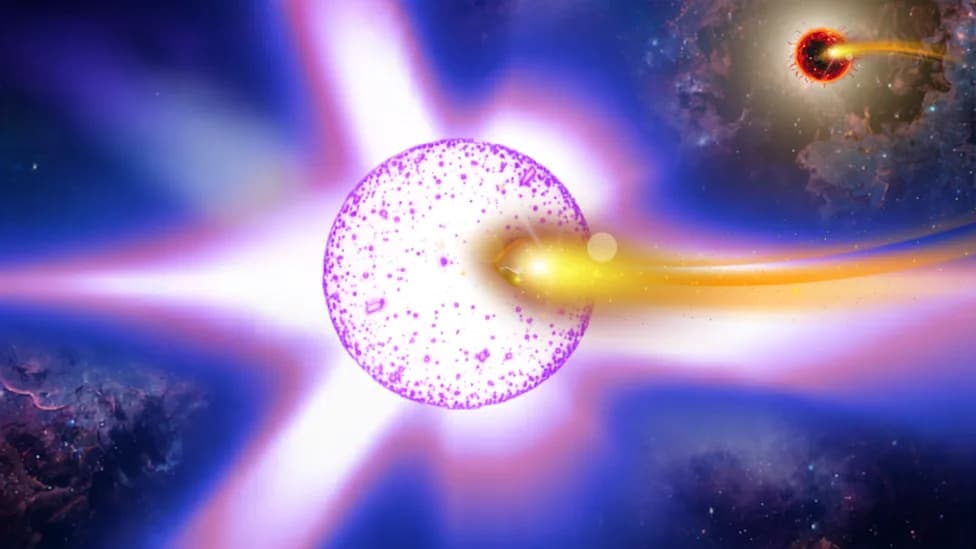
An artist's impression of Gamma Cassiopeia. (ESA/Y. Nazé)
For five decades astronomers have been puzzled by powerful, erratic X-rays coming from the bright blue star gamma Cassiopeiae (γ Cas). New high-precision observations with the joint JAXA–ESA–NASA mission XRISM now show that the X-rays do not originate on the Be star itself but from a compact, magnetized white dwarf accreting material from its massive companion.

The location of γ Cas in the northern sky. (Astronomy Now/Greg Smye-Rumsby)
Observations and Evidence
XRISM observed γ Cas in December 2024, February 2025 and June 2025. The X-ray spectral features shifted in velocity across those epochs, following an orbital modulation with a period of about 203 days. This motion ties the ultra-hot plasma directly to the unseen companion rather than to the Be star.
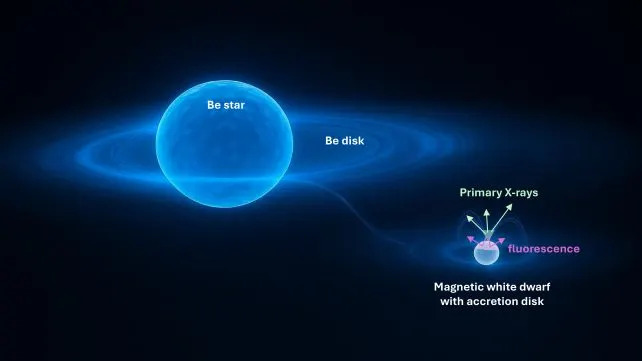
An infographic explaining the accretion-emission mechanism behind the X-rays. (University of Liège/Y.Nazé)
The X-ray emission is roughly 40 times brighter than expected for a normal Be star and indicates plasma heated to temperatures approaching 150 million kelvins. Those extreme properties require a compact, energetic source — exactly what accretion onto a magnetized white dwarf can produce.

Subscribe to ScienceAlert's free fact-checked newsletter
"There has been an intense effort to solve the mystery of γ Cas across many research groups for many decades. And now, thanks to the high-precision observations of XRISM, we have finally done it," says astrophysicist Yaël Nazé of the University of Liège.
How the System Works
The γ Cas system is a multiple-star ensemble about 550 light-years away, located at the central peak of the "W" asterism in Cassiopeia. Its brightest member is the prototype Be star — a blue-white giant of roughly 15 solar masses. The compact companion is a white dwarf, roughly Earth-sized but extremely dense and magnetized.
As the white dwarf orbits, it pulls material from the Be star's extended envelope or disk. The infalling gas is funneled along the white dwarf's magnetic field lines onto its magnetic poles, where the kinetic energy is converted to heat and X-rays as matter slams into the surface. This process explains both the luminosity and the very high plasma temperatures seen in the X-ray spectra.
Why This Matters
This result provides the first direct demonstration that γ Cas's ultra-hot plasma is associated with a compact companion and confirms the existence of the long-predicted class of Be–white dwarf binaries. Stellar-evolution models show how mass transfer in an earlier phase can produce a rapidly rotating Be star while the donor eventually becomes a white dwarf. γ Cas, long regarded as the archetypal Be star, now offers a concrete benchmark to refine models of binary interaction and stellar evolution.
The discovery and its analysis have been published in the journal Astronomy & Astrophysics.
Help us improve.