
Iran launched cluster-warhead missiles at central Israel days after the March 17 killing of Ali Larijani, killing at least two and injuring several. Cluster warheads disperse dozens of bomblets, turning a single incoming missile into many targets and making interception far more difficult. Human-rights groups warn of long-term danger from unexploded submunitions, while international law remains divided: the 2008 Convention bans cluster munitions for its 111 parties, but the US, Israel and Iran are not signatories.
How Iran’s Cluster Munitions Are Beating Israeli Defences — And Why Civilians Are at Risk
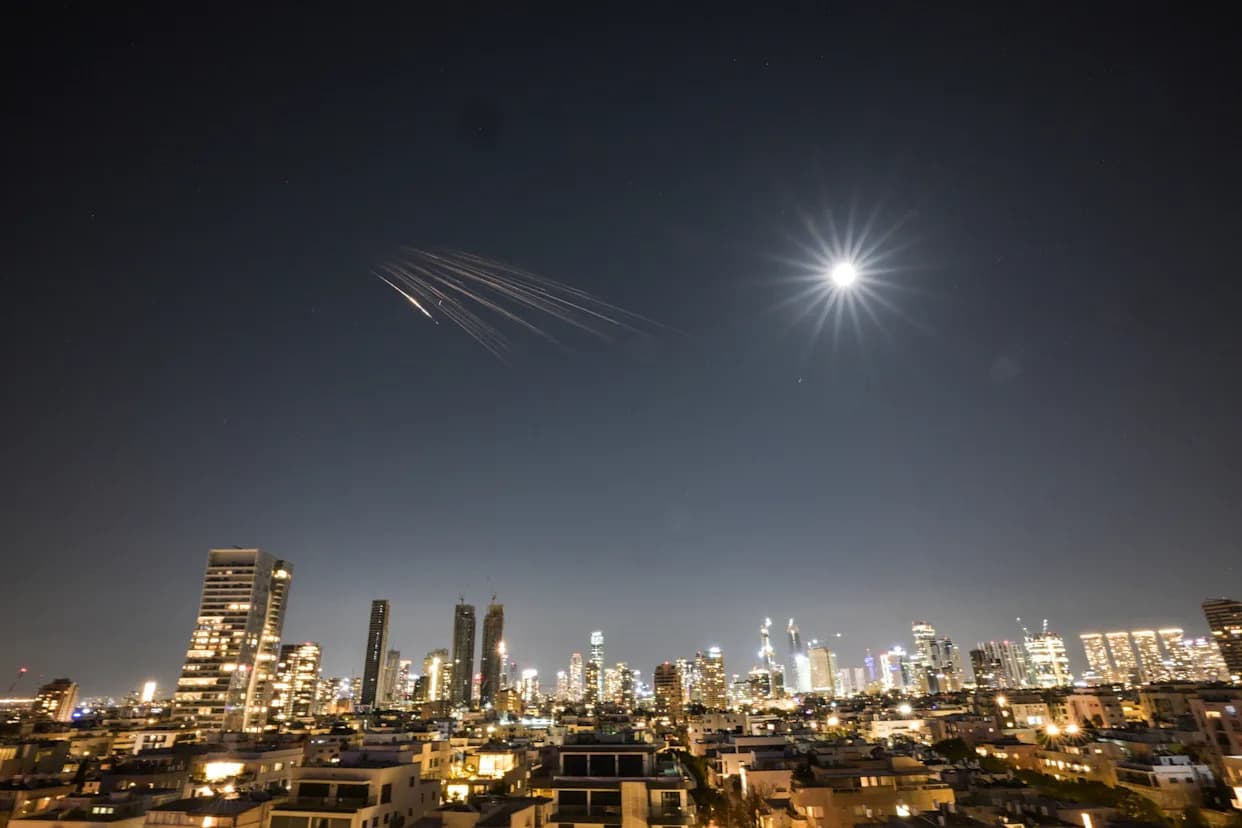
An Iranian missile with cluster munitions flies towards central Israel on March 5, 2026 [Dylan Martinez/Reuters]
Hours after Iran said it had avenged the March 17 assassination of senior security official Ali Larijani, the Islamic Revolutionary Guard Corps (IRGC) launched a barrage of missiles with cluster warheads at central Israel. The overnight strike targeted the Tel Aviv area, killing two people in Ramat Gan, wounding several others and causing notable property damage including at a train station, according to Israeli media.
What Happened
Al Jazeera reported that the two victims — a couple in their 70s — had a safe room but were unable to reach it in time, raising questions about the timeliness of air-raid alerts. Israeli officials said some interceptors were activated but failed to stop all incoming projectiles; an investigation is underway. Iran described the strikes as “revenge” for Larijani’s killing.
How Cluster Warheads Work
Unlike a single explosive payload, a cluster warhead carries many smaller submunitions, commonly called bomblets. As the missile nears its target the warhead opens and disperses dozens of bomblets across a wide area. That turns one incoming threat into multiple, separate targets — a factor that complicates interception and increases the chance of casualties and damage over a broader footprint.
“The tip of the missile, instead of containing a big barrel of explosives, contains a mechanism which holds onto a lot of small bombs. And when the missile approaches the target, it opens its skin… and the bomblets are released,” explained Uzi Rubin, founding director of Israel’s missile-defence programme.
Depending on design, Iranian cluster warheads reportedly hold roughly 20–30 bomblets or, in other configurations, 70–80. Once dispersed, interceptors must engage many small, fast-moving submunitions — a much harder task than shooting down a single warhead.
Iran’s Missile Inventory And Reach
Open-source material suggests Iran’s medium- and long-range systems include Shahab-3, Emad, Ghadr-1, Khorramshahr variants, Sejjil, and newer systems such as Kheibar Shekan and Haj Qassem. Cruise and surface-to-air missiles noted in reporting include Soumar, Ya-Ali, Quds variants, Hoveyzeh, Paveh and Ra’ad.
The Soumar is often cited as Iran’s longest-reach ballistic missile with an estimated 2,000–2,500 km range. There were unconfirmed reports that two missiles were fired toward Diego Garcia — roughly 4,000 km from Iran — but the UK said the attack failed and Iranian officials denied firing.
Former Supreme Leader Ali Khamenei reportedly maintained an informal missile-range cap near 2,200 km that was later removed. Iran’s missile programme has grown over decades to provide long-range strike options despite Tehran’s limited air force.
Humanitarian And Legal Concerns
Cluster munitions are not universally banned. The 2008 Convention on Cluster Munitions, to which 111 countries are party (including most European states and many NATO members), prohibits their use. The United States, Israel and Iran are not signatories. Rights groups, however, condemn cluster use because of the high risk to civilians and the long-term danger posed by unexploded submunitions.
The United Nations reported that civilians accounted for 93% of global casualties from cluster munitions in 2023, citing the Cluster Munition Monitor. Many bomblets fail to detonate on impact; unexploded ordnance can remain lethal for years or decades, posing particular danger to children and those clearing affected areas.
Demining specialists warn that dud rates and fragile fuzes make leftover bomblets unpredictable and enduring hazards. Human-rights organisations such as Amnesty International and Human Rights Watch have described the use of cluster munitions in recent conflicts as violations of international humanitarian norms.
Context And Precedents
Iran reportedly used cluster munitions in previous confrontations with Israel. Israel itself has faced accusations of cluster-bomb use, most prominently during and after the 2006 conflict in southern Lebanon where UN demining officials warned of hundreds of thousands — possibly up to a million — unexploded submunitions contaminating populated and agricultural land.
Other controversies include the 2023 US decision to approve transfers of US-made cluster munitions to Ukraine, which drew criticism from rights groups despite US claims that their munitions were safer than alternatives on the battlefield.
Why This Matters
The recent strikes highlight two linked challenges: the tactical difficulty of intercepting missiles that deploy multiple submunitions and the long-term humanitarian consequences of bomblets that fail to explode. Even when immediate casualties are limited, unexploded ordnance can cause injury and death years after a conflict ends and can impede recovery, agriculture and reconstruction.
What To Watch
- Official findings from the Israeli probe into intercept failures and the extent to which cluster mechanisms were used.
- Independent verification of which missile types and warheads were deployed.
- Humanitarian assessments and clearance efforts in affected areas to identify unexploded submunitions and reduce long-term civilian risk.
Reporting on this story is ongoing. Where possible the article uses verified statements from officials, NGOs and demining experts; some details are based on open-source material and media reports and remain subject to confirmation.
Help us improve.





















