
David Rothkopf warns that the Iran conflict is being driven by what he calls President Trump's "psychosis," enabled by loyal aides and weakened institutional safeguards. Since coordinated strikes with Israel on Feb. 28, Trump has made erratic public statements and reversed course repeatedly. The campaign has killed 13 U.S. servicemembers, disrupted roughly one-fifth of global oil flows via a Strait of Hormuz blockade, and followed recent personnel purges at the State Department and FBI that removed key specialists.
Veteran Analyst: Trump's 'Psychosis' Is Fueling an Unpredictable, Dangerous Iran Conflict
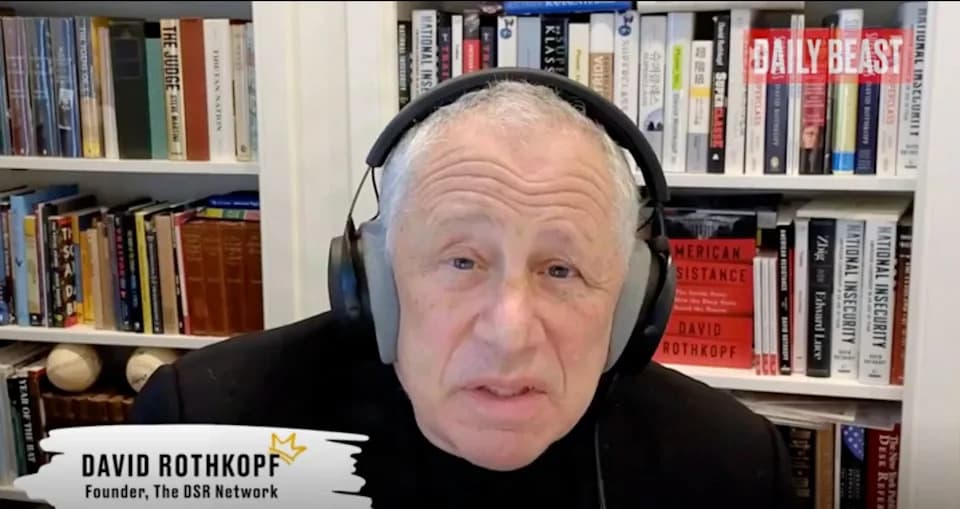
Veteran foreign policy analyst David Rothkopf warns that the widening conflict with Iran is being driven by the erratic impulses of one man — President Donald Trump — with potentially catastrophic consequences for the United States and global markets.
Rothkopf: "This War Is Driven By The Psychosis Of One Individual"
On The Daily Beast Podcast, Rothkopf told host Joanna Coles that the current campaign — launched in coordination with Israel on Feb. 28 — is unlike past conflicts because it is shaped by a single leader who surrounds himself with loyalists and dismisses dissenting advice.
"This is so different from any other war that we have ever seen, because it is being driven by the psychosis of one individual," Rothkopf said. "Trump doesn’t listen to advisors. As he says, he relies on his gut."
Rothkopf described a White House where "guardrails" and institutional processes have been weakened: advisors are ignored, established planning has been undermined, and experienced specialists who would normally help manage a crisis are no longer in place.

Patel’s revenge strike on the FBI wound up decimating the Bureau’s global espionage unit known as CI-12. / MediaNews Group/Inland Valley Da / MediaNews Group via Getty Images
Examples Of Erratic Decision-Making
The president, 79, has repeatedly reversed course in public statements as the conflict entered its fourth week. For example, on a recent Saturday he first posted that he had wiped Iran "off the map," and then within an hour threatened additional military strikes — the kind of sudden shifts Rothkopf says demonstrate a lack of coherent strategy.
At the time of publication, the campaign involving U.S. forces and Israel had resulted in the deaths of 13 U.S. servicemembers. The broader fallout has included economic disruption after Iran imposed a blockade on the Strait of Hormuz — a chokepoint that handles roughly one-fifth of global oil flows — contributing to higher energy prices and market uncertainty.
Personnel Changes, Planning Gaps, And Shifting Objectives
Rothkopf pointed to reporting that the State Department dismissed its oil-and-gas experts roughly six months before the attacks — personnel whose expertise would be central to managing the current crisis. He also cited accounts that FBI Director Kash Patel terminated a number of employees days before the campaign began, after discovering subpoenas related to a probe into the storage of classified documents at Mar-a-Lago.

Trump launched his war from a hastily constructed space in Mar-a-Lago with (left) John Ratcliffe, the Director of the CIA, (fourth from right) Secretary of State Marco Rubio, White House Chief of Staff Susie Wiles, and (second from right), Dan Scavino, his golf caddy turned aide. / White House / X
"The problem is there has been no planning," Rothkopf said. "There is no sense of consequences." He added that the administration's foreign policy has been unpredictable — "following the footsteps of a drunk out of the bar" — swinging from one position to another without clear metrics for success.
Trump himself has shifted public objectives: early demands for Iran's "unconditional surrender" gave way to narrower aims, such as preventing nuclear weapons, and more recently signals that operations may be "wound down." Rothkopf warned that without clear goals or agreed metrics, it is impossible to assess success or avoid escalation.
The Daily Beast has reached out to the White House for comment.
Note: Excerpts are drawn from Rothkopf's appearance on The Daily Beast Podcast. Readers should consider that quotes reflect the analyst's assessments and interpretations.
Help us improve.





















