
The RSF’s October takeover of El-Fasher resulted in mass detentions in makeshift prisons—hospitals, warehouses and shipping containers—where survivors report starvation, disease and torture. U.N. and CIR investigations document thousands detained, large daily death tolls during outbreaks, sexual violence, ransom extortion and forced transfers to prisons in Nyala. The RSF denies the allegations, while humanitarian groups call for independent investigations.
Survivors Describe Brutal RSF Detention Network in El-Fasher: ‘They Killed Us Like Animals’
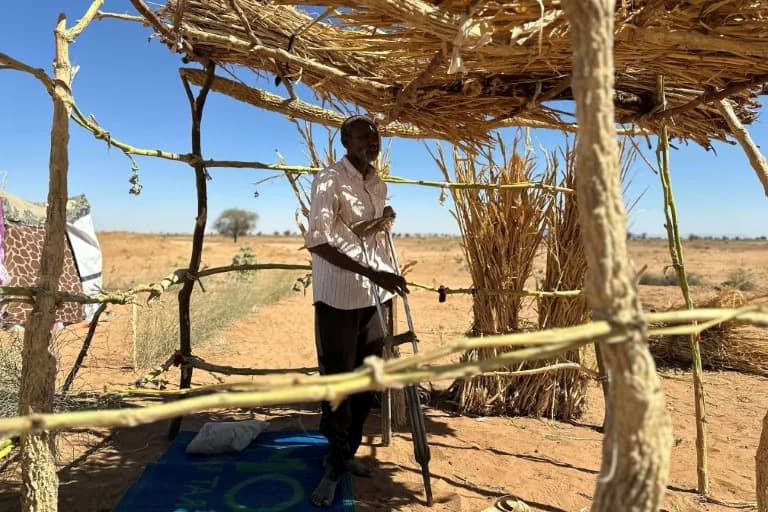
Ibrahim Noureldin leans on crutches at a makeshift shelter in the town of Tawila, Sudan (-)(-/AFP/AFP)
In the suffocating darkness of sealed shipping containers and makeshift cells, former detainees from El-Fasher describe a campaign of mass detention, torture, and deaths after the Rapid Support Forces (RSF) seized the city in October. The U.N. and the London-based Centre for Information Resilience (CIR) say evidence points to large-scale abuses that carry the “hallmarks of genocide.”
Captured, Cramped and Deprived
Ibrahim Noureldin, 42, told AFP from Tawila that he and dozens of others were forced into an airless shipping container in al-Borsa market and survived for weeks on “tiny sips of water” and a little lentils. “When people died of thirst and hunger, we were beaten and forced to bury them outside,” he said.
“If we moved too slowly, they beat us with whips,” Noureldin said, describing the overcrowded, locked container where roughly 120 men were held.
Hospitals and Public Buildings Turned into Prisons
Investigators documented that hospitals, schools, warehouses and shipping containers were converted into detention sites. One of the largest reported sites was El-Fasher Children’s Hospital, where the U.N. says more than 2,000 men were held without adequate food or water. Survivors say many died daily amid disease and neglect.
The U.N. recorded up to 40 deaths per day during a cholera-like outbreak and reported 260 fatalities in a single week. Testimonies, satellite imagery and verified video analyzed by the U.N. and CIR identify detainees as government employees, doctors, journalists, teachers and aid workers; many were held for ransom or singled out because of alleged army links or tribal identity.
Systematic Torture, Sexual Violence and Extortion
Survivors described widespread torture and degrading treatment: beatings with rods, flogging, suspension in painful positions, and sexual assault. Abdullah Idris, 45, said he survived on saline solution while dozens died around him, and Ahmed Aman described detainees having fingernails ripped out with pliers.
“They would select people randomly, killing us like animals,” mechanic Ahmed al-Sheikh said after four months in detention that left him limping and blind in one eye.
Women detainees reported sexual harassment, assault and exploitation. Nedal Yasser, 27, said she was beaten, bound and repeatedly moved between sites; she described being ordered to pay a $2,000 ransom despite having already been looted, and later suffered a miscarriage while fleeing to safety.
Mass Transfers and a Communications Blackout
The U.N. reported that thousands were held in El-Fasher and that at least 6,000 detainees were transferred to Tagris prison in Nyala, an area under strict RSF control with limited outside access. CIR-verified footage also showed large forced marches of detainees from sites such as Garni.
Responses and Verification
The RSF has denied the allegations, calling the reports “propaganda” and accusing the regular army of wrongdoing. Humanitarian groups and the U.N. stress that both sides face accusations of atrocities in Sudan’s wider conflict, but the scale and pattern of the El-Fasher detentions have drawn particular international concern and calls for independent investigation.
Sources: AFP interviews with survivors in Tawila; United Nations rights office reports; Centre for Information Resilience (CIR) findings; verified satellite imagery and video analysis.
Help us improve.





















