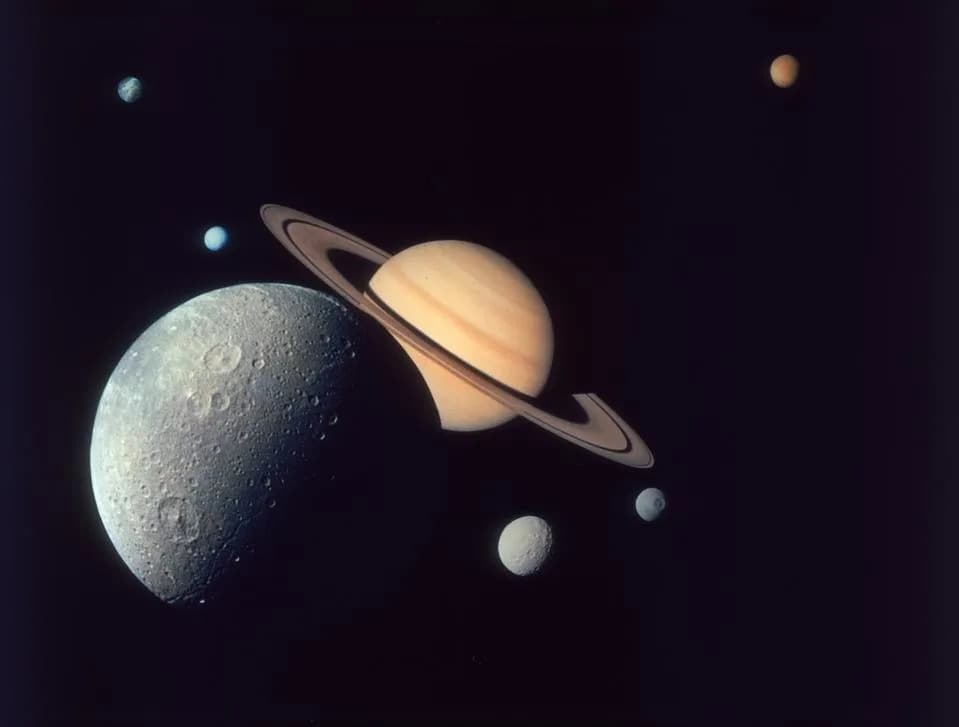
Astronomers have confirmed four new moons of Jupiter and 11 new moons of Saturn, bringing the confirmed totals to 101 and 285 respectively and pushing the Solar System's known planetary and dwarf-planet moons to 442. The discoveries are tiny (about 3 km across), extremely faint (magnitude 25–27) and lie on wide, distant orbits, so they were found using large telescopes (Magellan–Baade, Subaru, CFHT). The finds were reported in MPEC circulars and led by prolific survey teams including Scott Sheppard, David Tholen and Edward Ashton.
Astronomers Confirm 4 New Moons of Jupiter and 11 New Moons of Saturn — Solar System Moon Count Reaches 442
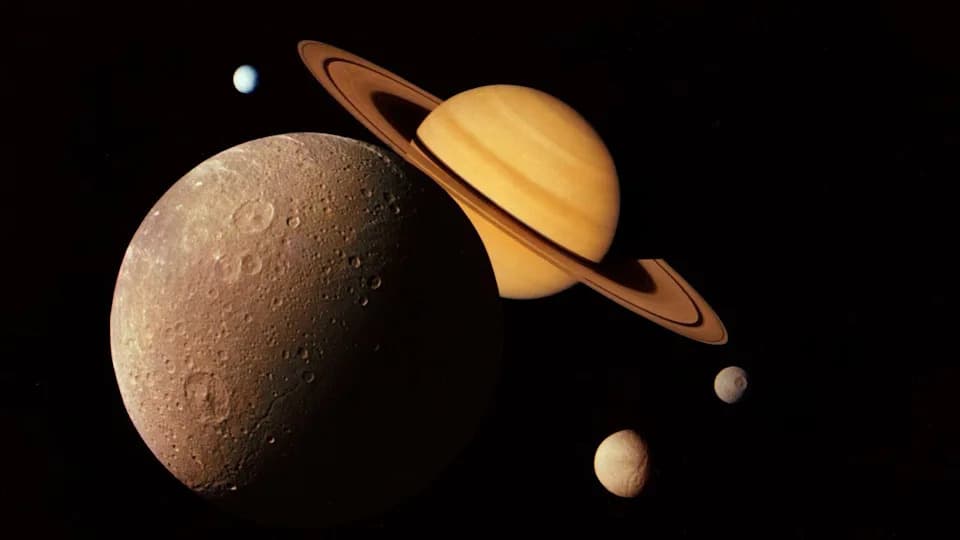
Credit: NASA/JPL
A fresh wave of discoveries has added four new moons to Jupiter and 11 to Saturn, bringing the confirmed totals to 101 and 285 respectively. Together with moons of dwarf planets, the tally of known natural satellites around planets and dwarf planets in the Solar System now stands at 442 (not counting numerous tiny moonlets that accompany some asteroids and Kuiper Belt objects).
Discovery Details
The new satellites were reported by the Minor Planet Center (MPC), the official clearinghouse for discoveries of asteroids, comets, centaurs and natural satellites. The four Jovian moons were announced in Minor Planet Electronic Circulars MPEC 2026-F09, F10, F11 and F12, while the 11 Saturnian satellites were listed in MPEC 2026-F14.
Who Found Them and How
The four new moons of Jupiter were discovered by astronomers Scott Sheppard (Carnegie Institution for Science) and David Tholen (University of Hawaii). They used deep imaging from two large ground-based facilities: the 6.5-meter Magellan–Baade telescope at Las Campanas Observatory (Chile) and the 8-meter Subaru telescope on Mauna Kea (Hawaii).
The 11 new moons of Saturn were reported by a team led by Edward Ashton (Academia Sinica Institute of Astronomy and Astrophysics, Taiwan) using the 3.5-meter Canada–France–Hawaii Telescope (CFHT) on Mauna Kea. Ashton previously led a survey that added 128 Saturnian moons as recently as 2025.
Moon Characteristics
All of the newly catalogued satellites are small, averaging roughly 1.9 miles (≈3 kilometers) across. They orbit far from their host planets on wide, distant trajectories and are extremely faint with apparent magnitudes between 25 and 27 (for comparison, Earth’s Moon is about magnitude −12.6). These properties place them well beyond the reach of amateur equipment and require deep exposures from large telescopes to detect and confirm.
Why It Matters
Tracking these small, distant moons helps astronomers map the architecture and dynamical history of the giant-planet systems. Many of these objects are likely captured asteroids or fragments from past collisions; their orbits, sizes and groupings offer clues to how Jupiter’s and Saturn’s satellite systems formed and evolved. Upcoming missions to the Jovian system — NASA’s Europa Clipper and ESA’s JUICE — arriving in the early 2030s, will deepen our understanding of Jupiter’s environment and may reveal additional satellites or detail about known ones.
Current Moon Counts (Planets & Dwarf Planets)
Planets: Earth 1; Mars 2; Jupiter 101; Saturn 285; Uranus 28; Neptune 16; Venus 0; Mercury 0. Dwarf planets: Pluto 5; Eris 1; Makemake 1; Haumea 2; Ceres 0.
Notes: The totals above refer to confirmed moons of planets and dwarf planets reported to date and do not include numerous sub-kilometer moonlets associated with some small bodies. The lead discoverers named here — Sheppard, Tholen and Ashton — have participated in the discovery of many dozens to hundreds of small satellites through large imaging surveys.
Help us improve.