
Astronomers using the James Webb Space Telescope report that L 98-59 d, an exoplanet first spotted in 2019, shows features unlike known planet types. Spectroscopy indicates global magma oceans and a sulfur-rich, volatile-heavy atmosphere with gases such as water vapor, sulfur dioxide and hydrogen sulfide. At roughly 1.63× Earth's radius and 1.64× its mass and located about 35 light-years away, the planet challenges standard formation models and is unlikely to be habitable.
Possible New Planet Class: L 98-59 d — Magma Oceans and Sulfur Skies
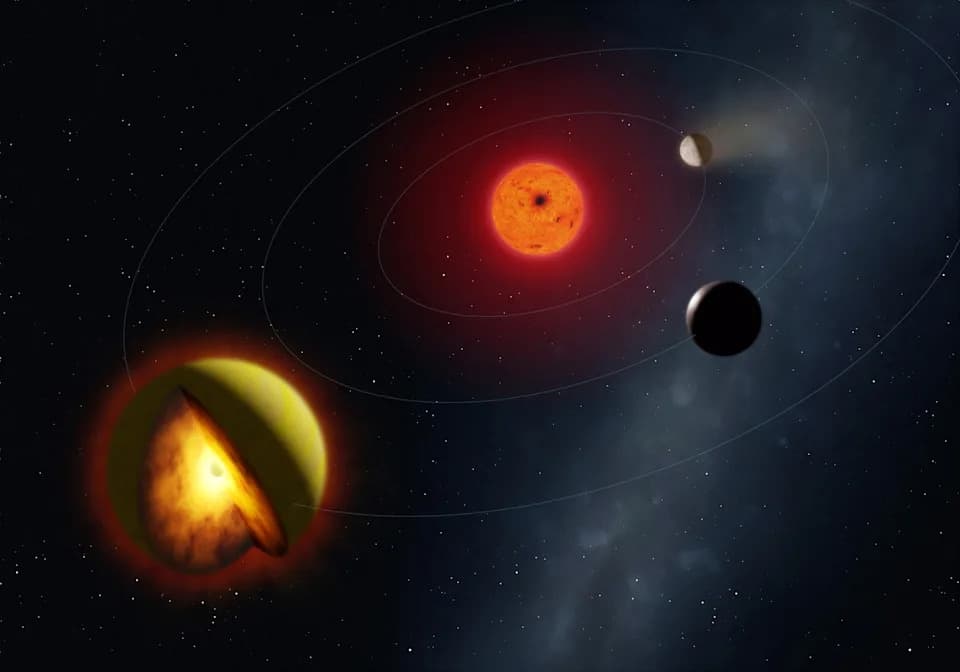
Mark A. Garlick via Reuters - PHOTO: An artist's impression of the exoplanet named L 98-59 d, shown with a cutaway to reveal its interior, orbiting a red dwarf star, with two of its sibling planets, seen in this image released on March 16, 2026.
Astronomers report that the exoplanet L 98-59 d — first identified in 2019 — may represent a previously unknown class of planet. New observations from the James Webb Space Telescope (JWST) and follow-up analyses, published in Nature Astronomy, reveal a world unlike the familiar gas-dwarf or water-world scenarios.
Unusual Physical and Atmospheric Properties
L 98-59 d is a rocky planet roughly 1.63 times the radius of Earth and about 1.64 times Earth's mass. It lies approximately 35 light-years from our solar system. Spectroscopic data indicate the planet hosts extensive molten-silicate (magma) oceans and an atmosphere dominated by sulfur-bearing gases.
- Magma Oceans: The planet's mantle appears to be molten silicate rock, suggesting surface temperatures high enough to sustain global magma lakes or oceans.
- Sulfur-Rich Atmosphere: Observations show the presence of water vapor along with sulfur dioxide (SO2) and hydrogen sulfide (H2S), implying a volatile-rich atmosphere shaped by early sulfur and hydrogen chemistry.
Why This Is Different
Standard formation pathways for similarly sized exoplanets include gas-dwarf models (rocky cores with thin hydrogen-helium envelopes) and water-world models (large inventories of water). L 98-59 d fits neither category cleanly: its composition and atmospheric signatures point to a hot, volatile-rich evolution that produced a sulfur-dominated atmosphere and molten surface.
Implications and Habitability
Because of its extreme temperatures and sulfur-laden atmosphere, L 98-59 d is considered an unlikely candidate for life as we know it. However, the discovery expands our understanding of planetary diversity and atmospheric evolution, offering a potential new class of rocky exoplanet shaped by early volatile chemistry and intense heating.
Detection: The key findings come from spectral observations made by JWST, whose sensitivity has allowed astronomers to identify atmospheric molecules and characterize conditions on worlds previously beyond reach.
Help us improve.





















